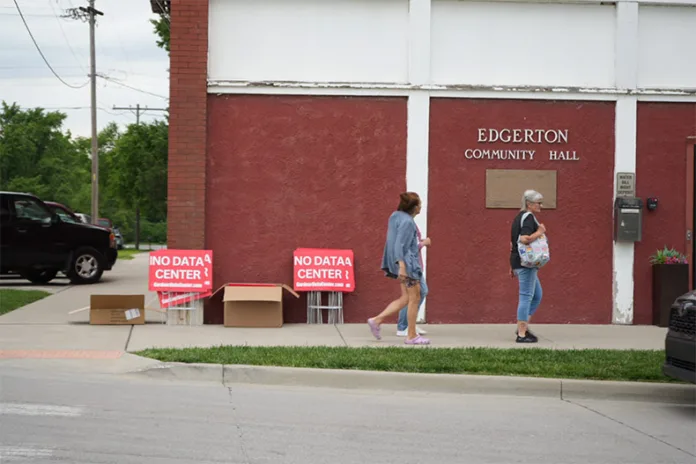
Edgerton is the latest town in southern Johnson County to consider a new data center, despite continued pushback from residents — and this time, the community might not have a choice.
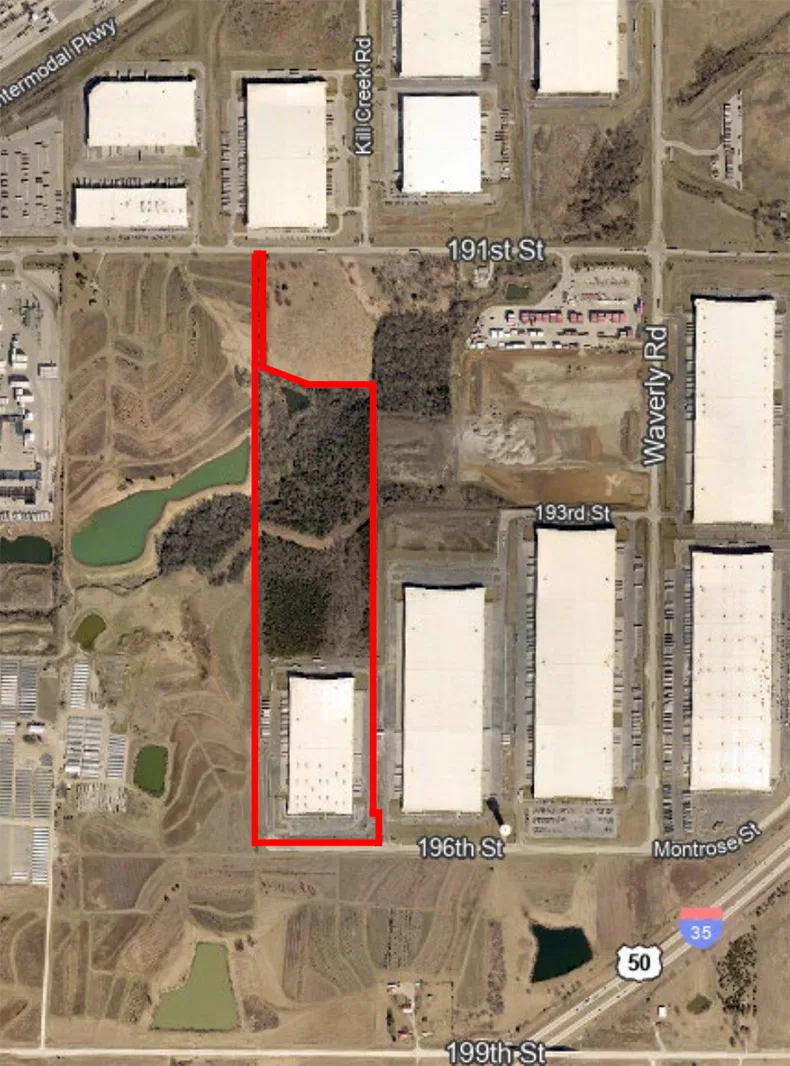
On Tuesday night, the Edgerton Planning Commission voted 4-0 to approve a preliminary plat that combines three properties to convert an existing 400,000-square-foot warehouse at Logistics Park into a large-scale data center.
The commission, however, also by a 4-0 vote, tabled the final site plan from Dubai-based company DAMAC Digital, putting off a final decision on the project for now. Planning Commission Secretary Jordyn Mueller was absent from the meeting.
Logistics Park Kansas City is already zoned to include data centers. With proper zoning for the DAMAC Digital site already in place, and the application meeting Edgerton’s requirements, finding a valid and reasonable basis to deny is challenging.
While the commission sat looking for answers on Tuesday night, people in the standing-room-only crowd yelled, “Just deny it.”
However, according to City Attorney Todd Luckman, denial must be based on established code. If the city denies a project that conforms to code, then it opens itself up for litigation.
As at other public meetings in nearby cities in recent months, residents packed the Edgerton City Hall chambers on Tuesday, mostly in opposition to the proposal.
More than 75 people were in the audience. Fifteen people spoke against the data center during the two public hearings, and two people spoke in favor.
Shane Mizer, an Edgerton resident, was one of those against it.
“The people of Edgerton, the vast majority, do not want it,” he said. “That’s what’s putting the planning commission, the city council in a tough position. As a citizen of Edgerton, I hope they figure out a way to make it fail.”
What does the vote mean?
Edgerton has strict regulations for approving or denying a final site plan. So long as an application meets eight standards for approval under city code, finding a valid reason for denial can be challenging.
Since DAMAC Digital’s application met those eight standards, according to a city staff report that recommended approval of the project (starting on page 27), and there was no clear reason to deny based on code, the planning commission had only two options: approve or table.
A motion to approve was made Tuesday, but failed by a 2-2 vote. Planning Commission Chair Tina Mathos and Commissioner Ray Soemer voted to approve, while Vice Chair Jeremy Little and Commissioner Adam Draskovich voted against that measure.
“The city has a legal responsibility to receive, review and consider all applications,” said Kara Banks, assistant to the city administrator of Edgerton. “For this project — like every project — planning commission and city council evaluate how that project aligns with our vision and goals set by the community.
“We encourage community members and other members of the public to understand the specific details of this project by reviewing all the materials in the planning commission packet,” she added.
Ultimately, the planning commission tabled the final site plan, requesting more information on diesel generators helping to power the data center and its expected noise levels.
When the measure comes back, no additional public hearing will be held. The planning commission will receive the requested information and vote again.
The city council will not hear the measure because the planning commission is the approving body for this type of application. If it’s approved by the planning commission, DAMAC Digital can begin work.
“The final site plan was tabled, so DAMAC will have to bring back the answers to planning commission’s questions at a future meeting,” Banks said. “We don’t have a date yet, but the planning commission only meets once a month on the second Tuesday.”
While the planning commission is the approving body for the final site plan, DAMAC Digital must still submit a final plat to the planning commission. Once it’s approved there, the city council will consider the final plat, a measure that only approves combining the three properties just west of Homestead Lane, along 196th Street.
The city council’s consideration of the final plat would not hinder DAMAC Digital’s ability to begin work on the data center.
Nearby facilities and proposals

DAMAC Digital’s proposal comes as data center proposals have popped up with more frequency in recent months in western and southern Johnson County.
Last week, California-based Beale Infrastructure withdrew an application for a 300-acre data center near the northeast corner of 191st Street and South Clare Road in Gardner, after the city said it would not provide public incentives for the project.
Earlier this year, another developer withdrew an application for a proposed 316-acre facility at 191st Street and Renner Road in Spring Hill following community pushback.
The only plan to move forward thus far is in De Soto, where a $3.1 billion data center, led by Beale, is set to break ground on construction this month. Residents, however, are still fighting against that development.
The Edgerton proposal
DAMAC Digital is planning to convert an existing 400,000-square-foot warehouse into a data center using a closed-loop cooling system.
The site plan includes the addition of two new roughly 2,000-square-foot medium voltage intake buildings, which help distribute power, a guard shack, 60 outdoor diesel generators, mechanical equipment screening, an electrical substation and an Evergy electrical switching station.
According to the company’s website, the closed-loop water cooling system is “a fully sealed, recirculating system that transfers heat efficiently while minimizing water loss and avoiding contamination.”
The site wouldn’t use the public water supply for cooling purposes after the initial, one-time fill. It would still be connected to the public water system for back-of-house functions, such as bathrooms and break rooms.
The company did not provide figures on the water required for the initial closed-loop system fill.
In Beale’s Gardner application, they planned a slightly different cooling method — a closed-loop, air-cooled system. The proposal estimated using 15,000 to 20,000 gallons of water per day. Other large data centers that use open-loop water cooling systems can use up to 5 million gallons per day, according to the Environmental and Energy Study Institute.

Water might not be the only cooling method DAMAC Digital employs.
“The facility’s overall cooling approach may incorporate additional technologies, as needed, to optimize performance across varying conditions, but water efficiency will remain a guiding design priority,” DAMAC states on its website.
While the company doesn’t state how many people it plans to hire, it does say that payroll costs are expected to reach $2.4 million annually. Many of the roles they’re looking to hire, including technician roles, usually require trade certifications or six to 12 months of specialized training.
According to the project website, DAMAC Digital is exploring partnerships with the Gardner Edgerton School District and Johnson County Community College to “to help connect Edgerton residents with the skills and training needed for careers in data center construction and operations.”
Local response
On Tuesday, residents and planning commissioners alike raised concerns over the proposed facility’s water usage, cooling methods and air, light and noise pollution. Other concerns mentioned included potential increases to property taxes, water bills and electric bills, despite assurances included on the project website and in the city report.
James Oltman, president of Elevate Edgerton, a public-private economic development partnership, spoke in favor of the development.
“At the end of the day, this project reflects many of the priorities that the community itself identified during the comprehensive plan process; keeping industrial development within LPKC [Logistics Park Kansas City], reducing truck traffic impact, supporting quality jobs and generating revenue for community infrastructure,” Oltman said. “For those reasons, I respectfully encourage you to support this project.”
Many residents disagreed.
For Edgerton resident Kim Twente, she said the lack of research on the long-term health and environmental implications is enough to deny the proposal.
“However, there have been enough recent studies that have shown that they are not beneficial to our communities,” Twente said.
Citing an article published by the National Center for Biotechnology Information, Twente said noise produced by data centers has been shown to surpass 85 decibels, a “threshold considered harmful to hearing.”
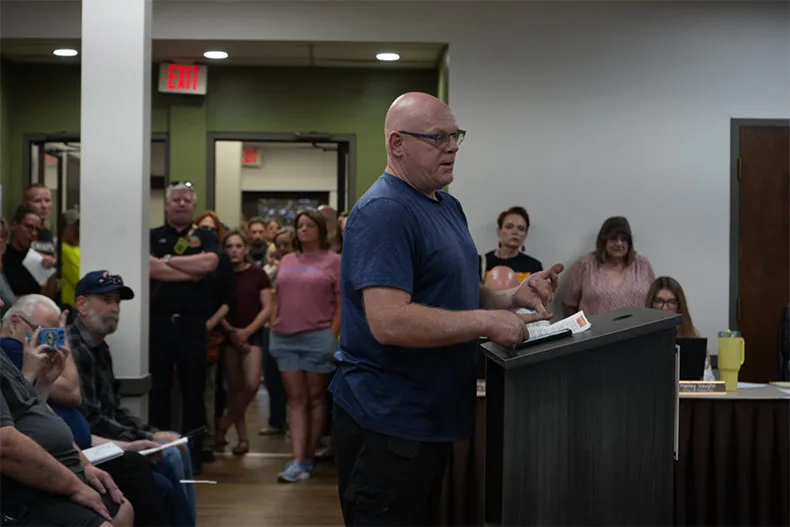
“And this persistent noise adversely affects data center staff, nearby communities and our local wildlife, which is something that we pride ourselves on around here,” she added.
Commissioner Draskovich echoed Twente’s concerns about noise, asking DAMAC’s representatives if they could provide any more information or figures about that.
“We’ll be compliant with all applicable zoning code,” said Chelsea Kulhanek, director of land acquisition for DAMAC Digital.
When asked for specific decibel figures on the noise level, Kulhanek could not provide any at Tuesday’s meeting. However, DAMAC Digital representatives said they were confident they’ll be able to keep noise levels under the code’s threshold.
“If you can’t provide a number,” Draskovich said, “that gives me all the information that I need.”