By Zach Boblitt
Updated Wednesday, Nov. 4
Johnson County Democrat Cindy Holscher declared victory in the razor-thin contest to determine Kansas’ next governor on Wednesday morning.
The Associated Press had yet to officially call the race as off 11 a.m. Wednesday, but Holscher released a statement saying she was “deeply honored” Kansans had selected her to succeed Gov. Laura Kelly.
After Tuesday night, Holscher led in unofficial final vote totals by a little more than 5,000 votes, or less than 1%, which by law would trigger a post-election audit.
“The people of Kansas made their voices heard, and I’m deeply honored by the trust Kansans placed in me to serve as your next governor. Whether I earned your vote or not, I will work for you,” Holscher said on Wednesday.
“Throughout this campaign, I heard from people who want their leaders to put politics aside and work together to deliver on the things that matter most: strong public schools, lower costs for our families and farmers, and an economy where every Kansan can get ahead,” she said.
For his part, Masterson released his own statement on Wednesday:
“Last night was a difficult night in Kansas and around the country. But I’m grateful to the hundreds of thousands of Kansans who stood with us, and to every volunteer who gave their time to this campaign,” he said in a statement posted to social media. “The first count does not seem to be going our way, but the margin is narrow enough that Kansas law calls for another look, and we’ll let that process finish. Every Kansan deserves to know the result is right.”
Kelly also weighed in, congratulating “governor-elect” Holscher, noting that it would be the first time in Kansas history that a Democrat succeeds a Democrat as Kansas governor.
“Kansans have once again rejected a return to the failed policies of the Brownback era and chosen to keep our state moving forward,” Kelly said.
Original story continues below:
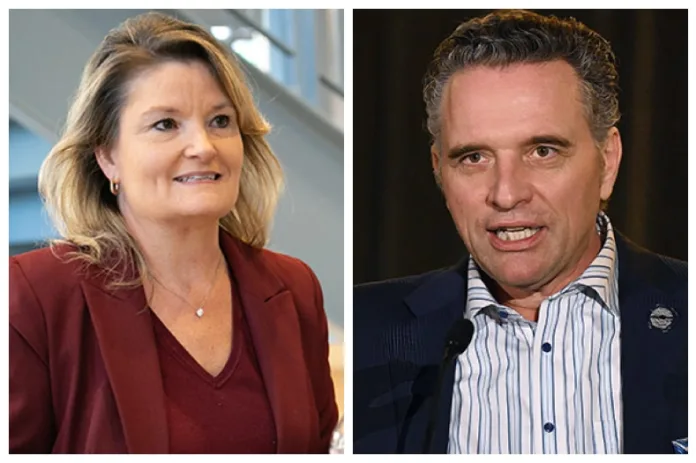
The race to replace outgoing Gov. Laura Kelly is too close to call, with both Republican Ty Masterson and Democrat Cindy Holscher telling their supporters to hold tight.
“We are confident that once all the votes are counted, we will win,” Holscher said at a party in Johnson County.
Holscher ran a campaign focused on taking on corporate interests, fully funding special education and legalizing recreational marijuana.
Masterson told his supporters to head home from Wichita, too.
“I just wanted to close this down tonight,” Masterson said, “because there’s obviously not going to be either a concession speech or a victory speech tonight.”
The election could be decided by mailed ballots that are postmarked by Election Day and will be counted if they arrive within three days after the election. Lawmakers tried to eliminate that three-day grace period, but the new law was blocked by the courts and the grace period remains in place.
With the tight margin in the race showing Holscher leading by less than 1% of the vote, an audit is expected to be called.
“I only have to win like 55% of whatever’s left,” Masterson said. “It’s going to be razor thin, right?”
Masterson campaigned on lowering property taxes, reducing government spending and improving literacy in public schools. He proposed limiting annual growth in taxable property values to 3% or less and has pointed to Mississippi’s approach to reading instruction as a model for Kansas.
The Andover Republican has served in the Kansas Legislature for more than two decades and has been Senate president since 2021. If Masterson wins when the votes are tallied, his election gives Republicans an opportunity to pursue their legislative agenda with a governor from their own party.
Holscher agrees with Masterson on the tightness of the race, but expects a different result.
“We feel really, really good about where we are right now,” Holscher told supporters.
Holscher, an Overland Park Democrat, hopes to take office in January after serving in the Kansas Legislature since 2017. If she wins it marks another setback for Republicans, who have been unable to reclaim the governor’s office since Sam Brownback won reelection in 2014.
Campaign spending
Both candidates raised millions during the general election. Holscher raised $2.34 million from late July through Oct. 22, nearly three times what she raised during the Democratic primary. Masterson raised roughly $2 million during the same period.
The race also drew significant outside spending. The Sunflower State Journal reported that national Republican groups spent more than $10 million, much of it on negative advertising targeting Holscher. While the Democratic Governor’s Association spent nearly $4 million in support of Holscher.
Looking forward
Whoever ends up being declared the winner will succeed Kelly, who won election in 2018 and reelection in 2022. Kelly was prevented by term limits from seeking a third term.
The winner will take office in January and faces a Republican-controlled Legislature, where the GOP holds a supermajority in the senate. Democrats said they picked up enough seats in Tuesday’s election to break the Supermajority in the House.
That political landscape could shape how much of the next governor’s agenda will be passed into law.
Zach Boblitt reports on the Kansas Statehouse for the Kansas News Service.
 Thanks for reading! If you value having an independent news outlet keeping tabs on local government, schools and taxes, we're asking you to contribute to our Education Reporting Fund.