Thanks to the support of Report for America and readers who donate, the Post this summer will be able to welcome a sixth full-time reporter to its newsroom.
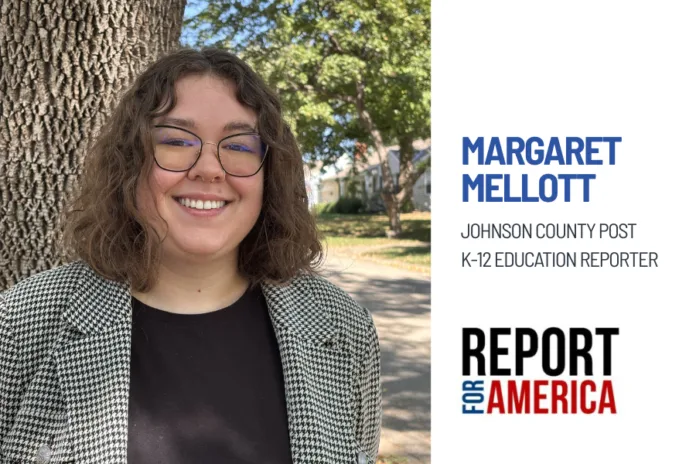
Report for America corps member Margaret Mellott joins us as a staff reporter following several months of contributing to us as a freelancer. Through the program, half of Mellott’s first-year compensation will provided by Report for America and the other half will come from generous contributions made by Post readers.
Ahead of her official start date this July, we asked Mellott, a Johnson County native, about her roots in the community, what draws her to the education beat and how she approaches the task of reporting on our public schools.
Tell us about your background and your connections to Johnson County schools?
Growing up in western Shawnee, I attended De Soto USD 232 schools from kindergarten until my graduation from Mill Valley in 2017. Afterwards, I attended Johnson County Community College and then transferred to Emporia State University.
After graduating college with a degree in communication and a minor in journalism, I covered statehouse news during an internship with the Kansas Reflector, and then moved to central New York to work at a daily print newspaper. During my time in Cortland, New York, I reported on county government, two local municipalities and health.
With aging grandparents, I decided to move back in August 2024. Shortly after, I started freelancing for the Johnson County Post.
My family’s roots run deep in this community — my parents were raised here and graduated from schools in the Shawnee Mission School District, and my older sister graduated from Mill Valley a few years ahead of me.
What drew you to education reporting — and what interests you most about covering K-12 schools in our community?
Ask any one of my family or friends, and they’ll tell you education is something I’m passionate about. When I entered college, I thought I was going to come out as a social sciences educator.
Then the COVID-19 pandemic happened and plans changed. My passion for education, however, didn’t.
I see my role as a reporter as a way to help teach a community. There’s often a lot of paperwork, jargon and complicated processes to work through, making it difficult for someone working 40 hours a week, raising a family and/or just trying to survive their everyday, to navigate the layers of information.
That’s where I step in.
Now, as the incoming education reporter, I’ll get to cover one of the most important groups in Johnson County — our students.
Students are our future doctors, teachers, sanitation workers and maybe a few are future county commissioners. Regardless of what job they work or where they settle down, they’ll be contributing to the community around them — including ours, if they choose to stay here.
So, what interests me most about covering K-12 education? It’s the students. It’s the opportunity to amplify their voices as we look to the future. It’s their ability to see the world from a different lens.
What’s something about your own school experience that still sticks with you today?
Growing up with attention-deficit/hyperactivity disorder came with its challenges, and while those experiences drive me, I’ll never forget the teachers who went above and beyond.
I still remember my kindergarten teacher, Mrs. Grauer, and my first grade teacher, Mrs. Hembrey. They offered kindness, patience and compassion, despite also managing a room full of children still learning how to function in a classroom setting.
When I was around that age, I told my mom I wanted to teach. When she asked why, I responded, “to help kids like me.” I knew I struggled in ways many of my peers didn’t.
The example those teachers set is one I want to continue.
When you’re reporting on schools, what kinds of stories are you especially interested in finding?
Student-led stories.
Reporting will naturally pick up with the legislative session and election season. Important news will come from those months.
But students, that’s where my favorite stories are.
That’s where you learn about Make48, a fast-paced competition where teams have only 48 hours to come up with an idea, build a prototype and pitch it to judges. Students get real-world experience talking with lawyers to ensure their design has no patents on it, something I never would’ve imagined doing when I was their age.
With the push for career and technical education programs, you also have students engineering 15-foot kinetic sculptures for cities and students graduating high school with Certified Nursing Assistant certifications — ready to work in the field.
That doesn’t even begin to scrape the surface of some of the coolest, most innovative work students in Johnson County are doing. Even at the middle and elementary school levels, you have students doing public service projects and hands-on learning in the community.
That’s not only invaluable for the students, but also for the rest of us.
What do you hope parents, students, teachers, and school staff know about your approach as a reporter?
I’m always learning. I have no plans to stop learning.
Sure, sometimes accepting new information can be challenging, especially when it contradicts older knowledge, but I’m not someone who frequently rejects new and accurate information.
I also enjoy researching and scouring through data. It can be time consuming, but it helps create a fuller understanding of a topic. I err on the side of gathering too much information. I’m OK taking my time to sort through dense research/reports and prioritize what’s most important.
What’s one education topic you think deserves more attention?
We hear plenty about the issues facing education every year — funding, particularly in special education, teacher retention, student mental health, cell phones in the classroom, etc.
My hope is to gather solutions. What are other communities, similar in size and demographics to Johnson County or the specific school districts, doing to improve teacher retention? What are other communities doing to provide resources for student mental health?
I’ve done similar reporting before. During my time with the Cortland Standard, the newsroom did a series on homelessness. We looked at communities similar to Cortland County, found how they tackled the issues — transitional, short- and long-term housing, resources and meeting people where they are.
It can be hard trying to figure out how to combat issues everyone deals with, but I think that’s what makes this type of journalism work; you learn from the failures and successes of others.
What’s one thing people might be surprised to learn about you outside of journalism?
In the past couple of years, I’ve started watching more movies. Ahead of Oscars season, I’ll watch the nominated movies and make my own predictions. I got quite a few winners correct this year.
My favorite movies, which I think might surprise people, are “Miracle”, a true story based on the 1980 U.S. Olympic Hockey team; “Hacksaw Ridge”, another true story based on a U.S. soldier who refused to bear arms during WWII; and “Scott Pilgrim vs. the World”, based on a 2005 comic series.
I also collect movie tickets. My collection goes back a couple of decades; one of the first tickets I held onto was for “Transformers” (2007). However, I stopped collecting during high school and college. I’ve since picked the habit back up in recent years.
We need YOUR help to reach our Report for America fundraising goal. Hundreds of readers have already stepped up and made their contributions, getting us nearly one-third of the way to our $30,000 goal. Will you help push us past $10,000 and get closer to halfway there?
Click the button below to make your tax-deductible donation. Any amount is greatly appreciated!
Yes, I’ll support K-12 reporting in the Post!
 Thanks for reading! If you value having an independent news outlet keeping tabs on local government, schools and taxes, we're asking you to contribute to our Education Reporting Fund.