
For the past year, most of the discussion about electronics in schools has revolved around cell phones. But on Monday night at the Shawnee Mission school board meeting, parents urged the district to go further in limiting screen time in schools.
About 25 parents came to the board’s public comment session before the regular meeting to urge board members to set new limits on school-issued educational technology, iPads and MacBookAirs, that students use for homework and for learning during school hours.
Diana Dewey of Overland Park told board members that the speakers were part of an effort from a new chapter of a national group, Schools Beyond Screens, that is attempting to get school districts to “rebalance” tech use in class.
Parents involved in the group want three things from district administrators:
- A block on student access to YouTube, social media, gaming and streaming on school-issued devices
- Required education on digital skills like typing and digital citizenship like online etiquette
- A ban on electronic device-based lessons for students from pre-kindergarten through second grade.
Dewey said that based on a survey given by Schools Beyond Screens, a significant number of parents would consider changing schools based on classroom use of electronics.
“We are not coming to you as parents that are looking to leave. We are coming to you in the hope that we can work with you to create a better future for our children by rebalancing ed tech use in the Shawnee Mission School District,” she said.
Dewey thanked board members for their work on setting rules for cell phones and personal electronics students use for communication. But she said the use of technology in education is a separate issue that parents now want to see addressed.
“I do not want my kindergartner on a tablet”
Five people spoke on the subject during the public comment session. All were in favor of stricter guardrails for educational technology.
Speaker Ryan Van Pelt of Prairie Village said there’s a danger that “digital skills can be conflated with learning all skills digitally.”
Van Pelt, who has a second-grade daughter, said he’d like to see administrators base the use of tech on evidence rather than the assumption that technology will be a benefit.
“We do not have iPads or phones for our children. So it was a shock to have our child bring home an iPad on the first day of kindergarten,” he said.
He said he has been unable to find research to support the use of such technology in early childhood education.
Amanda Davison, a former college teacher with a 4-year-old girl, said, “Professors are now faced with teaching a generation of students who don’t know how to write at a basic level, who lack critical thinking skills and who unfortunately also do not have an attention span longer than a TikTok,” she said.
She grew emotional as she spoke of student loneliness and a lack of curiosity and enthusiasm, “not only for academics but for life itself.”
Davison said she was unhappy when she learned at a kindergarten roundup that headphones were on the school supply list.
“I do not want my kindergartner on a tablet. I do not want her sitting in a room full of kindergartners sitting (with) tablets,” she said.
She added she unenrolled her daughter in public school and will send her to private school instead.
A “balanced” technology approach
Starting the next school year that begins in August, Shawnee Mission, like other districts in Kansas, will need to implement a new state law that requires students to keep their personal electronic devices secured and stowed away during the school day.
But the district also issues devices for students, iPads in elementary grades and MacBookAirs in secondary grades, a practice that goes back more than a decade. The use of school-issued devices in class has rankled some parents for years.
On its website, the district’s Instructional Technology page says Shawnee Mission follows a “balanced approach to the use of technology.”
“The Digital Learning Initiatives provide expanded resources in the classroom and is opening up more options for students to learn,” the district’s website says. “The district focus is to use technology in the classroom to collect data that drives instruction, provide collaborative learning spaces online, empower students to create their own products and to support communication between the classroom and home.”
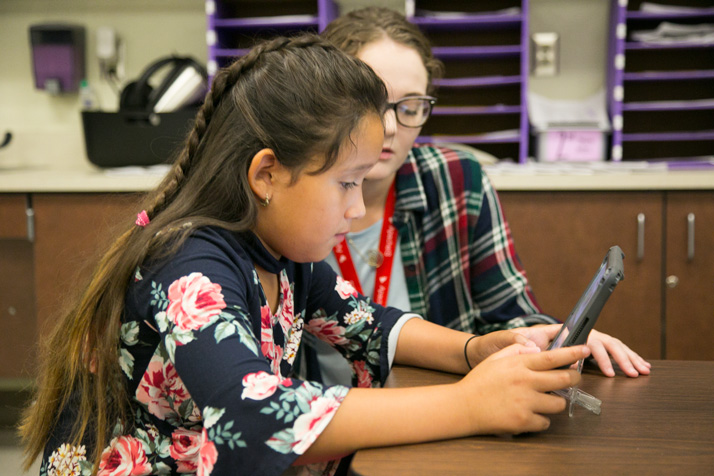
An existing FAQ page on the district’s digital learning initiative attempts to answer some parents’ concerns, including if they’re worried about their child’s amount of screentime at school.
In that case, the FAQ page says parents should contact their child’s teacher.
“We encourage all teachers to utilize technology as a resource to improve learning in a rigorous and meaningful way,” the FAQ says. “We look for ways technology can support consumption, communication, creation and collaboration.”
District’s policies a “vague posture”
Still, the district’s existing policies and technology guidance for classroom learning drew criticism from some parents on Monday.
Sushant Govindan said that as someone who has been in charge of rolling out artificial intelligence technology for several years, “I think it’s a bit ironic that I’m probably the most pro-tech person in this room, and I have significant concerns.”
He said unsupervised use of tech in schools is “a really bad idea.” He also said the school should clearly set out what it hopes to accomplish through the use of tech.
In the existing school documents, “I see a really vague posture, a posture that’s not thoughtful, really, at all,” he said.
He said the district’s digital strategy “needs to be better. Otherwise, you’re hearing it from all these folks, we’re probably going to leave and go somewhere else.”
Dewey said she thinks the concerns about educational technology are building as parents see their children using electronics for games and entertainment while not knowing how to type.
“They can’t navigate a basic Word document. They can’t understand how a computer works because all of it is touch and tap,” she said.
What’s next?
Board members did not discuss the issue during the session.
Supporters of technology use in education point to some benefits, including increased access to more resources, instant feedback and personalized lessons.
Dewey said she hopes to continue the dialogue with board members and administration.