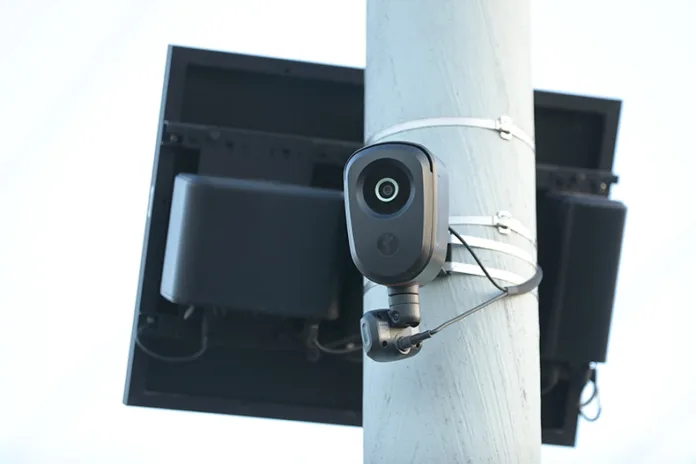
Growing concerns about the use of automated license plate readers, like Flock cameras, have prompted one Johnson County police department to discontinue its use of the controversial devices.
On Monday, the Gardner City Council voted to immediately turn off four Flock cameras in use in the city and cancel the city’s roughly $13,000 contract with Flock, after several residents came forward with concerns over privacy and surveillance.
Even though the topic was not on the meeting agenda, Gardner resident Eric Arnold used the public comment period to ask the city council to call the Flock contract forward for a vote.
Arnold said he and Police Chief Kelly Herron had previously sat down for a conversation after Arnold brought up his concerns at the last city council meeting.
Arnold and other residents who spoke Monday said the cameras, which monitor vehicles passing through their area 24/7 and can be used by law enforcement to investigate criminal cases like stolen vehicles and missing persons, infringe on constitutional freedoms.
The residents said the devices also too often end up tracking ordinary citizens, not just criminals, using taxpayer funds and are not properly regulated.
Chief Herron, who was at Monday’s meeting, said the Gardner department published a policy on auditing the cameras and access to the cameras’ data was limited to himself and the police captain.
He said he had already temporarily shut the cameras off on Friday to allow time for discussion before their use.
“The chief did his part in 11 days, and the only question now is what is the council going to do with their part?” Arnold, the resident, said. “So bring it forward and let Gardner see where each of you stands — whether you choose to act or choose to wait, the community is watching now.”
When asked whether terminating the cameras would harm his ability to do his job or cause safety concerns, Herron said no and that his choice would be to not renew the contract with Flock.
Gardner has two contracts with Flock, one that ends in December and one that ends in February. The Flock cameras have been operational since September 2025.
When asked by a Post reporter where the cameras are located, a city spokesperson cited Kansas Statute 45-221(a)(55), saying the city did not have to disclose where they are.
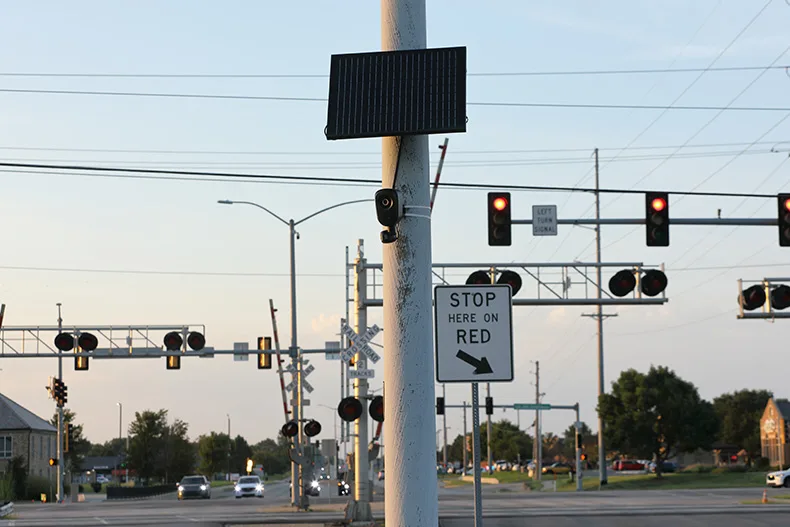
The open-source website DeFlock, which has identified and mapped the locations of more than 133,000 automated license plate readers nationwide, showed at least three Flock cameras within Gardner city limits, including one on West Madison Avenue, outside Gardner Edgerton High School, and two near each other on Moonlight Road, just south of Main Street.
A Post reporter on a subsequent drive this week was able to spot two Flock cameras within the city.
Since the full $13,000 for the contract has already been paid, the city council agreed that usage of the cameras could be terminated immediately and the contract with Flock not renewed. A swift consensus was made to do so and the city council voted to approve the move.
Councilmember Kelly Johnson wrote on Facebook that the move only impacts Flock cameras belonging to the city of Gardner, not other cameras belonging to the state or county.
“That doesn’t mean we’re ignoring those cameras,” Johnson wrote. “We’ll be looking into what options we may have regarding the cameras operated by other jurisdictions and how they are being used in and around our community.”
150 gather in Lenexa for “DeFlock”-related event
Elsewhere on Monday, about 150 people attended a meeting at the Shawnee Mission Unitarian Universalist Church in Lenexa centered around automated license plate readers in Kansas, to discuss concerns about what the data they gather and store and who has access to it.
The meeting was organized by the activist group Boots on the Ground Midwest and was meant to coincide with a National Week of Action by DeFlock, aimed at bringing attention to the technology and its potential misuses.
During the past year, concerns have grown over the technology, which can be artificial intelligence-assisted and used to capture and store information like car makes, license plates numbers and other vehicle features.
One of the biggest emerging targets is Flock, which has more than 120,000 cameras across the country, according to Axios.
The use of license plate readers has been controversial, with numerous incidents of misuse being reported, including an officer in Arizona resigning after he was accused of improperly using the Flock system to try to locate his wife in another city and an officer in Massachusetts accused of using it to track someone known to him.
Along with public concerns, reports of anti-Flock movements have also popped up, with people destroying or stealing ALPR cameras around the country, including in Kearney, Missouri.
Since July, 10 cities ranging from Madison, Wisconsin, to Ord, Nebraska, have either canceled their contracts with the company or deactivated their cameras, according to the anti-Flock website DeFlock.
It’s an issue that spans across political ideologies, Boots on the Ground Midwest co-founder Nancy Mays noted at the meeting, with David Graham, a Libertarian running for Kansas’ U.S. Senate seat and Republican Scott Speicker, who is running for a Kansas House seat in Johnson County, both in attendance on Monday.
“It has nothing to do with Democrat or Republican. This is just government overreach in general. It’s the government treating the public like the enemy and the fact that they need to tag us and serialize us, and then watch what we do, and then categorize our movements. It’s reconnaissance,” Speicker said.
A Lenexa resident was tracked by ALPRs
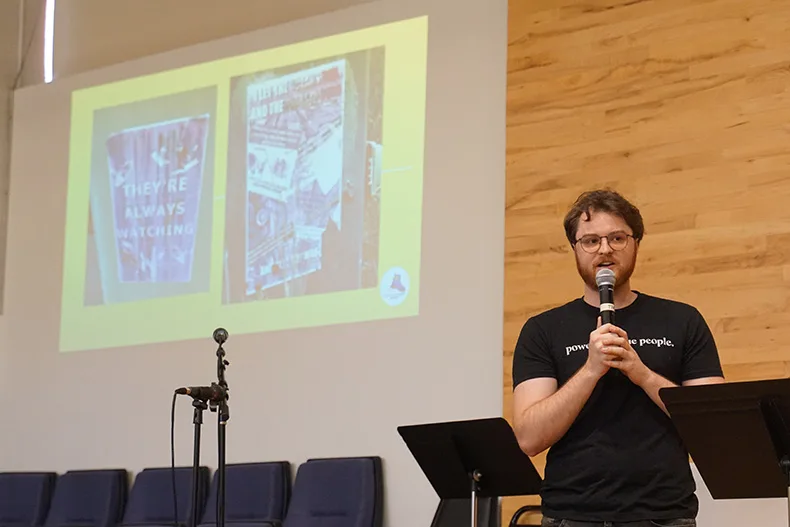
At the meeting, two speakers spoke out against ALPRs for different reasons.
Canyen Ashworth, a Lenexa resident, recounted a KCUR report describing how he discovered the Lenexa Police Department was tracking him using license plate readers after he wrote a Kansas City Star editorial that was critical of their handling of an investigation into the legal status of then-City Councilmember Melanie Arroyo.
After the article ran, anti-authority posters were posted around the city, with Lenexa police believing Ashworth was behind it.
“The Lenexa Police Department dubbed this ‘The Paper Hanger Case,’ which is an awesome name for something that’s really not that ridiculous … They thought I was the paper hanger,” he said.
Ashworth turned out to not be the suspect and nobody was ever charged, KCUR noted. The case is inactive, but could be reopened if new evidence is developed, Lenexa Master Police Officer Danny Chavez said in an email to the Johnson County Post.
Lenexa Police had no comment on the allegations Ashworth made.
“We do not comment on the possible involvement or status of any individual in a criminal investigation unless charges were filed,” Chavez said.
The investigation made Ashworth skeptical of ALPRs and how they’re used, he said.
“In Lenexa in particular, they have a two-year retention period for their data. If you do anything that is deemed worthy of using the surveillance system, all they need to do is go up to the computer and go, ‘OK, here’s everywhere Canyen has been in the past two years.’ And that’s just in Lenexa,” he said.
Ashworth referenced a projected map of automated license plate reader locations in Kansas published online by DeFlock, which shows 2,075 of the devices in Johnson County currently.
“They are creepy. They are pernicious.”

Representing the Kansas Justice Institute, a free public-interest litigation firm that is a subsidiary of the Koch-backed Kansas Policy Institute, attorney Samuel G. MacRoberts outlined his current case, where Wichita resident Mason Grimmett filed a lawsuit against the City of Wichita for their use of ALPRs, alleging they violate the Kansas Constitution.
“(ALPRs) are creepy. They are pernicious. They are used against all of us. It is dragnet surveillance at the worst,” he said.
Using the Article 15 of the Kansas Constitution’s Bill of Rights, which highlights people’s rights when it comes to search and seizure, MacRoberts said he hopes it can be helpful in outlawing ALPRs.
“Section 15 provides greater protections, and it will stop warrantless dragnet surveillance, like what’s going on in Wichita, and that’s why we filed this lawsuit,” he said.
Ava Belchez contributed to this report.
 Thanks for reading! If you value having an independent news outlet keeping tabs on local government, schools and taxes, we're asking you to contribute to our Education Reporting Fund.