By David Markham
A total of $800,257 in grants recently awarded through Johnson County Stormwater’s new Green Infrastructure Grant Program will allow JCPRD to jumpstart key initiatives in the agency’s Natural Resources Plan for 2026 and 2027.
“JCPRD is thrilled to partner with Johnson County Stormwater to move forward on our shared vision for a healthier, more resilient community,” said Development Director Kelly Blandford. “Even more exciting, it gives us the opportunity to weave in new recreational and educational experiences for visitors. Each project offers benefits far beyond stormwater management, strengthening ecosystems, improving wildlife habitat, and creating vibrant spaces where people can explore nature and connect with the outdoors.”
“We are excited to work with new partners to be better stewards of our Johnson County rivers and streams,” said Johnson County Stormwater Water’s Quality Specialist Lesley Rigney. “These projects will help improve water quality, reduce flood risk and restore the landscape’s ability to absorb and slowly release rainfall rather than sending it rapidly downstream.”
The Johnson County Board of County Commissioners approved the grant awards in mid-August. The five grants received by JCPRD were part of nearly $1.2 million toward seven projects awarded in the program’s inaugural year. The other grants went to Bridging the Gap Inc, for riverbank corridor restoration on the Blue River, and to Ducks Unlimited for Wetland Restoration in Gardner.
Johnson County’s Stormwater Management Program created the Green Infrastructure Grant Program earlier this year to fund implementation projects that advance watershed health, reduce flooding and erosion risks, and improve stormwater quality in alignment with Johnson County’s six watershed master plans. Each of JCPRD’s funded projects is aligned with Johnson County Watershed Master Plan priority areas, which have the potential to deliver highly impactful watershed benefits.
Here’s details for each of the JCPRD projects:
- A $257,819 for Mill Creek Wetland Restoration in Shawnee Mission Park – This project involves a full ecological restoration of a constructed wetland located on the tributary corridor between Shawnee Mission Park Lake and Mill Creek. Originally designed as a waterfowl sanctuary, the wetland has experienced degradation of infrastructure, reduced hydrologic capacity, invasive vegetation pressure, and diminished ecological performance. This project will rehabilitate the wetland system to improve resilience, biodiversity, and long-term ecosystem services while creating new opportunities for environmental education and passive recreation. The timeline for this project is late 2026 through fall 2027.
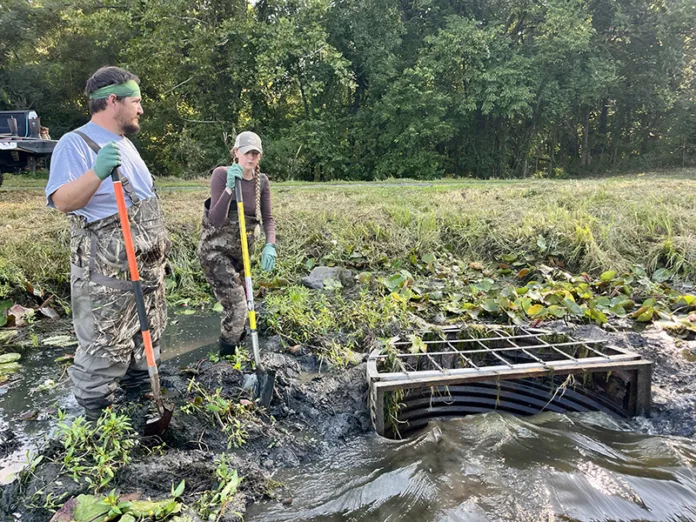
- A $127,506 for Blue River Wetland Restoration along the Blue River Streamway Trail – This collaborative wetland restoration project between JCPRD and Ducks Unlimited will focus on restoring hydrologic function within a wetland complex adjacent to the Blue River Streamway Trail. The project will improve water management capabilities, restore wetland connectivity, and stabilize critical infrastructure. Together, these improvements will enhance wetland resiliency, improve habitat conditions for waterfowl and other wildlife, and strengthen floodplain functionality along the Blue River corridor. This project will begin in the next few weeks and be substantially complete by the end of 2026.
- A $204,218 for Woodland Restoration in Shawnee Mission Park – This project will involve the removal of approximately 150 acres of invasive bush honeysuckle from the south side of Shawnee Mission Park Lake to restore native woodland and old growth forest. The project is a key component of the JCPRD Natural Resource Plan and builds off the investment in honeysuckle removal at the park (over 800 acres removed to date). Removing bush honeysuckle and restoring native woodland vegetation can improve stormwater management by promoting a more diverse and resilient plant community. Native vegetation can enhance soil structure, increase water infiltration, reduce surface runoff, and improve groundwater recharge. Restoration of the native understory also helps stabilize soils, reduce erosion, and support natural filtration processes that improve water quality. Timeline is throughout 2027.
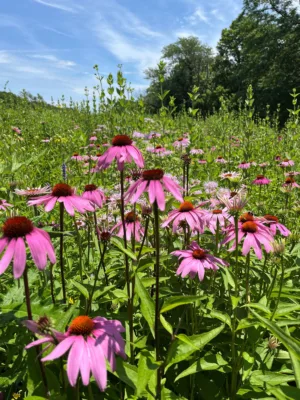
- A $120,470 for Prairie Restoration in Oakridge Hills on the north side of Shawnee Mission Park – Approximately 50 acres of cool season pastures to native prairie will be restored through invasive species removal, native seed installation, and long-term ecological management practices. Funding will support site preparation, prescribed fire implementation, invasive species management, and the establishment of diverse native grasses and wildflowers. The restoration effort will enhance wildlife habitat, improve stormwater infiltration, increase pollinator resources, and expand climate-resilient native ecosystems within the park. District-wide JCPRD has planted over 900 acres of prairie and converted an additional 500 acres of non-native grassland since 2019. Some of this work has focused on Oakridge Hills, which draws many visitors each year with its outstanding wildflower displays. Timeline is late 2026 to spring 2027.
- A $102,244 for Biodiversity Planting in Thomas S. Stoll Memorial Park – Restoring ecological integrity, increasing the diversity of native species, and improving long-term resilience of existing woodland and forest-edge habitats within Stoll Park are goals for this project. JCPRD recently invested in the full removal of bush honeysuckle from the park. This project will implement additional targeted invasive species control, native understory reestablishment, and habitat enrichment to transition simplified woodland stands into more diverse, layered native ecosystems. This will improve stormwater infiltration and habitat connectivity in the highly developed Indian Creek Watershed. This project will have the added benefit of expanding tree canopy cover throughout the park, reducing urban heat island impacts by increasing shade and cooling trails and recreation areas. Timeline is 2027.
Much of the work on these projects will be completed in collaboration with partner organizations and outside contractors, with JCPRD staff playing a key role in project management to ensure the establishment and long-term success of these projects.
The first project to begin will be the Blue River Wetland Restoration, where work is expected to begin as early as late August with substantial project completion by late fall of 2026. Initial site preparation for the other projects will begin this fall and continue into spring of 2027. JCPRD will work with Johnson County Stormwater to monitor the impact of these projects over time by assessing potential improvements to water quality and reductions in peak flows and runoff volume.
Blandford said this year’s grant funding will support the four remaining projects outlined in the natural resources 10-year phasing plan for 2026 and 2027. The fifth 2026 project in the plan – Stilwell Community Park wet prairie installation – has already been completed. The Blue River wetland project, while not specifically identified in the plan, supports a priority conservation area for JCPRD and was selected as an immediate opportunity because of JCPRD’s developing partnership with Ducks Unlimited who provided in-kind support.
JCPRD officials are hopeful the Green Infrastructure Grant Program can provide additional funding over the next several years to support planned future natural resource projects.
“The hope is that this will be an annual funding source for many organizations doing this kind of work throughout the county,” Blandford said. “We’ve heard again and again through our natural resource planning and park master plan engagement that our community deeply values its natural areas. Investing in these projects demonstrates our commitment to long‑term stewardship of these vital spaces and reflects how important they are to so many people.”