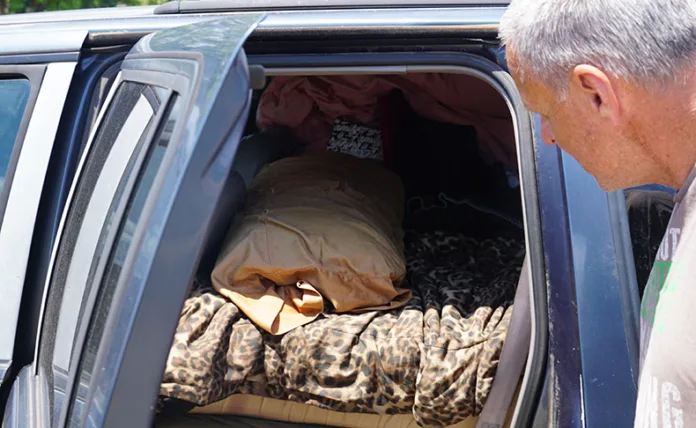
In a parking lot in Olathe in July, Gina Foulks sleeps overnight in her car with her doors and windows open to allow for air to pass through. Most nights, the air would be cooler than throughout the day, but not on many nights like this summer.
“It is so hot to sleep. I sleep with my doors open, not just my windows, but my doors open, and I park my car in a certain way, and I thank God for the wind,” she said.
Throughout the summer, people like Foulks who are experiencing homelessness in Johnson County have struggled to survive the hot weather, which is peaking this week and next with sustained high temperatures in the upper 90s and heat indexes breaking 100.
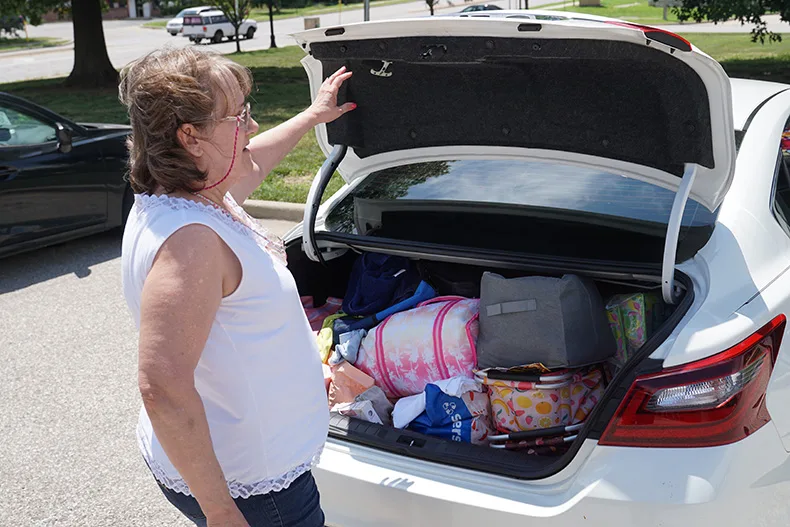
Still, Foulks is thankful to have her car, which she uses to drive around to get to the gas stations that she knows are friendly to people experiencing homelessness and will allow her to get free water and ice to cool off.
“If I didn’t have my car, I don’t know what I’d do. I don’t think I’d survive on the streets. I literally don’t think I would,” she said with a laugh. “I laugh, but it’s a nervous laugh.”
Homeless numbers continue to rise in Johnson County
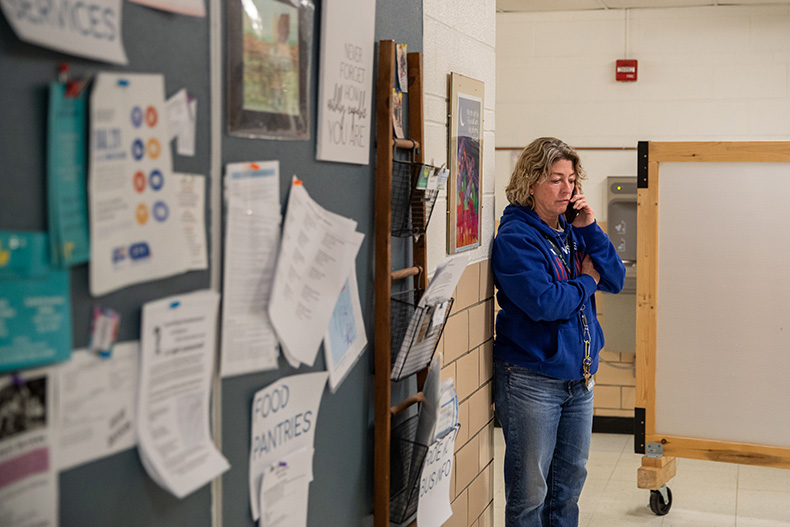
The extreme heat comes at a time when homeless numbers are up in Johnson County. An annual PIT, or “Point-in-Time,” count by the United Community Services of Johnson County for 2026 showed the number growing over one year from 253 to 321 people.
It’s also been alarming enough that it has caused homelessness advocates like Barb McEver, co-founder of Project 1020, to spend $14,000 of the shelter’s budget on hotel rooms for people experiencing homelessness this summer.
Though Project 1020 normally operates its shelter in cold-weather months, they are currently supporting about 25 people by paying for their hotel rooms to get them out of the summer heat, she said.
Part of the reason for McEver doing that is because they’ve seen people experiencing homelessness suffering heat stroke, as well as trying to avoid sending others who have been treated for ongoing health problems immediately back to the streets.
“They’re out in the heat, and the heat exacerbates (health problems). They’ve been hospitalized, but then they are discharged into homelessness, and we don’t feel like that’s a safe way for somebody to recover from some of these serious situations,” she said.
Since May 1, Johnson County MED-ACT, which responds to medical emergencies in Johnson County, has responded to 81 heat exhaustion calls, said Joe Folsom, public information officer for Johnson County Med-ACT.
That number doesn’t include other heat-related calls that could be classified as something else, like people found unconscious due to the heat.
The extreme heat is expected to continue with Extreme Heat Warnings for the Johnson County area lasting through 8 p.m. next Tuesday, with heat index values up to 103, according to the National Weather Service.
While Johnson County has a number of cooling centers during regular business hours and days, including Johnson County Public Library locations, several community centers and the Olathe Salvation Army, it doesn’t have a day center, a place for people experiencing homelessness to get services like showering, doing their laundry and caseworkers to help them develop a plan to find shelter.
The times and days the cooling centers are open can also vary, depending on the holiday, like this upcoming Labor Day weekend, for instance. There are no plans for cooling centers to be open on Sunday, but two will be available on Monday from 10 a.m. to 7 p.m., including:
- Christ Community Church, 13330 W. 62nd Terrace, Shawnee, KS, 66216
- Salvation Army, 420 E. Santa Fe St., Olathe, KS, 66061
Heat dome is causing heat to linger in Central U.S.

While this summer temperatures are comparable to last year’s heat, with high temperatures in the upper 90s, meteorologist Max Shaw at the National Weather Service in Pleasant Hill, Missouri, said a heat dome, or a strong high-pressure system that traps hot air over a large region, in the Central United States, makes it particularly harsh.
“It kind of blocks things up and keeps us in this hot pattern for an extended period of time,” he said. “That’s why we’ve seen hot hot weather for the past week, and we’re going to see that continuing to this next week as that that dome of heat kind of sits there.”
Still, being exposed to temperatures where the heat is over 100 can cause heat exhaustion, heat stroke and can have adverse effects to pre-existing conditions like heart disease and kidney failure, according to the National Academy of Medicine.
“People stay aware of the signs of heat exhaustion and heat stroke — fatigue, lightheadness, feeling dehydrated, that kind of thing. Obviously, we want people to take frequent breaks, especially if you’re working outside doing strenuous activities,” Shaw said.
Other news outlets have reported on the high heat killing football players during practice, like four college and one high school linemen in Kansas since 2018, including 15-year-old Ovet Gomez Regalado in 2024, who died of complications of heat stroke after an August workout at Shawnee Mission Northwest.
“It’s a fight for your survival”
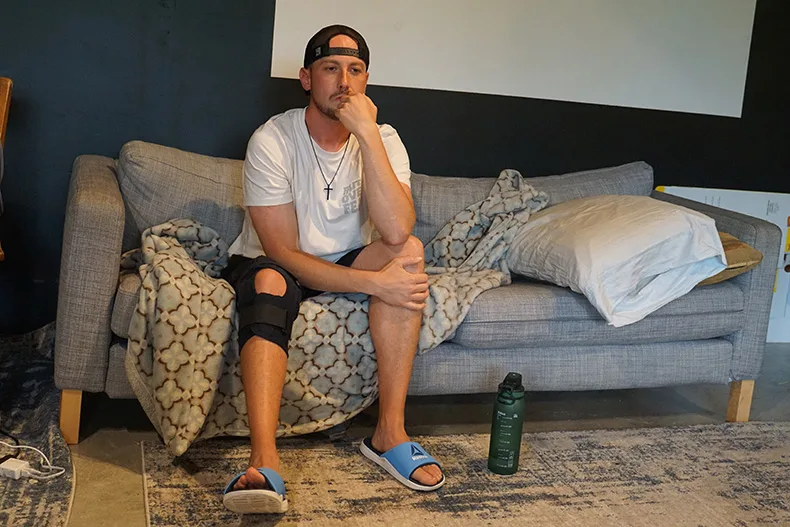
Living in his truck, Wiley Mlller, a Johnson County resident, often goes to work and then tries to get some sleep in his vehicle at night.
Normally, the night means cooler weather. With the nighttime temperatures sometimes only dipping into the 80s, it’s felt hotter than usual at night, and he’s needed help.
“I’ve had some days where I wasn’t dealing with the heat very well and reached out to Barb at Project 1020, and she was able to get me a room at (a hotel) for a few days … She has done that for so many this summer,” he said in an email to the Post. “(I) don’t know where me or several others would be without her help.”
Friends with both Miller and Foulks, Brian Perkins, another person experiencing homelessness in Johnson County, was able to find temporary housing at a church in the area.
While he considers himself lucky, he still said there’s everyday struggles, like walking to work or the bus station to get a bus pass, which used to be free, but now come with a fee that started on June 1.
“It’s been taxing on mine and many other’s mental, emotional, and physical health,” he said in an email to the Post. “It’s depleting and makes it nearly impossible to have the will to keep going. It’s a fight for your survival. Human beings aren’t built to endure extreme elements like this.”
Johnson County has no shelter for people in the heat
While Project 1020 is open from Dec. 1 through March 31, there’s no replacement for it when it’s closed.
While places like Johnson County Library branches and local community centers can act as cooling centers during times of extreme weather, they’re only a temporary fix, said Rita Carr, director of community planning for United Community Services of Johnson County.
What the county needs to start off is a homeless day center that other cities in the Kansas City area, like Kansas City, Missouri’s Hope Faith Homeless Assistance Campus, have, where people experiencing homelessness can take a shower, do laundry and seek assistance for housing, Carr added.
“We just don’t have an agency that does that type of service here. So it creates a big gap, and it ends up being that the libraries are the one available public space, but they’re not designed as day center-type services,” she said.
Johnson County commissioners, homeless advocates and those experiencing homelessness all say that there’s still a need for a long-term solution, like the proposed 24-hour homeless services center that the Lenexa City Council denied in 2024, which would protect people from extreme weather and offer a plan to find housing.
“This heat wave underscores what the most recent Point In Time Count already told us: unhoused Johnson Countians need more help,” BOCC Chairman Mike Kelly said in a statement to the Johnson County Post. “Our outreach teams are working daily to connect people to cooling resources, but the truth is our county still lacks year-round shelter capacity. We know it’s possible, and we need our cities and community partners at the table with us.”
The Johnson County Board of County Commissioners formed an Ad Hoc Housing Committee in January to address housing in the area, with solutions like transitional and attainable housing.
County Commissioner Julie Brewer, who previously served as executive director of United Community Services of Johnson County, said the committee is looking at the data and making careful, intentional recommendations for the county commission to take up.
The conversation is continuing, Brewer said, and data like the Point In Time count continue to fuel their decisions and a sense of urgency.
“I’m proud of the work that we’re doing as a county, and I’m proud of the work that cities are doing and the conversations that cities are having around ‘How do we get to more attainable housing and what are practical implementation activities that we can be doing?’ And you’re seeing that happening,” she said.
Still, people experiencing homelessness like Foulks, Miller and Perkins said they don’t have time to wait for decisions and that extreme conditions like the heat this summer carry on into other seasons.
“This is 1 season out of 4, where we fight for our survival. There’s been rain, thunder and lightning, along with the extreme heat. It’s been very difficult, and often times feels nearly impossible to have and find the will to keep going,” Perkins said via email. “The unhoused community are people too. We are human beings just like everyone else.”