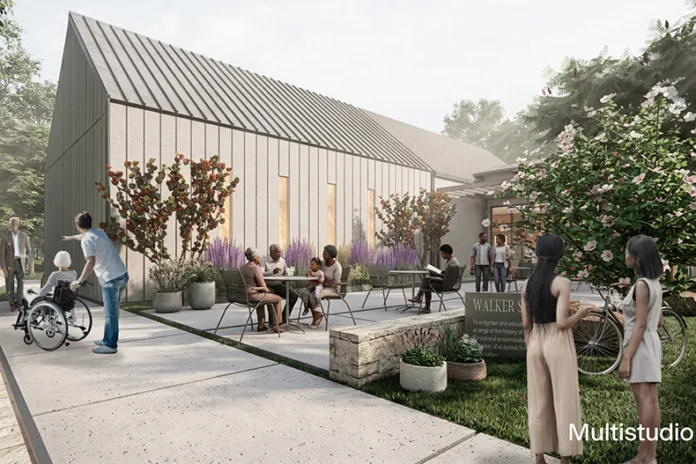
Earlier this summer, a small Merriam church that was once home to the Madam C.J. Walker School made history by landing on the National Register of Historic Places.
For Tony Adams, who grew up in the South Park area of Merriam where the school was located, the recognition was a long time coming, cementing the building’s history as part of the movement to outlaw school segregation.
The Kansas Supreme Court’s ruling in Webb v. School District No. 90, a 1948 lawsuit brought by the families of Walker School students, paved the way for Brown v. Board of Education — the landmark U.S. Supreme Court case that ruled school segregation was illegal nationwide in 1954.
But it turns out, getting the National Register designation may have been the easy part.
Adams is now at the forefront of an effort to raise $4 million to restore the Walker building — now home to the Philadelphia Missionary Baptist Church — as well as construct a new museum attached to the original structure.
In 2024, Adams, program coordinator for the church, said the original plan was to apply for numerous diversity, equity and inclusion-related grants through the National Park Service to cobble together the $4 million needed to complete the renovation in time for the 2026 World Cup.
That plan fizzled out when the second Trump administration took office in 2025, rolling back several DEI-related initiatives and funding sources nationally.
Now, Adams finds himself having to drum up interest and funding for a local landmark for which its significance is often untold. Adams said the Walker School story deserves to be in history books alongside the Brown v. Board of Education case.
“If it hadn’t been for them, there’d been no ‘Brown,’ so how come I’m not a footnote in history?” Adams said. “It became a mission after that.”
The renovation project, created in partnership with the Kansas City office of the national architecture firm Multistudio, envisions a lobby that functions as a museum to showcase the Walker School’s impact on history.
Tabitha Darko, project architect and senior associate with Multistudio’s Kansas City firm, said “a lot of our work is about impacting our community.”
“This one, being really tethered to not only our neighbors, but also on a national scale how it’s really impacted civil rights, education and knowing that that’s just in our backyard and we as designers get to help uplift some of our community members through that, it means a lot,” Darko said.
A nearly 140-year-old building’s impact on civil rights
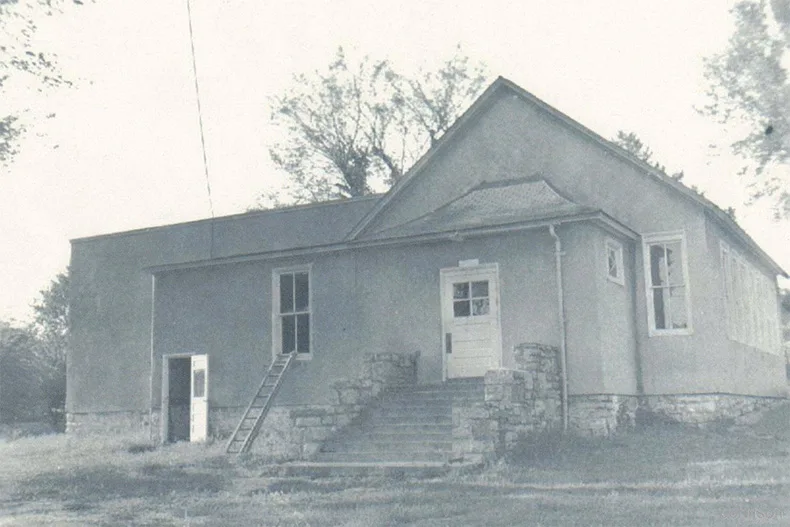
In the 1840s, Adams said about 300 families started the community known as South Park, which is now a neighborhood in northern Merriam.
The building that became the Madam C.J. Walker School was built in 1888, serving both Black and white students in the South Park community.
In 1900, School District 90 started separating students based on race, and a new South Park School was built for white students, according to the city of Merriam’s website. Black students continued to attend school at the Walker School.
Decades later, in 1947, the school district built another new South Park Grade School for white students only. At that time, state laws around segregation prohibited communities of 15,000 people or less, such as South Park, from segregating schools.
The original building that was the Walker School, where Black children still attended, was nearly 60 years old and deteriorating. It stood just half a mile away from the new South Park school for white students.
“The white students would walk up to the school (South Park Grade School), they would have to go through the Black neighbors’ yards to go to that school,” Adams said. “And everybody knew that … just crazy.”
A year later, several Walker School families banded together to file the Webb v. School District No. 90 lawsuit. At the same time, Walker School students and families boycotted the dilapidated building.
By 1949, two years after the new South Park school was built, the Kansas Supreme Court upheld a state law that prohibited school segregation in smaller towns.
This ruling allowed Black children to attend classes at the new South Park Grade School. In that way, Webb v. School District No. 90 helped pave the way for Brown v. Board of Education.
“The families that did it, you know, my family and others with the Webb family, they never did it for recognition or to change anything nationally,” Adams said. “They only did it so their kids could have the best education just like all the rest of the kids in the neighborhood, period.”
$4M restoration project will showcase school’s history
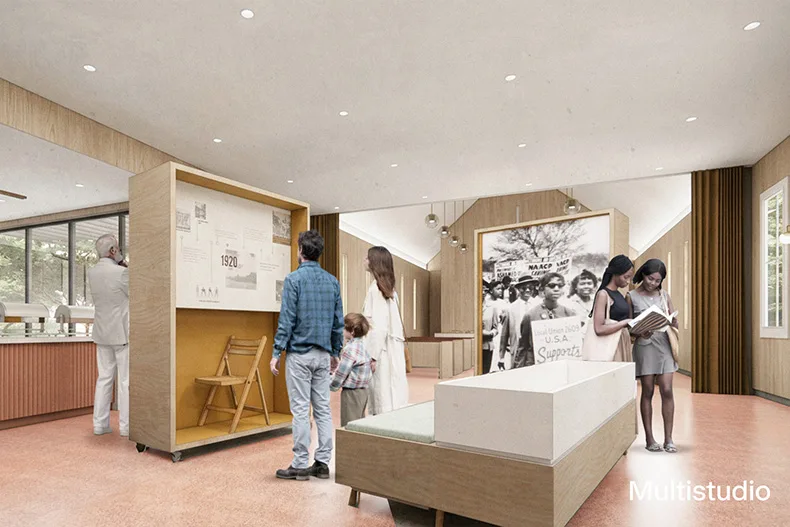
A couple of years ago, Multistudio created a $4 million restoration plan for the Walker School.
Adams said initially he believed that grants from the National Park Service, ranging from $300,000 to $700,000 apiece, would cover the cost of the restoration project.
“It was a done deal” in his mind, he said.
When the second Trump administration took office, however, those grant opportunities — many of them tied to diversity, equity and inclusion initiatives — dried up or were rolled back, he said.
“It was overnight when all these changes started happening, but where there’s a will there’s a way, because our story is what’s carrying us,” Adams said. “This is the fascination of it all. There should be a lot of support to make sure that story is never lost again.”
When the site was placed on the National Register of Historic Places this summer, it opened up new grant opportunities, Adams said.
Adams and the church are still working towards raising funds for the $4 million restoration plan that blends the current use as a place of worship with the building’s history and impact on U.S. education.

Multistudio’s plan envisions the following, as noted by Adams and Darko:
- Restoring the building to its original 20th-century appearance by reconstructing its south and east facades.
- Removing recent additions to the building in order to reconstruct the front entryway as it is pictured in historic photos during the building’s time as the Walker School.
- Reimagining the current fellowship hall and sanctuary to become an exhibit that tells the site’s history in the fight against racial discrimination.
- An addition on the north side of the building to expand the existing sanctuary and fellowship hall.
- A front courtyard that is centered around a repurposed, original schoolhouse well that will be turned into a fountain.
- Upgraded parking and landscaping.
Darko said Multistudio approached the design with the history of the building in mind and wanted to create “a confluence of gathering” at the entry of the building.
“We thought that was kind of cool in a way that we’re not really separating use (of the space),” Darko said. “The story, or the significance of this, as well, is separating Black children from white children in education.”
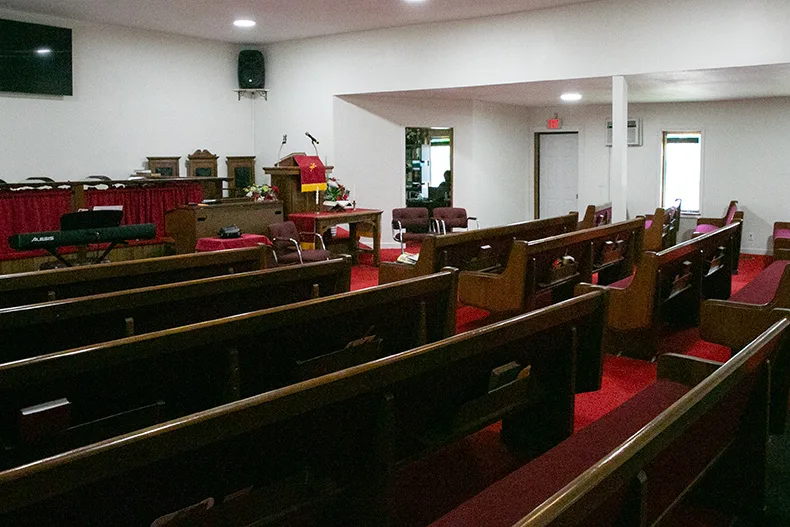
Adams said the National Register of Historic Places recognition opens up new opportunities for potential grants to restore the building.
Outside of grant opportunities, Adams said, there is a grassroots fundraising effort currently underway.
Those who are interested in helping restore the Walker School can send a monetary, tax-deductible donation online here. The full fundraiser brochure can be found here.
Once the funding for the project is in place, the $4 million restoration is expected to take roughly nine months to complete.
Keep reading causes and community news: ‘It’s magic’ — Broadmoor Boutique offers free clothes for SMSD community
 Thanks for reading! If you value having an independent news outlet keeping tabs on local government, schools and taxes, we're asking you to contribute to our Education Reporting Fund.