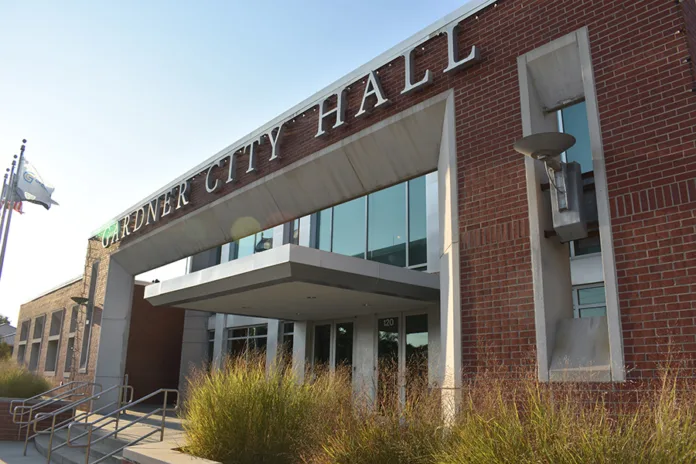
A Gardner resident points a finger at the mayor, another resident declares he’s running for city council, city councilmembers passionately debate budget cost cuts, and obscenities are spoken from the crowd and at the podium in response to some councilmembers’ statements — all parts of the nearly two-hour first act of the Gardner City Council meeting on Tuesday, Sept. 8.
The topic of discussion: adopting a resolution of the city of Gardner to exceed the revenue neutral rate for the city’s $114.8 million budget for 2027, and then to officially adopt that budget.
The city council voted 4-2 on both motions, with Councilmembers Kelly Johnson and Steve McNeer voting no. Five residents stepped up to the podium during the two public hearings to voice their dissent toward exceeding the revenue neutral rate, and to implore the city council to consider the financial stress it could put on Gardner residents through their property taxes.
During the budget discussions, councilmembers mostly focused on what to cut from the 2027 budget in an effort to keep the budget revenue neutral. Under Kansas law, municipalities are required to set budgets that bring in the same amount of money year over year, regardless of growth or inflation. Otherwise, these bodies, including the Gardner City Council, have to follow a set of additional procedures, including more budget-related hearings, in order to increase revenues.
City Administrator Jim Pruetting said city departments gave presentations on their personnel and equipment requests, which were then put into a budget document and cut until only the needs were left, resulting in the proposed budget plan.
With approval of the budget, the city council agreed to hold the city’s mill levy of 17.814 mills steady. Johnson County released a new assessed valuation estimate of $388,449,573 for Gardner on June 12, 2026, representing an increase of 5.2% and reflecting the community’s continued growth and economic strength, according to the July 31 budget message to the city’s governing body.
This year, the budget was about $130 million.
Read highlights from the city’s budget brief here.
Breaking down the average Gardner homeowner’s tax bill
For 2027, Gardner will keep the city’s property tax rate at 17.814 mills. The property tax rate, sometimes referred to as the mill levy rate, dictates how much a property owner pays in taxes to the city based on the assessed value of their property.
According to real estate statistics maintained by the Johnson County Appraiser’s Office, Gardner’s average residential property value is $357,837, up 3.8% from last year.
To calculate what your actual tax bill to the city will be, multiply the value of your home by .115 (the residential assessment rate). From there, take that number and divide it by 1,000. Then, multiply the result by the proposed mill levy rate of 17.814.
For the average home in Gardner, that means about $733.07 in property taxes owed to the city in 2027.
According to Finance Director Matthew Wolff, the city’s proposed 2027 budget is based on the proposed mill rate of 17.814, which exceeds the revenue neutral rate of 16.933. Residents will likely see an increase in their property taxes because of this. Calculating the property tax on a specific address can be done on the Johnson County government website.
Wolff said the dollar value increase of exceeding the revenue neutral rate is about $261,000. He recommended that the city council adopt the budget.
Frustrated residents decry budget in hearings
The residents were vocal during the public hearings about the rising cost of living in the city. Some felt they would be pushed out of Gardner, some felt that the city council wasn’t representing them, and some felt the city council wasn’t being transparent about their financial planning.
“While I understand the complexities of managing a growing city, I am deeply concerned about the compounding structural increases and overall cost that are being passed directly onto the citizens of Gardner, such as myself, during a challenging economic climate,” Gardner resident Bradley Steinmetz said.
Council President Mark Baldwin cited inflation and the country’s monetary policy, saying that every year costs will continue to increase.
During the second public hearing, Steinmetz addressed this comment and said he was disappointed in the members of the city council who voted to exceed the revenue neutral rate.
“Mr. Baldwin, I don’t care what you just said right there about, ‘It’s always going to go up, it’s always going to go up,’” Steinmetz said. “You guys are supposed to be representing us.”
Steinmetz then stated, in order to be a voice for the people, he plans to run for city council in the upcoming election.
Gardner resident Lynn Stuart, who moved to the city five years ago, said everything has gotten more expensive ever since then.
“You, sir,” Stuart said, pointing to Mayor Todd Winters, “stepped up to my door and told me that you were going to take charge of all this. You were gonna bring it down because of all the wasteful spending.”
Addressing the city council, Stuart said that if they voted for the increase, he would force a recall on them. According to him, the city council had already made up their minds, and he accused them of not caring about Gardner citizens.
Baldwin said later in the meeting, “It just floored me that people came up and attacked us. You made accusations like we don’t live here, like this isn’t our bill too. We get nothing out of this, except the same services you do. It’s not like an ‘us versus you’ perspective.”
A majority of the discussion between councilmembers centered around Councilmember McNeer presenting the idea to cut $261,000 from the budget, which would prevent them from exceeding the revenue neutral rate.
McNeer proposed specific cuts, including removing the open city positions that haven’t been filled in over 60 days, then reallocating that money. He also suggested delaying spending money on the $295,000 dump truck or $300,000 phone system. Other councilmembers pushed back, saying some of those decisions could prove more costly in the long run and also put pressure on an overworked, smaller staff.
“I think we’re really spending beyond what we need to be,” McNeer said.
Pruetting said the new dump truck for the Gardner Public Works Department is based on a fundamental operational need.
Toward the end of the meeting, there was talk of finding other ways to reduce city spending, like closing the pool for a year or canceling the Independence Day festival.
“No one likes extra taxes, no one likes any extra costs,” Mayor Winters said. “But our responsibility is to take what we feel the needed, appropriate amount is to keep the city functioning the way our citizens want.”