By Gabrielle Thompson
At JCCC, student voices tell the story of our campus. Each month during the academic year, the JCCC Updates column will feature a story originally published in The Messenger, JCCC’s student newspaper, to share student-reported stories about the issues, events, and people shaping campus life with the Johnson County community. This article was written by student journalist Gabrielle Thompson and originally appeared in The Messenger.
If you’re a veteran or military-connected student at JCCC, there’s a good chance you’ve walked past a small office, perhaps without realizing what it was, and wondered where you were supposed to go for help.
That’s now changed.
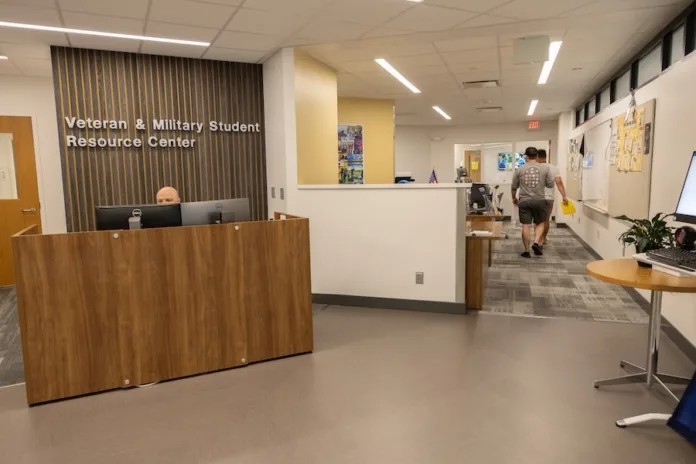
The move marks one of the more visible changes to student support services on campus this year. The new location replaces the center’s previous office, which had become increasingly crowded as the program grew, and gives students a more accessible place to find the services and resources available to them.
A space that finally fits
Speaking with Program Director Kena Zumalt, she explained that it took five years of planning, advocating and working with college administrators before they were able to provide a larger location. During that time, the program continued serving students in its previous office, even as the space became increasingly crowded and limited the center’s ability to accommodate students comfortably.
“We were just getting more and more squished into our space,” she said.
It’s worth noting how much the program has grown to get here. When the director first started working with the veteran program, it was a part-time position with a handful of VA work-study students helping out. Since then, it’s picked up more student employees, a peer advisor program and partnerships with outside organizations, growing into something the old space just couldn’t hold anymore.
A more central place for support
The new space also brings several community partners together under one roof. Students can now access VA career and benefits counseling alongside assistance with veterans’ claims.
“Number one, it brings our community partners and our center in one space,” she continued. “Now we’re all together, and so that makes for a better dynamic.”
More room to work
More space means staff can work with students individually while also helping more students at the same time, instead of everyone competing for the same corner of the room. It just wasn’t possible before when computers and space were both in short supply, especially during busy stretches of the semester.
Greg, a student who works at the center, said the layout change alone makes a real difference. In the old space, the lounge and student work area were basically the same room, so if you were trying to focus on something while other students were hanging out nearby, you were kind of stuck.
Not only is the space much more accessible and easier to locate, but with the upgrades, it offers a much more vibrant and welcoming atmosphere.
“It smelled like a brand-new shoebox, you know? Coming in was a pleasant surprise, much brighter in here, nicer carpets, more space. One of the things that stuck out to me was that the lounge is now separate from the student work area,” Greg continued.
Having more workstations has cut down on the waiting, too. He said that before, there was essentially one computer for everyone trying to work through VA.gov or fill out JCCC forms, so people ended up standing around just to get started. Now there’s enough room to actually sit down and work through it while staff walks you through the process.
A growing community
The center currently serves somewhere between 700 and 750 veteran and military-connected students each semester, according to the director, and around 300 to 350 of those students use benefits the center helps support.
Looking ahead, the center wants to reach students who don’t even know it exists yet. The goal is to connect with people earlier, right as they’re starting college, instead of waiting for students to eventually find their own way to the center. The peer advisor program is also expected to keep growing, pairing veteran and military-connected students with others who understand what they’re going through firsthand.
“A lot of times, these folks are first-generation college students, so we want to make sure that they know that there are other students, just like them, here, and those students are here to help them,” the director responded.
Come see it for yourself
For her, the new space is about more than simply having additional room. She wants it to become a place where students can spend time between classes, meet other students and get the support they need.
“I want it to be a place where they feel like they belong,” she said.
Greg’s advice to other veteran and military-connected students is simple: come see the space for yourself.
“We have what you need,” he said. “We have space. We have quiet space. We have snacks. We have coffee.”
At the end of the day, the director wants students to know that they do not have to navigate college alone. The goal is to make sure students understand that asking for assistance is encouraged and that the program is committed to helping them succeed.
“I want it to be a place where they feel like they belong, that they can create meaningful connections with other students, that they can get their questions answered and be supported.”