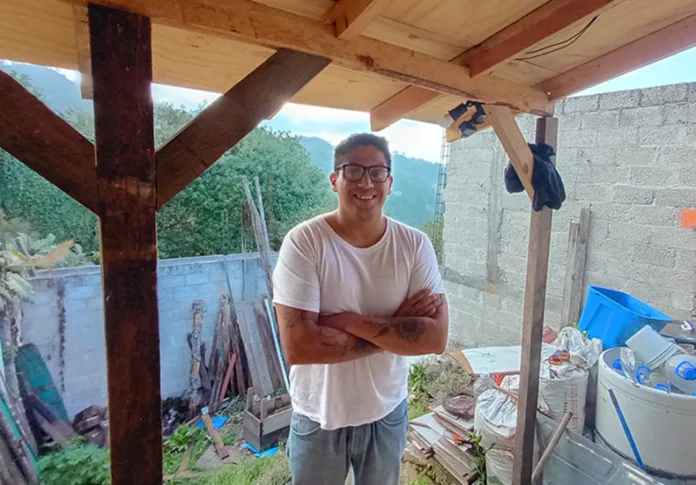
When a blue Ford F-150 pulled up to his work site in Lawrence on Aug. 18, Oscar Sanchez-Corona knew exactly why it was there.
He recognized the truck from videos of ICE detentions he had seen on social media.
Sanchez-Corona, an undocumented immigrant who had been deported once before, knew there was a chance immigration agents would eventually come for him.
He had even made the decision to tell his two young children about his immigration status, just in case.
“I just didn’t want them to be caught completely off guard,” he said.
That day, ICE agents detained Sanchez-Corona, who lived in Shawnee, in front of his coworkers and took him away in shackles, he said.
He spent the next two and a half weeks traveling across the country to different immigration detention centers before he was eventually deported to Mexico — a country his family left when he was around 1 year old.
Childhood

Sanchez-Corona spent most of his childhood in Johnson County.
The 36-year-old lived in Lenexa until around fourth grade and would walk to the now-closed Don Bonjour Elementary, weather permitting.
“I feel I just had your typical American childhood,” he said. “We played soccer, baseball. There was a park down the street, and it was just all the neighborhood kids, especially in the summers, we were just out all day just playing.”
Sanchez-Corona said he doesn’t remember the exact moment he learned he was undocumented, but that he was probably 10 or 11. He realized his situation was different than his friends’.
Other families went on vacations.
“And my parents [said], ‘Well, you know, we can’t really travel like that,’” he said.
His family later moved to Overland Park, where he went to East Antioch Elementary School and later Shawnee Mission West High School, where he graduated.
Sanchez-Corona described himself as a nerdy kid, who got mostly straight A’s. His favorite subject was math, and he said he won the Shawnee Mission School District Math Pentathlon in back-to-back years.
“I think that later on it helped me in construction because there’s a lot of math in construction,” he said.
He also loved sports.
“Whatever sport I could play, I loved playing it,” Sanchez-Corona said. “Football, soccer, baseball, I played them all.”
By 15, Sanchez-Corona had started working.
“For me, high school was after work, after school was going straight to work,” he said.
His first job was at McDonald’s. He later worked at the now-closed restaurants Elephant Bar and Rainforest Cafe.
He started getting in trouble in his late teens.
Then, in his early 20s, following a misdemeanor marijuana charge and probation violations, he was deported to Mexico in May 2013.
He tried to make Mexico City his home, but he said he missed his family and the place he grew up. After six months, Sanchez-Corona decided to return to the United States and what he considered his home in the Kansas City area.
He crossed the border illegally and spent two days walking through the desert without food or water.
Back in Kansas City, he made the decision to change his life and stay out of trouble. He eventually got into construction and became a father.
He now has a 9-year-old daughter and a son who’s turning 8 this fall, who are students in the Blue Valley School District.
Detention

On that August morning in Lawrence, Sanchez-Corona was pouring concrete for sidewalk repairs on a residential street.
When federal agents got out of the truck, they asked for Sanchez-Corona by name. Photos of the incident shared on social media show at least five agents in tactical vests.
They shackled him in front of his coworkers, putting a chain around his waist and handcuffing him. He said they had trouble getting the ankle shackles around his work boots.
Sanchez-Corona said he isn’t sure how the agents knew where to find him.
He was taken to a Department of Homeland Security office near Kansas City International Airport and then to the Midwest Regional Reception Center, an immigration detention facility run privately by CoreCivic in Leavenworth.
The Post has reached out to the Department of Homeland Security and CoreCivic for comment but has not received a response as of publication.
Four days in Leavenworth
Sanchez-Corona arrived at CoreCivic on a Tuesday afternoon.
Because of his criminal record, he said ICE initially placed him in the unit with people classified as high- and medium-security detainees.
He was sitting at a table when he noticed something dripping on the back of his neck.
“I look around and there was a puddle on the table next to me, and I look up,” he said. “The roof was leaking.”
He said he saw another leak elsewhere in the unit.
Later that day, Sanchez-Corona said a caseworker reassigned him to a lower-security classification.
“You don’t need to be in here with the oranges and the reds,” he recalled the caseworker saying.
Sanchez-Corona then joined the five other detainees who had traveled with him from the DHS office to CoreCivic.
He said that group had been placed together in a cell when Sanchez-Corona was in the other unit. They told him their cell had flooded when it rained, but weren’t moved until the next morning.
Sanchez-Corona said the facility felt understaffed.
On one occasion, he said there were roughly 40 men in the yard being supervised by one guard.
He also recalled that security procedures seemed inconsistent. Sometimes guards patted him down as he moved through the facility but not always.
Metal detectors also weren’t always used.
“Sometimes they wouldn’t tell us to walk through them, sometimes, ‘Ah, don’t, don’t worry about it,’” Sanchez-Corona said. “Sometimes they’re not even plugged in.”
He said some employees appeared young and inexperienced.
“A lot of people just seemed out of place,” he said.
According to Sanchez-Corona, CoreCivic guards and medical staff were the only outside employees he saw. Besides that, detainees did all the work around the detention center, including cleaning, cooking, laundry and working in the barber shop.
One told him they made about $2.50 to $3 a day.
“I was like, ‘Did you say a day, or do you mean an hour?’” he said.
Sanchez-Corona gets frustrated thinking about it.
“So we’re in this country where we’re being accused of stealing American jobs, but now they’re asking us to work for $2.50, $3 a day, just so these for-profit companies can increase their profits,” he said.
He decided not to work.
“I’m not going to let somebody take advantage of me like that,” he said. “I’ll just sit here and do nothing all day.”
Sanchez-Corona said communicating with his family was another challenge.
He said he received one free five-minute phone call when he arrived. After that, someone outside the facility needed to add money to his account for him to make longer calls.
But even with the money to make calls, it wasn’t always a guarantee. He said the lines were so long, he’d tell his family phone calls were always a “maybe.”
Medical care also became a concern for Sanchez-Corona throughout his 18-day detention.
He wears contacts but wasn’t given contact solution for a few days, forcing him to sleep in his contacts, which he said was painful.
Still, Sanchez-Corona said his own medical needs were minor compared to what he saw other detainees experience.
“I can get an eye infection. I can suffer damage to my cornea. I can lose partial vision, lose vision. But I wasn’t gonna die,” he said.
He said he repeatedly saw diabetic detainees struggle to get insulin.
“The insulin is something I saw constantly everywhere,” he said. “That was the big thing.”
“The worst hell I went through”
After four days, Sanchez-Corona was moved again.
He said he’d been told by a Mexican consular official that they were going to El Paso, Texas. Shortly before boarding a plane, an ICE agent told him they were going to Louisiana.
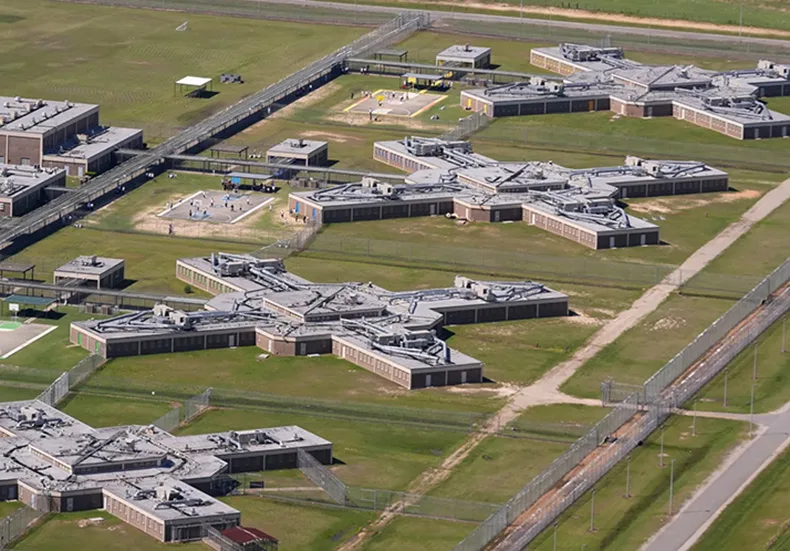
He was taken to Winn Correctional Center, which is about 90 miles southeast of Shreveport.
Sanchez-Corona described it as the worst facility he experienced.
“As soon as I got there, it was just horrible,” he said. “It’s a very old prison.”
Winn has made headlines for its unsafe conditions. An inspection by the DHS Office of Inspector General in June found leaky ceilings, issues with food sanitation and use-of-force violations.
Earlier this year, the Post spoke with another Johnson County man briefly detained at Winn who also said it was the worst detention center he was held at.
At Winn, Sanchez-Corona was again placed in a higher security unit. But this time, they wouldn’t move him.
“So you really are in there with guys that are coming from doing federal and state prison time,” he said. “Actual dangerous people, and I’m just some kid that grew up in the suburbs of Kansas City.”
He said there were usually no guards in the unit.
“It’s basically a free-for-all,” he said.
Without supervision, detainees would stay up all night. He said people would play cards into the early morning hours and then sleep all day.
This, in addition to the one-inch mattress he was given, made it difficult to sleep.
After about three days, Sanchez-Corona and other detainees believed they were finally being deported.
Instead, they spent much of that day waiting.
Sanchez-Corona said they spent hours on a hot bus with little water. He said he was accustomed to the heat because of his construction job but that the conditions were difficult.
“We were sweating. We were hot,” he said. “We would yell out the window, ‘We need water, we need water, we need water.’ We were just ignored the whole time.”
“The worst hell I went through was Louisiana,” he said.
Full restraints made it difficult to eat
Sanchez-Corona was eventually taken to Camp East Montana, an immigration detention facility in El Paso.
He said it was better than Winn because the mattress was thicker and the food was hot.
At CoreCivic and Winn, Sanchez-Corona said the food was cold and the portions were small.
He had been detained for a week at this point and had already lost eight pounds.
“When I weighed in at CoreCivic, I was 199. When I got to Winn, I was down to 194. When I got to Camp East Montana, I was down to 191,” he said.
He said he still didn’t know when he would be deported.
At one point, he was put in full restraints and flown to San Diego. He never made it to the detention center. Instead, after hours of waiting and problems with the plane, he was returned to El Paso.
“Anytime they move you, you’re in full restraints,” he said. “At your ankles, and there’s a chain around your waist.”
His handcuffs were attached to the waist chain, making it difficult to do much.
“It’s such a difficult thing just to drink water when your arms are restrained like that,” he said.
At times, detainees were given bread, cheese and bologna separately, and they had to try to make their sandwiches while still restrained.
“After a certain point, it all starts to hurt,” he said. “It starts to hurt your ankles, your wrist, and then to be forced to have to try to eat like that and then drink it, it was difficult.”
With each transfer, Sanchez-Corona would think about the distance between him and his kids.
“With each passing day I was getting further, further away from my kids,” he said. “That was the hardest part.”
His family was searching for attorneys, hoping they could find a way to stop the deportation.
Sanchez-Corona didn’t believe they could.
“My family still had hope,” he said. “They were looking for lawyers, hoping for a miracle.”
But Sanchez-Corona said he believed there was a “99.5 percent chance” he would be deported.
“There was no way out of the situation. No lawyer was going to save me, nobody was going to save me,” he said.
“Missing home”
After 11 days in El Paso, Sanchez-Corona’s detention ended more simply than he expected.
Instead of another flight, he was put on a bus for the roughly 30-minute drive to the U.S.-Mexico border. He crossed into Juarez on foot.
All told, he had spent 18 days in federal immigration custody.
Sanchez-Corona said ICE didn’t return his phone or Mexican ID before his deportation.
“I’m traveling through Mexico with no phone, no way to contact anybody if I need to right away,” he said.
He initially stayed at a government shelter for deportees before traveling toward Mexico City and eventually Puebla, where he is now staying with a cousin. He said most of his family has moved to the U.S.
It wasn’t Sanchez-Corona’s first time adjusting to life in Mexico. After his 2013 deportation, he spent time in Mexico City and learned how to navigate the city.
This time, the culture shock wasn’t as severe.
“The worst part is just the whole missing home,” he said.
Sanchez-Corona is now trying to figure out what his life in Mexico will look like.
He helps his cousin at a hotel and said being bilingual gives him employment opportunities, including at call centers or in places with a large number of tourists.
He video calls his kids as much as possible.
Because he’s been deported twice, Sanchez-Corona said he can’t legally return to the United States for 20 years.
“I can survive out here. I can make a living out here,” Sanchez-Corona said. “But this is never going to be home. Home is Kansas City.”