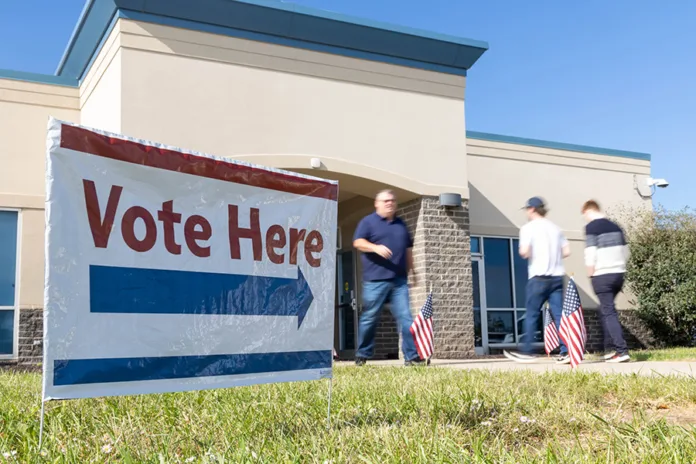
Kansas Secretary of State Scott Schwab says his office will refer concerns about funding for a partial recount of votes in this midterm’s U.S. Senate race to federal authorities.
David Graham, an Overland Park lawyer who finished a distant third as the Libertarian candidate in Kansas’ U.S. Senate contest on Nov. 3, requested the recount on Tuesday, as part of what he described as an “academic project” on behalf of a Wichita statistician who has for years cast doubt on the accuracy of electronic voting machines’ totals.
Graham’s request specified that the recount be conducted in 60 precincts spread over Johnson, Shawnee and Wyandotte counties.
In Johnson County, election workers began hand counting votes in 23 precincts on Thursday afternoon. The county election office announced that a final canvass of the recount would occur at 4 p.m. on Friday at its offices in Olathe.
Matter being referred to FEC, Justice Department
In a statement Thursday afternoon, hours after the recount was initiated, Schwab said he had “concerns” about how the recount was being funded, noting that the check used to pay for the recount bond did not come from Graham’s campaign account or a campaign recount fund.
Instead, Schwab said a bond payment totaling $47,548.12 was drawn from an account tied to the Show Me the Votes Foundation, a state-registered corporation founded in 2015 and led by Beth Clarkson, a statistician with a doctorate degree from Wichita State University.
“The source of the funds provided to the foundation has not been disclosed,” Schwab said in a news release.
Schwab said he planned to refer his concerns to the Federal Election Commission and the U.S. Department of Justice.
“The use of these funds raises serious concerns about potential violations of federal campaign finance restrictions, including prohibitions on contributions from impermissible sources and limits on contribution amounts,” Schwab said.
The Post reached out to both Graham and Clarkson on Friday and did not get a response.

Helping Clarkson with an “academic pursuit”
Schwab noted that Graham said the “sole purpose of the recount was to assist Beth Clarkson with her academic research.” Schwab added that Graham “expressly stated that he did not doubt the accuracy or the outcome of the election.”
Graham totaled 3% of the vote in the much-watched Senate contest, which was won by Democrat Adam Hamilton, a Leawood pastor. Hamilton defeated Republican Sen. Roger Marshall by a margin of 51% to 46%.
Clarkson has spent more than a decade arguing that Kansas’ electronic voting machines can’t be trusted unless their results are checked against hand counts. In 2015, she sued Sedgwick County under the Kansas Open Records Act to gain access to voting machines’ printed-out paper records, but a judge denied her access to those records.
According to her LinkedIn profile, she earned a doctorate in mathematics and has worked as a statistician for Wichita State University’s National Institute for Aviation Research.
Schwab’s statement matches what Graham himself told the Post on Thursday.
Since Clarkson is not a candidate, she cannot request a recount herself. Graham said she reached out to him to request one on her behalf, and said he agreed “because she convinced me that this is a legitimate academic pursuit and it could result in something helpful to the body politic.”
But when pressed on where the funds for the recount bond came from, he would not go into specifics.
“There’s no cost to me or the [Libertarian] party,” he said.
When asked if that meant Clarkson was paying for the recount, Graham replied: “I’ll let her tell you the answer to that question, if she wishes.”
Johnson County recount expected to end Friday
The Johnson County commission, acting as the Johnson County Board of County Canvassers, is set to convene on Friday at 4 p.m. to canvass the results of the recount in Johnson County.
In total, Graham’s request identified 23 precincts in Johnson County for the recount, covering parts of Gardner, Leawood, Lenexa, Olathe, Overland Park and Shawnee. (Those precincts make up about 3% of the 696 precincts in Johnson County overall.)
There were also 16 precincts in Wyandotte County and 21 in Shawnee County requested for the recount. Schwab said work recounting the votes by hand in those precincts could go into the weekend.
Initially, Johnson County Election Commissioner Connie Schmidt said she needed 50 election workers to be available from 9 a.m. to 5 p.m. on Saturday and Sunday for a recount, though it appears the recount process will conclude in Johnson County on Friday.
Schwab said the cost for the recount breaks down as follows: $24,750 in Johnson County; $9,962.52 in Shawnee County; and $12,835.60 in Wyandotte County.
 Thanks for reading! If you value having an independent news outlet keeping tabs on local government, schools and taxes, we're asking you to contribute to our Education Reporting Fund.