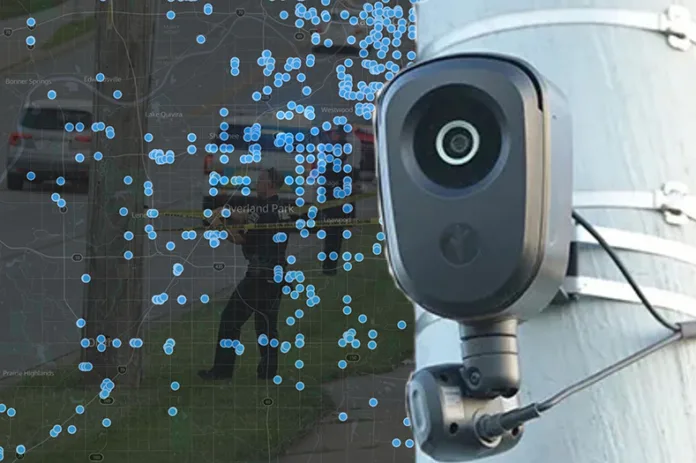
It didn’t take long for Gardner to decide to stop using its Flock Safety cameras early after residents started raising concerns about the technology and its potential privacy implications.
The devices in question are a type of Automated License Plate Reader, or ALPR. These camera systems capture license plate information from passing vehicles, compare it immediately against a “hot list” of vehicles of interest, and can store it for investigative purposes for a set period of time or indefinitely.
These devices, used primarily by police departments and law enforcement agencies, can be made mobile by attaching them to patrol vehicles or be more permanently located on stoplights, overpasses and streetlights. Multiple vendors make these cameras, like Genetec, Motorola and Flock Safety, and cities across Johnson County have used them for years.
Local departments set their own rules on ALPRs
In the absence of comprehensive state or federal laws, police departments and law enforcement agencies are largely left on their own.
Several Johnson County departments have enacted their own internal policies — often without direct oversight of elected officials — and run their ALPR camera programs under those standards.
Some departments that use those devices have no official policy at all or apply outdated rules for other surveillance technology to these modern tools.
Proponents have lauded the technology as an important law enforcement tool that’s helped find missing individuals, catch violent offenders and recover stolen vehicles.
However, critics have increasingly voiced worries about privacy, the widening surveillance net and potential constitutional violations. Particular concern has been raised about Flock Safety’s camera, which collects data that goes into a cloud network accessible by subscription-holders across the country.
ALPR devices in general have been at the center of growing public scrutiny nationwide, especially as instances of reported misuse have become more common. It’s also become a flashpoint in races for political office at all levels.
On Aug. 3, Eric Arnold and others came to the Gardner City Council asking for the use of the Gardner Police Department’s Flock cameras to cease.
By the time the city council met again later that month, Police Chief Kelly Herron said he had disabled access to the Flock cameras, had enacted a new policy on the use of all ALPR cameras and had conducted an audit.
Then, the city council reached a consensus about letting the Flock leasing contracts expire without renewing them and having the cameras disabled in the meantime.
Gardner isn’t the only Johnson County city to make headlines for its ALPR cameras.
Earlier this year, KCUR reported that the Lenexa Police Department had used its ALPR cameras made by Leonardo, Axon and Genetec to keep tabs on a resident named Canyen Ashworth who had written a critical column about the Lenexa Police Department in the Kansas City Star.
The department seemed to link Ashworth with an unrelated criminal inquiry into posters critical of ICE hung around the Lenexa Civic Campus at City Center. Charges were never filed against Ashworth in connection with that investigation.
Critics call for restrictions on ALPR cameras

For organizations like the digital rights organization Electronic Frontier Foundation, the danger of privacy invasions outweighs any public safety benefit when it comes to ALPR cameras.
They would prefer to see police departments pull the plug.
“Our position is that this ALPR mass surveillance should not exist, and that it they’re irredeemably harmful, and that states and cities should eliminate it,” said Rindala Alajaji, associate director of state affairs for EFF.
“The focus isn’t really on a certain vendor or a certain brand name, but the broader idea of ALPRs turning our every movement into a log and database of our lives,” she continued. “Our position is that ALPRs are surveillance tools, and they invade our personal privacy and threaten our civil liberties.”
However, Alajaji told the Post that the foundation does recommend a series of policy standards for police departments to implement if they intend to use ALPRs.
For instance, she said a department must have a policy in place that keeps a tight leash on the way the devices are used and how the data is accessed. One thing she called “essential” is imposing a warrant requirement or other safeguards that require departments to have actual probable cause to add their plate information to the “hot list,” which is the list of vehicles that are actively being tracked locally or nationally.
Alajaji also said departments should impose short data deletion windows, pointing to New Hampshire’s new rule requiring images of license plates that don’t ping against the hot list to be deleted in three minutes or less.
“You’re not keeping a data log of someone’s movements for an entire year or a month or however much time that they’re keeping it for,” she said. “There’s no reason for millions of license plates to be tracked and kept for no reason.”
Another requirement the foundation supports is adding regular internal and annual external audits to ensure data is being used appropriately and accessed for actual law enforcement purposes. That could head off some of the alleged misuse that’s been reported recently, including a former Bonner Springs Police detective accused of using police surveillance technology to track his wife and other individuals.
ALPRs are vital law enforcement tools, supporters say
Law enforcement officials and other proponents of the technology see it differently than the critics and have pushed back on assertions that the devices are a violation of privacy.
In an online transparency page for the Johnson County Sheriff’s Office, Sheriff Byron Roberson says “these tools are important for law enforcement’s ability to keep citizens safe.”
“This technology has helped our deputies in Johnson County locate missing people, recover stolen vehicles, and apprehend an armed man wanted after threatening a daycare,” Roberson said in the online message.
He pointed to various examples of when ALPRs had been used effectively locally. One such example from earlier this year was a series of license plate reader hits on a vehicle that led to the arrest of a suspect of aggravated assault and robbery. Another instance, in mid-2025, involved the arrest of a suspect involved in the sexual abuse of a child.
Departments across Johnson County and the sheriff’s office have adopted policies that place limits on how the technology can be used and the generated data accessed, some very similar to the recommendations made by the Electronic Frontier Foundation.
“Strong safeguards and effective law enforcement are not mutually exclusive,” Roberson said.
The breakdown: Which JoCo departments use ALPRs?
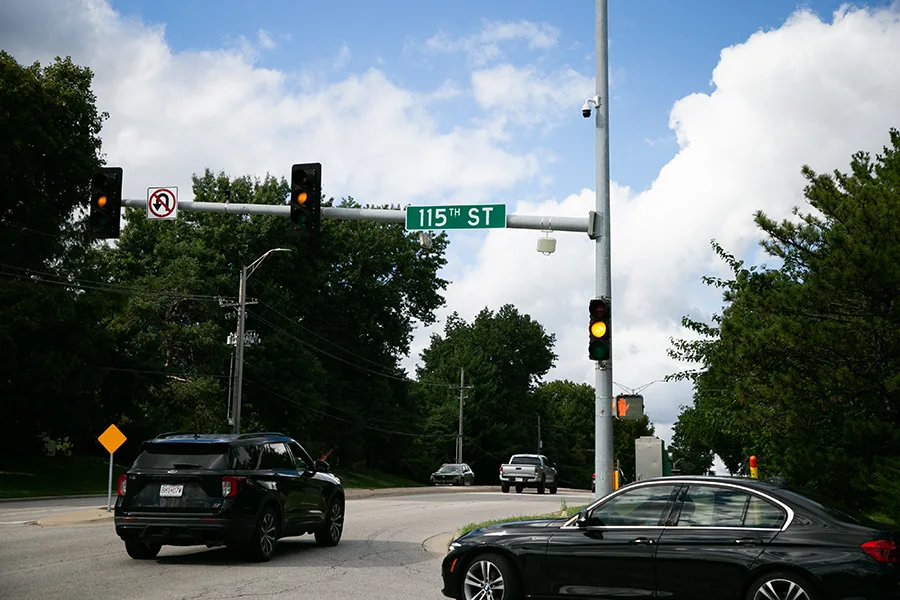
Many police departments across Johnson County use a mix of mobile and fixed devices from various brands and have some sort of policy that dictates their use. Find out if and how your city uses these devices below.
This list only includes city-owned and operated ALPR units, not units that may be owned or operated by private entities, businesses or homeowners’ associations.
Overland Park
The Overland Park Police Department has used LPR technology in some form since 2010.
Today, it operates 38 fixed cameras from Genetec and 113 mobile Axon cameras attached to patrol vehicles, said Officer John Lacy, department spokesperson, in an emailed statement. The department does not utilize Flock cameras.
All of the equipment is owned by the department, as is the data that it generates, which is stored for one year. The police department can share data from its fixed cameras with some other local law enforcement agencies in the KC metro area but does not share data with federal law enforcement agencies.
Access to the data is restricted, logged and periodically audited by the Professional Standards Unit. Officers who do access the plate reader data must enter a specific reason, as dictated by a recently updated department policy.
Read more here.
Olathe
Olathe has been using LPR technology for more than 15 years, said Sgt. John Moncayo, in an emailed statement.
The Olathe Police Department uses a mix of mobile and fixed units from ELSAG and Genetec, but Moncayo did not say how many devices the department has.
The department does own the equipment and stores the data in an Olathe database. Data can be shared with other police departments and law enforcement agencies with permission.
The data generated by the plate readers is stored for 90 days.
Trained officers and the department’s crime analysts can access the reader data by logging into the system and access can be logged and audited.
Shawnee
A Shawnee spokesperson did not answer directly a list of questions from the Post covering a range of topics, like how many readers the police department has and from what manufacturers.
However, through a public records request, the Post did obtain the Shawnee Police Department’s policy on license plate readers.
According to the policy, the department owns the equipment and the data the plate readers create. Data is only to be used for “official business,” which will be dictated by a commander, who sets protocols for access and data retention. Other agencies can access the data by request only.
Data is stored for 180 days.
The Post previously reported that the police department started using the devices in 2010 and has a mix of mobile and fixed units.
Lenexa
The Lenexa Police Department started using license plate reader technology in 2009.
Now, the department uses a mix of Leonardo, Axon and Genetec cameras and has 40 fixed units and 42 mobile units.
The city owns these devices, said Danny Chavez, Master Police Officer, in an emailed statement.
Department policy for public safety visual surveillance systems places limits on who can access reader data and in what cases. Command staff can monitor and audit system access. Other law enforcement agencies can access the data by request only.
Lenexa Police stores the data for 60 days.
All that said, Chavez also told the Post that the department is reviewing a new ALPR policy that is likely to be implemented soon.
Find the full policy manual here.
Leawood
Leawood began using ALPR technology in 2014 with a mobile unit on a patrol car. However, that particular camera is no longer in use.
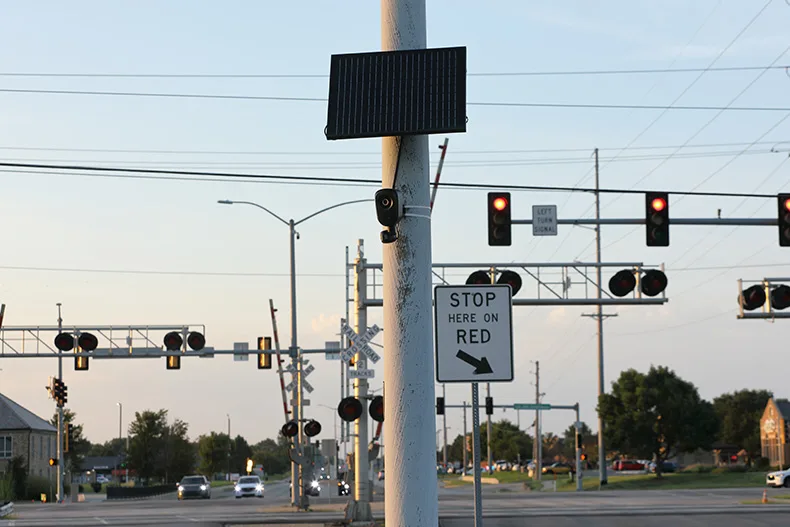
Today, the Leawood Police Department has 13 fixed ALPR units, which are placed around major intersections throughout the city. All of the units and the software associated with them are made by Genetec.
All of the equipment and the data that it generates are owned by the department. That data is stored for one year.
Access to the data is restricted to authorized personnel with a password, though data can be shared with other departments under regional agreements. Audits can be conducted.
The police department does have a policy that governs data storage and access; however, Capt. Jason Ahring said in an email to the Post that policy revisions are underway “given the public concerns identified in the last few weeks.”
Gardner
The Gardner Police Department did, until recently, use Flock cameras.
However, in August, the Gardner City Council decided to discontinue using two fixed and two mobile Flock camera units early, following pushback from the public.
The department has continued to use 15 mobile Axon cameras on patrol vehicles. Data from those cameras is stored for 30 days, and access to it is limited by department policy. All searches, which can only be completed with a case number or logged purpose, are logged for periodic audits. The data is not shared with other agencies.
“A department audit found no improper access or use within the systems,” said Daneeka Marshall-Oquendo, communications manager for the city, in an emailed statement.
Prairie Village
The Prairie Village Police Department began using LPR technology in 2022, said Capt. Josh Putthoff in an emailed statement.
It operates 30 fixed cameras from Axis throughout the city, as well as 25 fixed cameras in Mission Hills. The department uses Genetec software for the cameras. The department does not utilize Flock cameras.
The equipment is owned outright by the department, and Prairie Village Police keep the data on its own servers. The data is stored for 90 days. Other agencies must formally request access to the department’s data and document a specific reason.
Officers and dispatchers can access the data generated by the cameras, but only after logging in and giving a specific reason, according to department policy. Access is logged and audited semiannually by the Staff Services Division Commander.
Read more here.
Merriam
The Merriam Police Department has used LPR technology for about 10 years, said Ciera White, city communications specialist, in an emailed statement.
The department has 19 fixed cameras, which are made by Genetec. The department does not utilize Flock cameras.
The city owns the equipment and stores all of the generated data for up to 180 days. Other agencies must formally request access to the department’s data and document a specific reason.
Police officers and department crime analysts who have undergone the required training can access the equipment or data, according to department policy. Even so, all inquiries are tracked and can only be completed with a case number or other reason given for the search. Audits are completed each quarter.
Spring Hill
The Spring Hill Police Department began using ALPR cameras earlier this year, acquiring 10 mobile units from Axon and another mobile unit from Leonardo. Spring Hill does not have any fixed LPR cameras, said Jenna Gant, city spokesperson in an emailed statement.
The department owns these devices and the data they generate. Access to the data is restricted, logged and audited annually by the Operations Captain. Under department policy, officers who do access the plate reader data must enter a specific reason or case number.
The data is stored for 90 days.
Mission
Mission started using ALPRs in 2024 after getting a U.S. Department of Justice Grant.
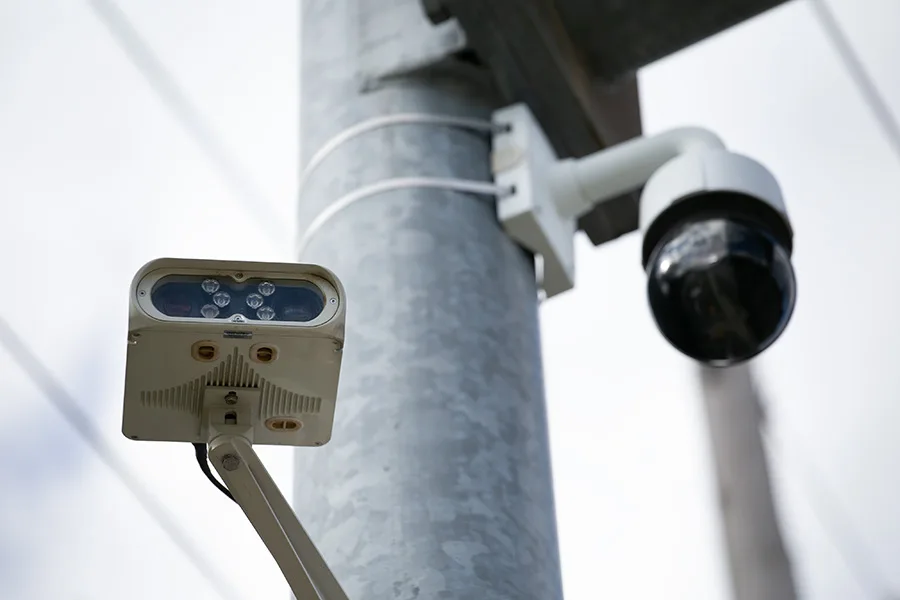
Today, the Mission Police Department has 22 fixed cameras made by Genetec located throughout the city. The department owns these devices and stores the data generated by them for 90 days, said Laura Smith, city administrator, in an email.
Access to the data is limited to trained officers, logged and audited quarterly by the Professional Standards Captain. Some other law enforcement agencies can access the data.
De Soto
De Soto does not operate its own police department but contracts out to the Johnson County Sheriff’s Office. The city does not operate or own any ALPR cameras or technology, said Whitney Lange, communications director for De Soto, in an emailed statement.
Roeland Park
The Roeland Park Police Department started using LPR cameras in 2023, and operates three fixed units made by Genetec. The city owns these devices, Police Chief Cory Honas said in an email.
Data generated by the readers is stored for 90 days and is shared with other law enforcement agencies. Access is limited by a login system and can be audited by the police chief “on a regular basis,” per department policy.
Fairway
The city of Fairway first began using plate readers in 2024.
Today, the Fairway Police Department operates seven fixed cameras and one mobile camera, all made by Genetec.
All of the equipment is owned by the department. Data that readers generate is stored for 90 days. Access to the data is logged and can be audited by the Chief of Police.
Some other law enforcement agencies can access reader data “freely per an approved memorandum of understanding,” said Nathan Nogelmeier, city administrator, in an email.
Nogelmeier said the department does have a policy governing how and when data from these devices can be used but did not share it with the Post.
Edgerton
Edgerton does not operate its own police department but contracts out to the Johnson County Sheriff’s Office. The city does not operate or own any ALPR cameras or technology, said Kara Banks, assistant to the city administrator, in an emailed statement.
Westwood
Westwood does not have ALPR cameras or technology of any kind, said Katherine Carttar, city administrator, in an emailed statement.
Johnson County Sheriff’s Office
The Johnson County Sheriff’s Office does use some Flock Safety cameras in its collection of about 50 LPRs.
Kristen Boxman, public communications manager, said the office uses 45 LPRs from Genetec, two fixed and one mobile unit from Flock and three mobile units from LSAG.
The sheriff’s office first started rolling out LPR and ALPR technology in 2022, after receiving a grant. It owns most of the cameras it uses, but does lease all of its Flock cameras and some of the Genetec cameras.
Boxman said the fixed units are placed at intersections in De Soto, Gardner, Mission, Olathe and Fairway, but declined to provide specific locations.
Data created by these cameras is stored for 90 days. Access is limited to authorized users who must log in and state a specific reason. Audits are also completed annually and can be triggered more frequently as needed.
The data can be shared with other authorized agencies.
“Interagency access or sharing shall occur only with agencies specifically authorized by JCSO through an approved data-sharing arrangement, memorandum of understanding, or approved vendor/platform sharing configuration,” Boxman said.
Juliana Garcia, Andrew Gaug and Kate Mays contributed to this story.
Keep reading: Gardner shuts off Flock license plate cameras amid growing privacy concerns