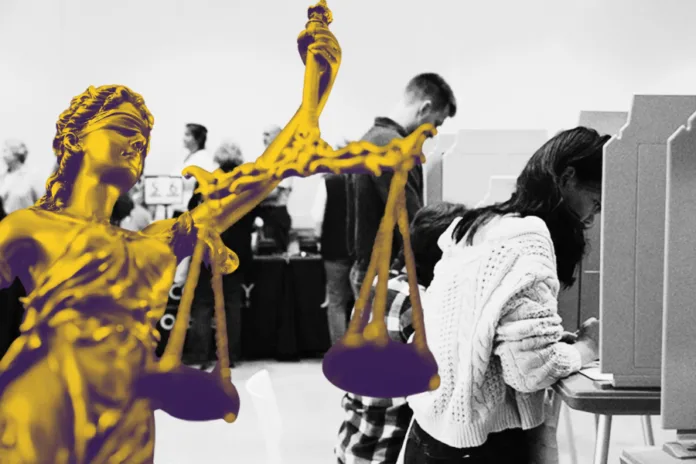
State supreme court justices may not be on the road kissing babies and making stump speeches this year, now that a proposed constitutional amendment failed, but voters will still get to have a say on judicial retention this November.
The amendment, which appeared on August’s primary ballot, would have made Kansas Supreme Court justices run for reelection, the same way state senators and representatives do. However, voters rejected it by a 61-39% margin.
If approved, the amendment would have upended a decades-old system for selecting and retaining high court justices that is aimed in part at keeping politicking out of the judicial process.
As it stands, state supreme court justices will continue to stand for up-or-down retention votes like other judges in the state.
What is judicial retention?
The “judicial retention” part of the Nov. 3 ballot presents names of Kansas Supreme Court, appeals court, district court and magistrate judges.
These usually appear as a bloc near the end of the ballot, with a “Yes” and “No” next to each judge’s name.
For anyone not involved in the court system, the names will likely be unfamiliar. The vote is whether each person gets to keep their job, and there will be no partisan labels.
The retention ballot is a way for voters to have a say in the performance of judges who have been appointed by the governor or nominating commissions.
Kansas’ different courts
On the Nov. 3 ballot, Johnson County voters will be presented with 18 names — two state supreme court justices, five appeals court judges, ten district court judges and one magistrate.
The appointment process and qualifications vary with the tier of the court system.
Supreme Court: A nine-member nominating commission with members from each congressional district recommends three names to the governor, who makes the final decision.
A state supreme court justice has to be at least 30 years old, with at least 10 years practicing law in Kansas either as a judge, a lawyer or full-time teacher at an accredited law school.
New justices are up for a retention vote after their first year on the high court bench and then every six years after that.
The state supreme court rules on constitutional questions and on questions of law that have arisen through appeals from district and appellate courts.
Appeals Court: The governor takes applications and makes an appointment to the state’s second highest court. Those appointments are subject to confirmation by the state senate.
Applicants have to be at least 30 years old and practicing for at least 10 years in Kansas as a lawyer, teacher or judge.
Appeals court judges are up for a vote after their first year and then again every four years.
The Court of Appeals generally tackles issues that originated in lower courts and have been appealed.
District Court: Although some Kansas counties elect district court judges by partisan ballot, the 10th Judicial District, which is made up of Johnson County, does not.
Here, judges are selected on merit by a nominating commission made up of lawyers and non-lawyers who send recommendations to the governor’s office.
Nominees must be at least 30 years old with five years of experience practicing law and a resident of the district at the time of occupying the seat. They stand for a retention vote every four years.
The district court is the trial court handling criminal and civil cases as well as family court, probate and small claims.
Magistrate Court: The nominating process is the same as for district court judges, except the commission, rather than the governor, makes the final appointment.
To be considered for a magistrate position, a person has to be a resident of the county while holding the seat, a high school or secondary school graduate or equivalent and either a member of the Kansas Bar or able to pass a test for certification within 18 months, given by the Supreme Court.
Magistrates face retention votes every four years.
Magistrates operate at the municipal level, primarily on city ordinance violations, traffic citations and other minor offenses.
Bar associations rate judges on ballot
The Kansas and Johnson County bar associations provide some background information on the judges.
The associations survey their members for an assessment of judges’ performance and whether they believe the judge should continue in office.
Retention ratings are given by the Kansas Bar Association for the state supreme court and appeals court judges. Find full information about this year’s ratings here and more on the methodology here.
Information about the ratings for district and magistrate court judges can be found at the Johnson County Bar Association website.
Who am I voting for?
The following judges are up for a retention vote November 3:
Kansas Supreme Court
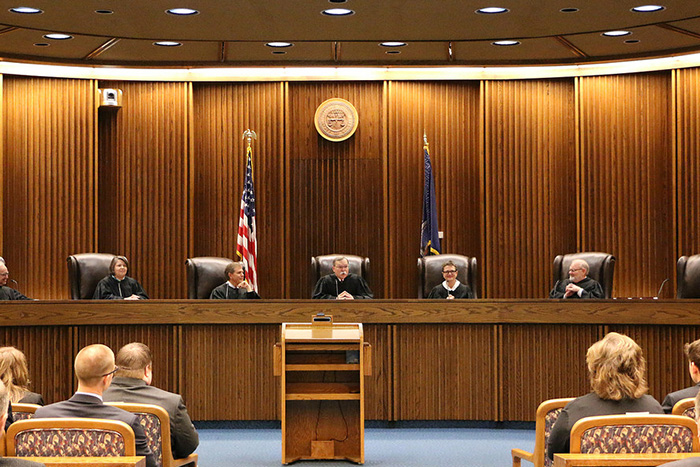
Eric Rosen
Rosen was appointed in 2005 by Gov. Kathleen Sebelius and is currently the chief justice of the seven-member court. Rosen, of Topeka, studied at the University of Kansas before getting his law degree at Washburn University. His background includes work in private practice and as a Shawnee County assistant district attorney. He’s also been an instructor at the Kansas Law Enforcement Training Center in Hutchinson. Rosen was a district court judge in the 3rd Judicial District for twelve and a half years before being appointed to the state supreme court. He received an 88% retention recommendation from the Kansas Bar Association.
Larkin Walsh
Gov. Laura Kelly named Walsh to the state’s highest court in 2025. Walsh, from the Kansas City metro, clerked for the Kansas Supreme Court from 2005 to 2008 before becoming a law clerk for the U.S. District Court for the District of Kansas from 2008 to 2012. She returned to clerk for the state supreme court in 2013 before moving to private practice in 2013. She got her law degree at the University of Kansas School of Law after an undergraduate English and studio art degree at Southern Methodist University. Walsh received a retention recommendation of 91%.
Kansas Court of Appeals
Lesley Ann Isherwood (Position 2)
Isherwood, of Wichita, was appointed by Gov. Laura Kelly in 2021. Before that, she was a senior assistant district attorney for the Sedgwick County DA’s office. Isherwood got her J.D. at Washburn University School of Law, and her undergraduate degree in English, also at Washburn. She received a 75% retention recommendation from the state bar association.
Amy Fellows Cline (Position 3)
Cline, appointed by Gov. Laura Kelly in 2020, joined the appeals court after 20 years litigating cases in private practice. A resident of Wichita, Cline received her undergraduate degree in political science at Wichita State University, followed by a law degree from the University of Kansas. She still maintains an office in Wichita and received an 83% recommendation.
Kim R. Schroeder (Position 5)
Schroeder was appointed to the appeals bench in 2013 by Gov. Sam Brownback after a career in private practice in southwest Kansas and as a district judge. He served 14 years as a district judge in the 26th Judicial district before his appointment to the appeals court. Schroeder attended community college in Liberal, Kansas, then received his undergraduate degree from Washburn University, where he also graduated from law school. He received an 89 percent retention rating.
Lori Ann Bolton Fleming (Position 7)
Fleming was appointed to the appeals court in 2025 by Gov. Laura Kelly. She graduated from Pittsburg State University with an undergraduate degree in music education and taught for a time at public schools in Leavenworth and Fort Scott before getting her law degree at Washburn University. From there, she served in private practice and was an adjunct professor and legal clinic director at Pittsburg State. She was a district judge and chief judge in the 11th Judicial District before becoming an appeals court judge. Fleming received a 91% retention rating.
Jacy Hurst (Position 13)
Appointed in 2021 by Gov. Laura Kelly, Hurst, of Lawrence, came to the court of appeals after a career as a business litigator in private practice with an interest in health care and employment law. From 2014 to 2017, she was general counsel and chief compliance officer for Swope Health Services, of Kansas City, Mo. Hurst, who is also an adjunct professor at the Washburn University School of Law, got her law degree at the University of Kansas School of Law and an undergraduate degree in business administration, also at KU. She received a 78% retention recommendation.
Johnson County District Court Judges

Keven O’Grady (Division 1)
O’Grady, of Prairie Village, was named to the district court bench in 2012 by Gov. Sam Brownback. He was in private practice for 25 years before that. He has served on state supreme court advisory groups on dispute resolution and access to justice and also has a background in family law. He got his law degree from the University of Kansas and undergrad at Rockhurst College. The Johnson County Bar Association evaluation gave him an 87% retention recommendation.
Rhonda K. Mason (Division 4)
Mason, of Olathe, was appointed in 2016 by Gov. Sam Brownback. Before that, she spent many years in private practice. She also worked in the Jackson County prosecutor’s office in Kansas City, Missouri, early in her career. Mason got her J.D. at Washburn University and an undergraduate degree in communications and history at Oakwood University in Alabama. She received an 86% retention rating from the bar.
Erica K.Schoenig (Division 5)
Appointed in 2013 by Gov. Sam Brownback, Schoenig came to the district court bench after six years in private practice. She was an assistant district attorney in Johnson County from 2001 to 2007 and is currently on the Johnson County Bar Association board of directors. Schoenig received undergraduate degrees from Wichita State University and her law degree from the University of Kansas. She received a 96% rating.
Christina Dunn Gyllenborg (Division 9)
Gyllenborg was appointed in 2012 by Gov. Sam Brownback. She began her career as a congressional intern for U.S. Sen. Robert Dole and was a law student intern prosecutor at the Johnson County District Attorney’s office before becoming an assistant DA there for ten years. She was in private practice from 2004 to 2012. She received her law degree at the University of Kansas after getting a bachelor’s degree in business, also at KU. The county bar association gave her a 99% retention rating.
Kathleen L. Sloan (Division 10)
Sloan, of Olathe, was appointed by Gov. Kathleen Sebelius in 2004. Her legal career includes 22 years as a district court judge, preceded by private practice and work as a staff director for U.S. Rep. Jan Meyers and legislative assistant for U.S. Rep. Larry Winn. She got her law degree from the University of Kansas and bachelor’s from George Washington University. She received an 83% rating.
Michael Patrick Joyce (Division 15)
Joyce, of Leawood, was an appointee of Gov. Sam Brownback in 2012 after 24 years in private practice. He got his J.D. degree at the University of Houston Law Center in 1988 and a Master of Judicial Studies at the University of Nevada in 2022. His undergraduate degree was at Creighton University in Omaha in 1982. He taught on the topic of criminal sentencing at the University of Missouri-Kansas City Law School from 1997 to 2001. He received a 71% retention rating.
Neil B. Foth (Division 16)
Foth, of Lenexa, was first appointed to the district court bench by Gov. Kathleen Sebelius in 2009. He previously worked in the third judicial district public defender’s office in Shawnee County from 1984 to 1987 before moving over to private law practice. He has held positions on legal groups concerned with family law, including the National Council of Juvenile and Family Court Judges and the Johnson County Family Law Bench-Bar Committee. He got his law degree at the University of Kansas and his bachelor’s in English, also at KU. His retention rating was 91%.
Thomas Kelly Ryan (Division 17)
Ryan, of Shawnee, was a Sebelius appointee in 2008. He served as assistant county attorney in Lyons County, Kansas, and assistant district attorney in Johnson County in the 1980s. He’s also been an assistant city prosecutor and a municipal court judge in Edgerton, Kansas, and was an assistant city prosecutor in Fairway before coming to the district court bench. He got his law degree at Washburn University and his undergraduate degree in journalism and mass communications at Creighton University in Omaha. His retention rating was 96%.
Timothy P. McCarthy (Division 18)
McCarthy, of Overland Park, was appointed in 2013 by Gov. Sam Brownback and was in private practice in the years leading up to his appointment. He is also the judge who presides over the county’s Veterans Treatment Court. McCarthy received his law degree at Washburn University and his undergraduate degree in journalism at the University of Kansas. His retention rating is 89%.
Jacquelyn Ellen Rokusek (Division 19)
Rokusek, of Shawnee, was appointed in 2020 by Gov. Laura Kelly. After fifteen years in private practice, she became a special assistant in the Kansas district of the United States Attorney’s Office. She worked in the Johnson County District Attorney’s office from 1994 to 1999. Rokusek got her law degree at Washburn and a bachelor’s in communication at Emporia State University. Her retention rating is 91%.
Magistrate Court
Jenifer Ashford (Position 1)
Ashford, of Prairie Village, was appointed magistrate in 2017 by the Tenth Judicial District Nominating Commission. She has been an assistant prosecuting attorney in Jackson County, Missouri, assistant circuit attorney in St. Louis, Missouri, assistant district attorney in Johnson County and municipal prosecutor in Shawnee and Lake Quivira. She got her law degree at the University of Kansas and her undergraduate degree at Kansas State University. Her retention rating was 81%.
 Thanks for reading! If you value having an independent news outlet keeping tabs on local government, schools and taxes, we're asking you to contribute to our Education Reporting Fund.