By Public Art Specialist Angi Hejduk
This fall, visitors to Cedar Niles Park can experience an unusual intersection of public art, recreation, and prairie restoration, all while exploring one of JCPRD’s newest parks.
JCPRD’s Art and Natural Resources Residency brings artists together with natural resource professionals to explore the intersection of art, ecology and our relationship with the natural world. Each year, artists immerse themselves in the work of caring for our parks, translating what they learn into creative experiences that invite the public to see these landscapes in new ways.
Artists Rena Detrixhe and Casey Whittier, JCPRD’s 2026 Art and Natural Resources Residents, have focused their work on native seeds, prairie restoration and the surprising ways people can participate in the natural process of seed dispersal.
Throughout their residency, they’ve explored a simple but intriguing question:
Can play also be an act of care?
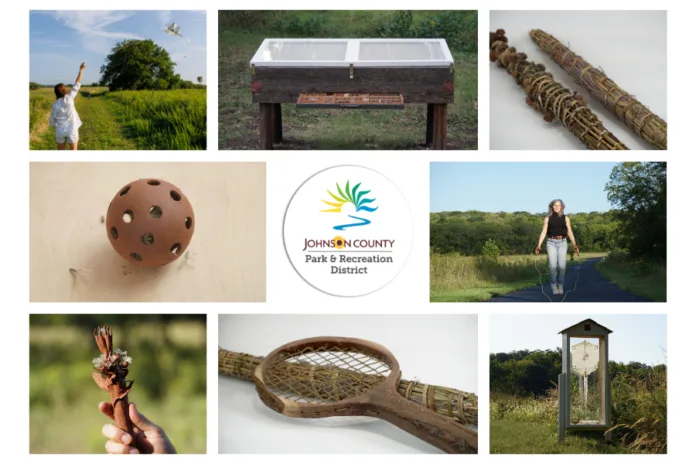
Their project turns familiar recreational activities, including Wiffle ball, badminton, jump rope, and kite flying, into imaginative ways of thinking about native plants, seed dispersal, and our relationship with the landscape.
Three custom display cases located along the trail near the 119th Street access contain recreational objects handmade from natural and reclaimed materials. Visitors will find Wiffle balls woven from plant material and filled with native seeds, bats woven from wild bergamot and big bluestem, badminton rackets made with walnut from Cedar Niles, jump ropes incorporating native plants and seeds, and more.
The installation will remain at Cedar Niles Park through May 2027, giving visitors an opportunity to watch the project, and potentially the landscape around it, change with the seasons.
Come for the Wiffle ball game
On Saturday, Oct. 24, from 2:30 to 4 p.m., visitors are invited to experience the project in action during a special Wiffle ball engagement at Cedar Niles Park, located at 25117 W. 119th St, Olathe.
The matchup pits Tap Roots against The Rhizomes, with special guests Sass-A-Brass adding to the fun.
But this isn’t an ordinary Wiffle ball game.
Detrixhe and Whittier designed the Wiffle ball diamond with prairie restoration in mind. The balls incorporate natural materials and native seeds, while the bases, home plate, and pitcher’s mound are made from earth and unfired clay embedded with seeds. As the game is played, seeds are dispersed throughout the site.
The artists imagine what is now an unremarkable field becoming something entirely different next spring: a place where native plants emerge and bloom.
Planning to join us? Since we’ll be gathering in the prairie, consider bringing a lawn chair for comfortable viewing, and applying a little bug spray before heading out. Then settle in and enjoy the game!
Stay awhile and explore Cedar Niles Park
The Wiffle ball game may get you there but give yourself some extra time to explore.
Start at the 119th Street access point and follow the trail into the park. After an easy stroll of just a few minutes, you’ll come to the first display case, filled with curious objects created for play and seed dispersal, including Wiffle ball and badminton equipment made from natural materials.
Just a few feet farther along the trail, you’ll find a second case featuring a handmade kite. Take a moment to look east from here. You can’t miss the Wiffle ball field, mowed directly into the existing prairie, where recreation becomes part of the landscape itself.
Continue west along the trail for a few hundred yards. On your right, you’ll find the badminton field. A handmade “net,” planned for installation in November, will incorporate native plants and seed-filled materials, creating places for birds to perch and opportunities for seeds to move into the surrounding landscape.
A few more steps down the trail, look to your left for one final case of curiosities. Peer beneath the glass to discover handmade jump ropes and be sure to open the surprise drawer filled with seeds.
Throughout the installation, look closely at the materials the artists used. Many were gathered from Johnson County parks and nearby natural areas, including walnut, redbud, big bluestem, rattlesnake master, and wild bergamot. Together, these playful objects invite visitors to think differently about recreation, restoration and the many ways people, plants, and wildlife can help move seeds across the landscape.
From there, keep exploring Cedar Niles. Walk or bike a stretch of trail. Look for birds. Notice what’s going to seed. See how many native plants you recognize. Bring a picnic or snacks and give yourself permission not to hurry.
The artists’ work provides a good excuse to slow down and look more closely at things we might otherwise pass without noticing.
And then come back
Perhaps the best part of this project is that your first visit doesn’t have to be your last.
Return in winter and see what the landscape looks like after the growing season has ended.
Come back in early spring and look for the first signs of new growth.
Visit again before the installation concludes in May 2027 and see whether you can spot evidence of the seeds dispersed through the project.
Detrixhe and Whittier created the residency around the idea that recreation and restoration don’t necessarily have to be separate. A walk, a game, a kite, or even a Wiffle ball can become an invitation to pay closer attention to the land around us.
At the heart of the project is a simple idea: Could getting to know our natural areas more intimately help us care for them?
At Cedar Niles this fall, finding out might be half the fun.
The 2026 Seeds of Change project marks JCPRD’s fifth Art and Natural Resources Residency. Established in 2022, the program brings artists together with natural resource professionals to explore important conservation themes and inspire new ways of connecting with our natural environment.
To learn more about this year’s residency and explore past projects, visit JCPRD.com/PublicArt.