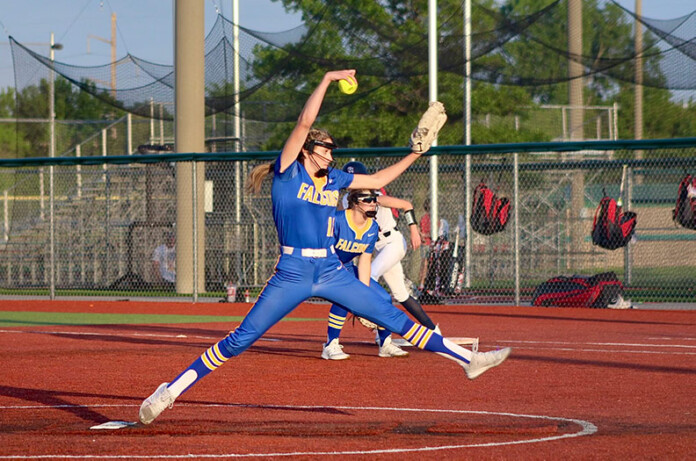
For decades, the Olathe Girls Softball Association’s partnership with the city provided fields and programming for generations of players.
Now, Olathe is reconsidering how that relationship should work, raising concerns among some coaches and association leaders about the future accessibility and affordability of the sport.
The city is evaluating proposals to operate softball programming at the Olathe Girls Softball Complex and the Lone Elm Complex. Olathe could select one operator or divide access among multiple organizations, including the Olathe Girls Softball Association.
The softball association’s backers spoke at the Olathe City Council meeting on Sept. 15, urging them to preserve the partnership.
“I ask you to look beyond the bid, look at the history, the investments, the volunteers and their families, and most importantly, look at the girls,” said Hailey Hess, the softball association’s newly appointed vice president, who played in the association as a child and now coaches her four daughters.
Representatives of the softball association warned that replacing nonprofit programming with a for-profit organization could make softball more expensive for families.
At the same time, the softball association is facing declining participation, financial losses and internal disagreements over how the association should be run.
Background
In 1983, the Olathe Girls Softball Association purchased about 16 acres at 151st Street and Pflumm Road for $109,200 to develop into softball fields, now the Olathe GIrls Softball Complex. Five years later, the association entered into an official partnership with the city to complete the complex, according to the 1988 contract.
Outlined in the agreement, the softball association would be responsible for preparing the site, building the fields, concession stands and restrooms. The city would then add permanent lighting, walkways, seating and landscaping.
The agreement called for the softball association to transfer the property to the city around April 1990. Olathe assumed the association’s remaining mortgage and additional development expenditures.
The complex would be for public use, with the softball association receiving priority scheduling. The city would maintain the facility. The softball association would operate its leagues.
It was this long-running partnership that led to backlash and confusion when the city issued a request for proposals for future programming last month.
Why now
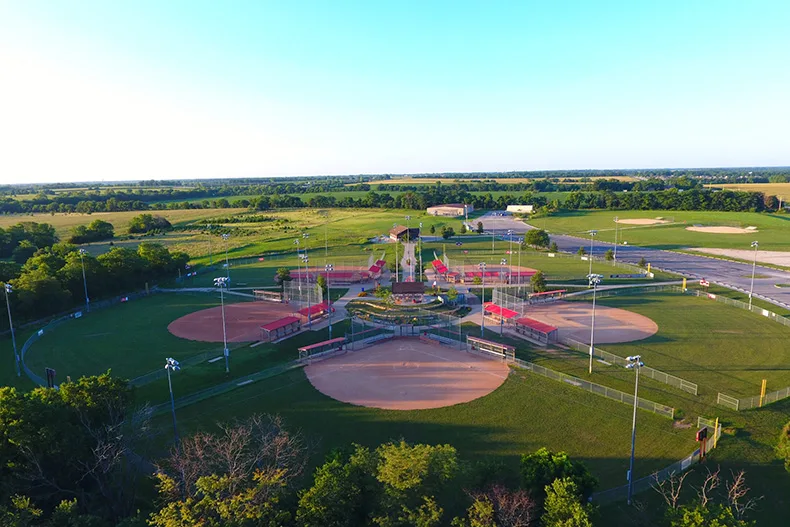
Secretary Darren Elliott of the Olathe Girls Softball Association said the city brought up a possible competitive bidding process at a meeting in December 2025, saying other organizations had expressed interest in the fields.
“When asking the questions ‘why?’, we’ve never gotten a clear answer other than, ‘We’re just doing something different,’” he said.
At the same time, declining participation was changing how much space the softball association needed, Elliott said.
Families and players can opt to play in a recreational league, which is for beginner and casual players, or competitive leagues that may travel for tournaments and require more time and money.
There is also some overlap. Competitive teams have also played in weekday leagues to get experience between weekend tournaments.
But Elliott said competitive teams increasingly want to practice during the week and play tournaments on the weekends, rather than play in weekday leagues.
Softball coach Steve Dickey, who was on the softball association’s board from 2021 to 2023, described the same shift.
Dickey said he believes the association was slow to adapt. He said frustrations with scheduling, communication and team favoritism contributed to his resignation.
He alleges that it was the softball association’s mismanagement that led to its current financial position.
Financial records show losses
The softball association’s publicly available federal tax filings show expenses exceeded revenue the past three years.
In 2023, the softball association spent $163,250 more than they earned. The deficit narrowed to about $73,000 in 2024 and $30,000 in 2025.
By the end of last year, the softball association was reportedly left with $22,916 in net assets.
A 2026 agreement between the Olathe Girls Softball Association and the city lists a $123,378 annual fee to Olathe, paid in six installments, for use of the facilities, as well as 5% of concession profits.
The filings don’t establish if the softball association missed a payment to the city or if its financial situation prompted the request for proposals.
The city hasn’t addressed the softball association’s payment history and has maintained that their goal is sustaining softball opportunities while responsibly managing public facilities.
“We value OGSA’s history, its volunteers, and the many families it has served,” the city said in a statement to the Post.
Elliott denied financial problems within the organization to the Post. He did say that declining league participation and tournament rainouts this summer have affected revenue, however.
What’s in the request for proposals?
The request for proposals asked for organizations to propose weekday leagues, weekend tournaments, exclusive seasonal use or a combination of programming at one or both complexes.
The city could award separate agreements by facility, type of programming or dates.
Proposals were due Oct. 7. The city’s tentative schedule for the request for proposals says contracts would be awarded this month, with an estimated start date of Jan. 1, 2027, and an initial three-year term
In the request, the city outlined how they will make their decision. “Company qualifications & experience” and “quality and feasibility of operational plan” were given the greatest weight. While “financial return, value to the city” was a lower priority.
“The overall goal is to keep quality softball opportunities in Olathe while being responsible stewards of public facilities,” the city said in a statement.
Elliott said his understanding of the process has developed since last month’s city council meeting.
“It’s about maximizing the use of those facilities,” he said.
The softball association submitted a proposal seeking its traditional tournament weekends, he said. It has rented unused dates to other organizations in the past. Elliott said he now believes the city wants to establish those relationships directly, while maintaining their partnership with the association.
What’s at stake

For Dickey, preserving opportunities for girls who are still learning the sport should still be the priority in the complexes’ next chapter.
The softball association has provided a bridge between recreational and competitive softball, he said, helping families find teams and opportunities to develop.
“There was enough of an ecosystem there that a family that didn’t know what they were doing could get into the league and get guided,” Dickey said.
At the September city council meeting, Hess, the association’s new vice president, stressed the importance of giving girls the opportunity to play the sport.
“These fields have taught young women more than just softball,” she said. “They have taught teamwork, discipline, perseverance, confidence, leadership and what it means to be part of a community, and I know that personally.”
Elliott said the softball association intends to continue even if it doesn’t win the city’s bid and that the board is exploring other options. Ideally, however, it could stay at those facilities.
“We put a lot of money and blood, sweat and tears into those fields for 40 years,” he told the Post.
 Thanks for reading! If you value having an independent news outlet keeping tabs on local government, schools and taxes, we're asking you to contribute to our Education Reporting Fund.