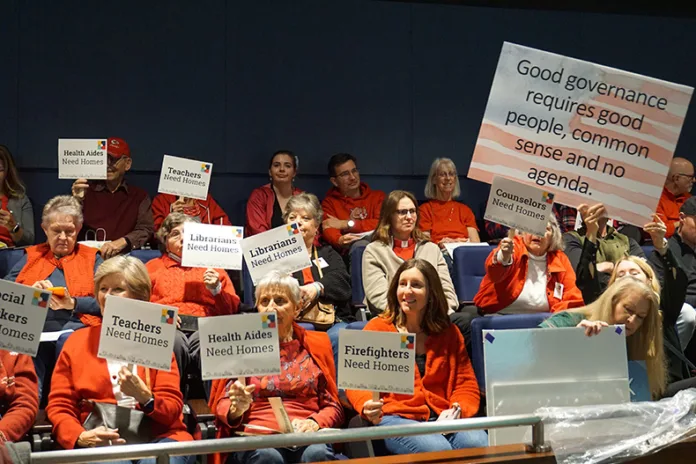
Note: The story has been updated with statements from Lenexa City Councilmember Chris Herron and Lenexa resident Jeff Cheek.
Kansas Attorney General Kris Kobach found five Lenexa city councilmembers discussed a large development project privately before a public meeting and vote in violation of state law.
On Sept. 16, Kobach’s office filed a finding of violation of the Kansas Open Meetings Act, or KOMA, a state law that requires meetings of state and local public agencies to be open and transparent to the public, against five Lenexa city councilmembers.
KOMA requires meetings between local public agencies to be open and notice be given to the public to avoid secret meetings or discussions.
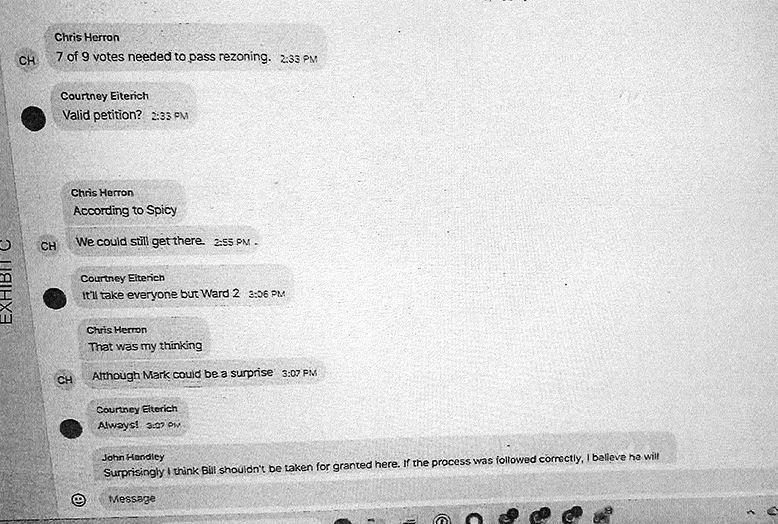
In their finding of violation, Kobach’s office details that Lenexa City Councilmembers Chelsea Williamson, Courtney Eiterich, Christopher Herron, Bill Nicks and John Michael Handley engaged in private discussions either in text messages and in person in February prior to voting on a rezoning ordinance and a preliminary plan for the Clear Creek Subdivision, proposed by Habitat for Humanity.
On Feb. 17, the Lenexa City Council voted 7-2 in favor of three different measures to approve the project. Councilmembers City Councilmembers Bill Nicks and Mark Charlton voted in dissent on all three.
The violations include, according to documents filed by Kobach’s office:
- A group text message on Feb. 10 where Williamson, Eiterich, Herron and Handley discussed whether the city council could get seven votes to approve a rezoning ordinance and a preliminary plan for the Clear Creek Subdivision, how Councilmembers Nicks and Charlton would vote, and how a motion to postpone should be handled.
- At 8 a.m. on Feb. 12, Herron met with Nicks to discuss the Habitat for Humanity project, including a motion to delay the vote to approve the project and division of the property within the Clear Creek Subdivision.
- After the meeting, Herron messaged the group text message thread the substance of his discussion with Nicks.
- At 11:30 a.m. on Feb. 12, Councilmember Williamson also met with Nicks to discuss the Habitat For Humanity project. During this meeting, they discussed the size of the proposed houses in comparison to the adjacent neighborhood.
As part of their punishment, the city councilmembers had to:
- Cease and desist from any future violations of the KOMA
- Comply with the provisions of K.S.A. 75-4317 et seq., and amendments concerning laws about public meetings for government affairs and business
- Identify and complete at least one hour of KOMA training
- Provide a written certification of attendance within ten days of the training
- Pay a civil penalty of $50. The penalty had to be paid by the individual and not from any public funds.
Lenexa Mayor Julie Sayers confirmed on Thursday to the Johnson County Post that Kobach’s office considered the matter “closed,” but declined to comment on the details of the violations.
In an email to the Johnson County Post, Herron apologized for the violation.
“I did not meet the standard the law requires of me as an elected official. To the people of Lenexa: I am sorry. I have completed the training required by the Attorney General and complied with the Attorney General’s order. I will follow the letter and spirit of the Kansas Open Meetings Act going forward,” he wrote.
Handley declined to comment on the violation in an email to the Johnson County Post. Williamson, Eiterich and Nicks did not return a request for comment.
Kris Kobach’s office did not return a request for comment.
The Kansas attorney general issues KOMA violations
Per Kansas Statute 75-4320d(a), the attorney general’s office has the authority to issue a finding of violation to a public agency like a city council.
The individual members of the public body are responsible for making sure they’re complying with KOMA rules, not the staff or its employees.
The ruling serves as a warning to members of governing bodies to adhere to Kansas laws and statutes, Kobach’s office stated in the KOMA violation filing.
“(The listed city counclmembers) fell below the expected standards for a public body or agency in complying with the KOMA. It also serves as a reminder that the individual members of a public body bear the burden to comply with the law and safeguard the public policy embodied by the KOMA,” they stated.
The Habitat for Humanity project has been controversial

Prior to the city council’s vote to approve the Habitat for Humanity project, six Lenexa residents filed a lawsuit against the city, declaring that city officials are selling parkland to Habitat for Humanity without giving them proper notice.
In the lawsuit, the residents stated, among other allegations, that City Manager Beccy Yocham held private meetings with the developer before the city council approved it.
In an email to the developers quoted in court documents, Yocham said she didn’t expect anyone from the public to attend.
“We did list it on our weekly meeting list, so it is technically an open public meeting, but I do not expect anyone from the public to attend,” she wrote in the email. “I will be sure to tell you if anyone is there that isn’t one of our team.”
Because the lawsuit is pending litigation, the city of Lenexa would not comment on the lawsuit, said city spokesperson Denise Rendina.
The city mentioned notice in a weekly meeting email sent out on July 11, 2025, that the Lenexa governing body would meet in July 2025 at Pathway Community Church in Olathe. That church spearheaded Habitat for Humanity’s neighborhood project Pathway at Heritage Park.
Jeff Cheek, one of the plaintiffs in the case, said he was feeling positive about the case.
“While we are grateful that Attorney General Kobach held them accountable for these backroom deals, our fight for transparency is not over,” he said in an email to the Johnson County Post. “The city expects residents to follow their rules, so we expect them to follow the law and respect our rights. Unfortunately, we are forced to continue our ongoing lawsuit against the city just to make them follow additional state laws regarding the sale or destruction of our parkland. They need to learn that they are not above the law and we are committed to holding them accountable.”
The case is set for a ruling in Johnson County District Court at 10:30 a.m on March 31, 2027. Judge Catherine Triplett is presiding over the case.
 Thanks for reading! If you value having an independent news outlet keeping tabs on local government, schools and taxes, we're asking you to contribute to our Education Reporting Fund.