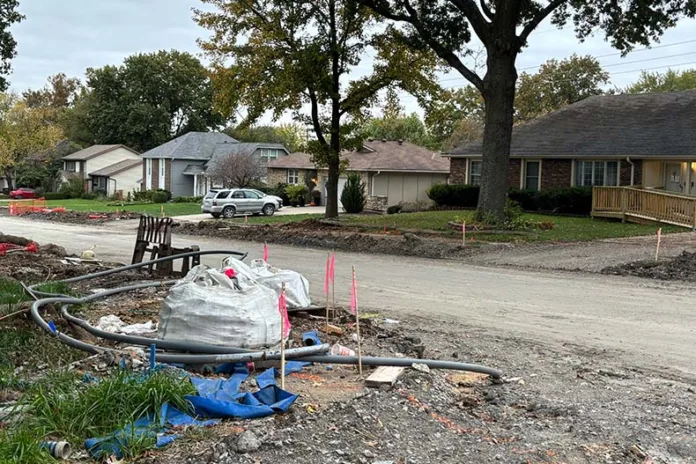
For about 15 years now, Overland Park has been chipping away at a backlog of repairs to aging neighborhood streets that are in need of replacement or otherwise nearing the end of their functional lives.
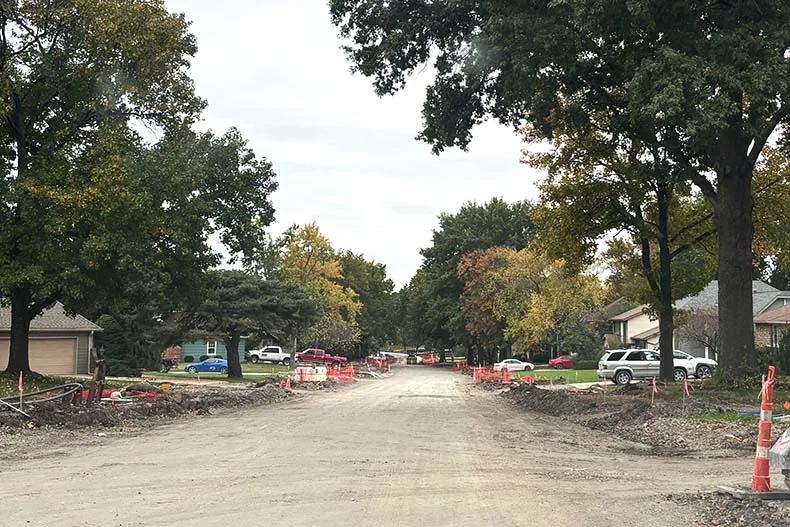
The projects, though necessary to replace streets that are in some cases 60 years old or older, can be hard on residents who must live through months of intense work just outside their homes. In the end, the work can leave their streets completely unrecognizable, with wider concrete roads and fewer mature trees that provide shade.
“We’re working in neighborhoods that were built, you know, well over 60 years ago, and we are doing our best to bring them to our best practices today,” Public Works Director Lorraine Basalo has said previously.
So, with an updated resolution, Overland Park is hoping to head off some of the impacts in future neighborhood street reconstruction projects. All of that could spell less impact for neighbors going forward.
How does the neighborhood street reconstruction program work?
Overland Park’s neighborhood street reconstruction program, sometimes shortened to NSRP, targets streets that are considered to be failing based on the city’s pavement condition index, which is developed through regular inventories.
The state of the infrastructure below the road, the effectiveness of recent street maintenance treatments like chip-seal and the relative age of the street are also factored into decision-making.
Recently, Overland Park accelerated its program, dedicating about $10 million more per year starting in 2026, following recommendations from the Infrastructure Advisory Group.
Since the program was first established in 2011, Overland Park has replaced about 45 lane miles or neighborhood streets, with another 24 lane miles expected to be completed in the next couple of years.
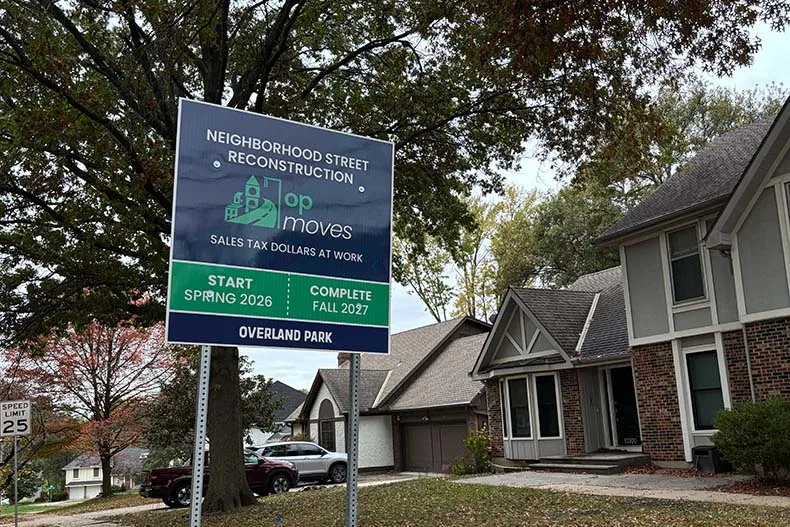
Still, some 130 lane miles of neighborhood streets will need replacing in the future, and more miles are added to the list each year.
That brings the annual allocation for neighborhood street repair to about $16.5 million, enough to complete up to 10 lane miles each year. Before, Overland Park completed roughly four lane miles annually.
Neighborhood street rebuilds can be disruptive
The projects themselves are often disruptive and can be headache-inducing.
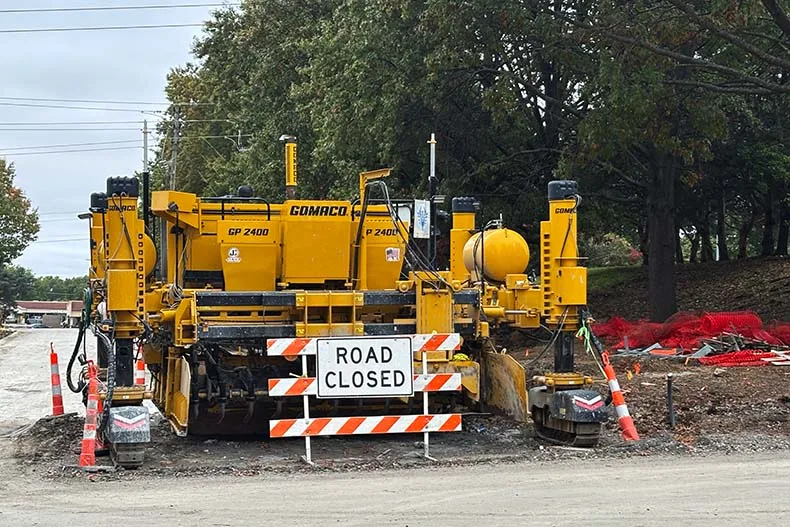
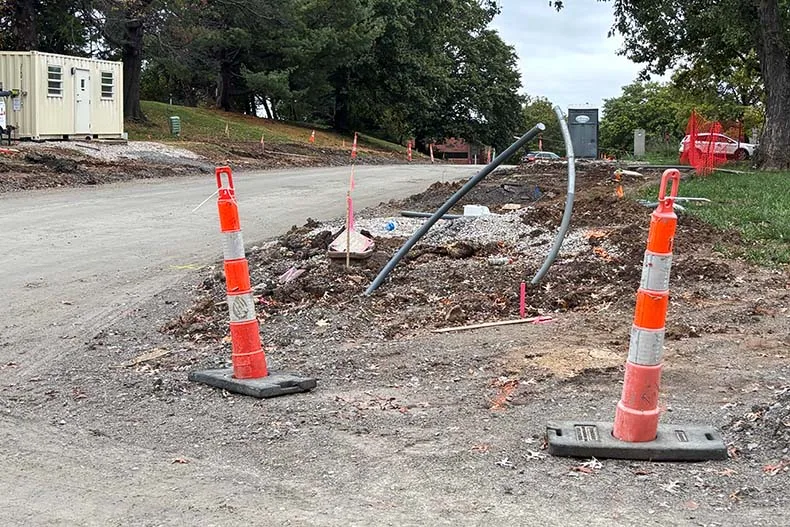
For one thing, neighbors who live in a neighborhood during a reconstruction project can expect to see the street in front of their home closed for weeks. Eventually, every street in a neighborhood will be closed at one point during the process for a full replacement.
That’s because the old asphalt street itself and the infrastructure under it will need to be completely removed. Sometimes, that can require significant grading changes, street widening, street tree removals and other changes.
Then, the street is repaved in concrete, under new neighborhood street requirements.
Project can take a year to complete, if not longer, depending on utility relocation or upgrade needs in the area, the scope of the project and any other infrastructure improvement work that may need to be completed alongside it.
“It really is an intense project,” said Kyle Dieckmann, deputy city engineer, during a Public Works Committee meeting earlier this year.
Basalo agreed, calling neighborhood street projects “the most impactful” work the city does, pointing to the “firsthand” disruptions neighbors feel while it’s happening.
Often, when it’s all said and done, a neighborhood street can feel completely different afterwards, with a brand new concrete street, towering street trees replaced by spindly saplings and sidewalks where there may have been none in the past.
In the Quail Ridge neighborhood, where a neighborhood street reconstruction project is planned for 2027, residents have already started voicing their concerns about some of what’s proposed.
Myrtle Stiaszny, who has lived in the same cul-de-sac for more than 40 years with her husband, is particularly concerned that, under the old rules that govern neighborhood street reconstruction in Overland Park, crews will be required to add sidewalks where there hasn’t historically been one, including in her cul-de-sac.
“All of us agree that we do not need a sidewalk and we do not want a sidewalk on our cul-de-sac,” she said during public comment at an Overland Park City Council meeting earlier this year.
Stiaszny also said the neighborhood doesn’t like the idea of replacing some of the existing sidewalks in Quail Ridge with the new concrete street because they would require the city to remove at least a dozen mature oak and maple trees. She called it “an environmental catastrophe.”
At the city council meeting in August, Stiaszny urged the city to reconsider the street reconstruction rules that imposed these standards in the first place.
What’s changing?
At the time Stiaszny spoke at the city council meeting over the summer, the Overland Park City Council’s Public Works Committee had already started the process of rewriting the ordinance in a bid to cut down on some of the very impacts Stiaszny and her neighbors were fretting over.
“I think we’ve come up with a really good product here,” said Councilmember Logan Heley, who chairs the committee.
Under the new ordinance, which the city council officially adopted on its consent agenda last week, the city made some changes that could save more mature trees, cut down on long-term changes to a street’s profile and create more flexibility in the future.
For starters, the new standard requires a tree survey, which will inventory the location of each tree that could be impacted by a project, its species, size and general status. That’s something the city had been trialing, but the new resolution makes it a formal requirement.
At the same time, there are new standards intended to limit the removal of trees when possible and to replace any lost trees, to maintain or improve the neighborhood’s overall tree canopy.
On top of the tree preservation changes, the city is changing how it handles when to widen a neighborhood street during reconstruction. Now, a street will only be widened if it is narrower than 26 feet from the back of each curb. Some streets may also be narrowed if they are wider than the 28-foot maximum standard, Basalo said.
Overland Park will also add a new requirement to conduct a speed study on a neighborhood street that will be reconstructed to determine if traffic calming may be needed.
Additionally, the new resolution has additional selection criteria for picking which neighborhoods will have their streets rebuilt and when. Things like stormwater infrastructure condition and traffic safety — currently considered secondary factors — could be added into the equation, too.
“We felt [it] gave us a good way to balance when we might have similar circumstances in two neighborhoods,” Basalo said.
All of these changes are now part of “the new guide” that will be used in the Overland Park neighborhood street reconstruction program going forward, Basalo said at the October Public Works Committee meeting.
Read the full redlined resolution here.
Keep reading: When Overland Park streets are rebuilt, older trees often have to go. Could more be saved?
 Thanks for reading! If you value having an independent news outlet keeping tabs on local government, schools and taxes, we're asking you to contribute to our Education Reporting Fund.