The future of downtown Merriam will soon be in the hands of voters.
On Monday, the Merriam City Council approved ballot language putting a 10-year, half-cent citywide sales tax before voters in the spring. Residents will be asked to approve the levy, which is projected to generate about $52 million over its lifespan, to help pay for long-discussed downtown improvements.
If approved, the special sales tax revenues will go towards implementing one of two visions for the downtown area’s future laid out in a new downtown master plan that the Merriam City Council also unanimously accepted on Monday, along with approving the sales tax ballot language.
Both visions project tens of millions in costs for developing downtown and mitigating against future flooding.
If voters reject the sales tax, the city plans to implement a much less extensive and less costly third option for downtown, which features little to no flood mitigation. (Take a deeper look at all three visions in our previous coverage here.)
The decision to put downtown’s future on a March mail-in ballot comes as the city council also unanimously approved discontinuing Merriam’s 26-year-long partnership with the U.S. Army Corps of Engineers, in a third separate vote on Monday.
City Administrator Chris Engel told the city council that city staff recommended ending the partnership due to several factors, including the “economically unjustified” benefit-cost ratio. The cost of the Corps’ projected work to guard against flooding in downtown Merriam had increased from roughly $37 million in 2015 to nearly $250 million by this past summer.
While it is “disappointing” to walk away from the work after 26 years, Engel said, the process worked itself out and “there’s really nobody to point the finger at.”
“This recommendation that staff is making is really not a criticism of [the Corps],” Engel said. “We’ve asked them to help us run this concept to ground, and we’ve run it to ground.”
Why a special sales tax?
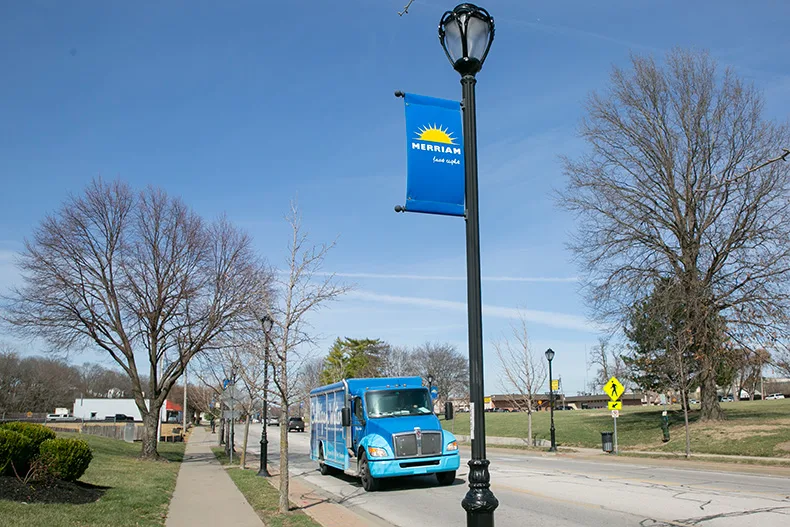
As a downtown master plan came into focus this year, the city floated a special sales tax as a way to help pay for the millions of dollars worth of changes that will be called for with a downtown overhaul.
Engel told the city council at previous meetings this year that the city’s pull factor, or non-resident, draw to its retail corridor defined by IKEA and car dealerships, is the city’s “superpower.”
The idea behind the special sales tax, then, is to leverage that “superpower” for downtown improvements.
Earlier this month, the city council landed on a half-cent sales tax that would be approved by Merriam voters in a mail-in ballot election in spring 2027, after it considered a range of options, including quarter-cent and 3/8-cent levies.
The half-cent sales tax is expected to generate about $52 million in revenue over a decade. It also generates the largest amount of money from non-residents at $43.1 million, according to city estimates.
Other potential funding sources to complete the plan include county cost-share programs for stormwater, flood control and street portions of the plan, federal and state grants for local art and other improvements, or leveraging development incentives, according to the draft master plan.
On Monday, the city council unanimously approved moving the special half-cent sales tax forward to a ballot measure in spring.
What a “yes” vote could mean
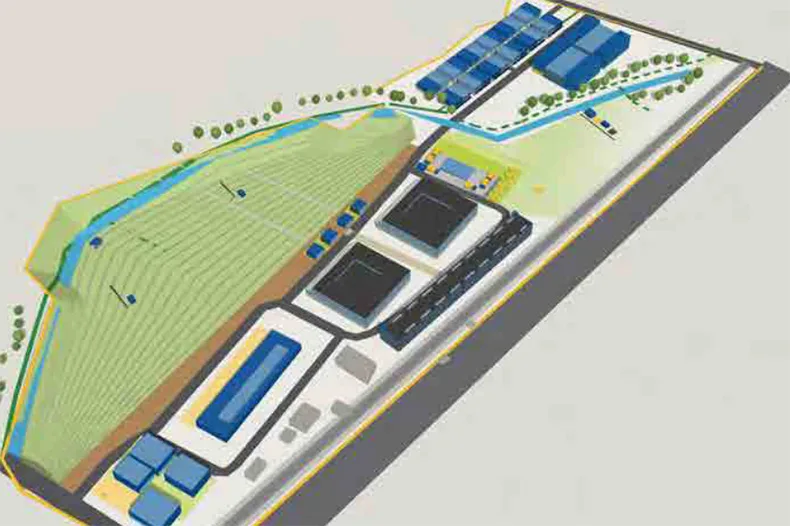
Since the beginning of the year, the city has worked on a downtown master plan draft, with stakeholder meetings, a steering committee, surveys and more.
The draft master plan features three different and increasingly drastic visions for changing downtown.
If voters approved the half-cent sales tax in March, then the city will move forward with one of two visions, dubbed Vision B and Vision C, in the master plan approved Monday.
The estimated costs for each, respectively, are $122.3 million and $196.3 million.
The downtown master plan steering committee recommended Vision C, which calls for the most drastic (and most expensive) changes.
Both options, as first proposed by Overland Park-based engineering firm HNTB in May 2025, remove all existing structures from historic downtown Merriam between the Johnson and Merriam drive bridges.
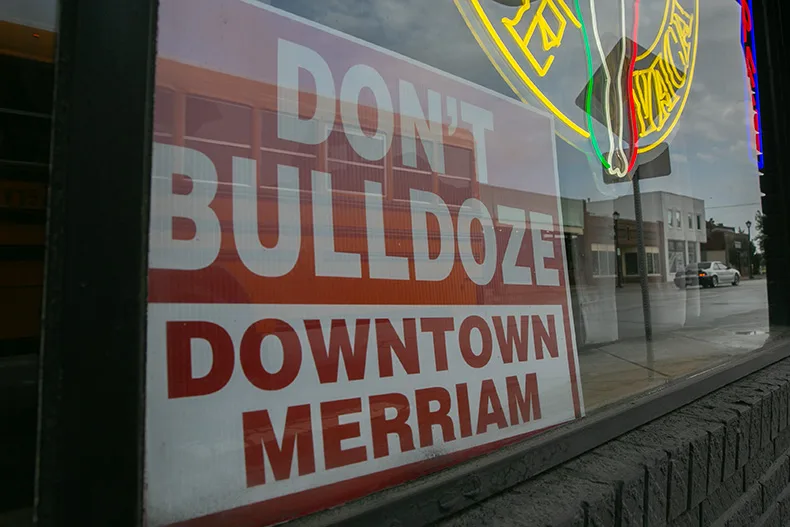
Downtown business owners have pushed back on HNTB plans that call for removing their buildings, now with signs popping up in storefronts and in yards that read “Don’t bulldoze downtown Merriam.”
Vision B, priced at roughly $122 million, uses the HNTB “no-rise” plan and features the following, as outlined in the draft master plan:
- Flood storage west of Merriam Drive removes 30 of 50 acres out of the floodplain
- Adds about 685 housing units in and around downtown by 2050
- Adds between 251,000 and 265,000 square feet of commercial space by 2050
- Allows for a three-level parking garage with about 530 parking spots
- Creates a 12-hour, six-day downtown experience
- Highly disrupts existing owners
Vision C, priced at nearly $200 million, uses the HNTB “full-build” plan, and calls for the following, as outlined in city documents:
- Removes 44 of 50 acres out of the flood plain
- Adds 830 housing units in and around downtown by 2050
- Adds between 270,000 to 284,000 square feet of commercial space by 2050
- A four-level parking garage with about 710 parking spots
- Creates an 18-hour, daily downtown experience
- Disrupts existing downtown owners more than any other vision
If voters approve the special half-cent sales tax in March, the city will take that as a sign of support for either vision B or vision C, according to city documents.
What a “no” vote means for downtown Merriam
A “no” vote doesn’t necessarily mean nothing will happen in downtown Merriam.
Earlier this month, the city council voted7-0 to eliminate a “do nothing” option for downtown, meaning some sort of investment will still be made in downtown Merriam, even if voters reject the special sales tax in March.
A “no” vote, then, will likely mean that the city would move forward with a third vision, dubbed “Vision A” in the downtown master plan draft master.
Vision A comes at a projected cost of $19.8 million, according to city documents, and features the following:
- The removal of 16 of 50 acres out of the floodplain
- Adds about 250 housing units by 2050, north of Turkey Creek
- Adds between 179,000 and 189,000 square feet of commercial space by 2050
- Keeps the downtown experience to weekdays
A “disappointing” end to Corps partnership
For years, the city has worked with the Corps to plan for the remaking of downtown Merriam.
The partnership with the U.S. Army Corps began with a feasibility study in 2000, which came at the request of the city following $50 million worth of damage along Turkey Creek caused by floods in 1993 and 1998, according to city documents.
In 2015, the Corps finished that feasibility study with an estimate that necessary flood mitigation work would cost $37.8 million. The local match, to be shared between the city and county, was $13.2 million at that time, Engel said on Monday.
By this past summer, however, the project’s estimated cost had ballooned to $247.5 million as the plan’s scope increased.
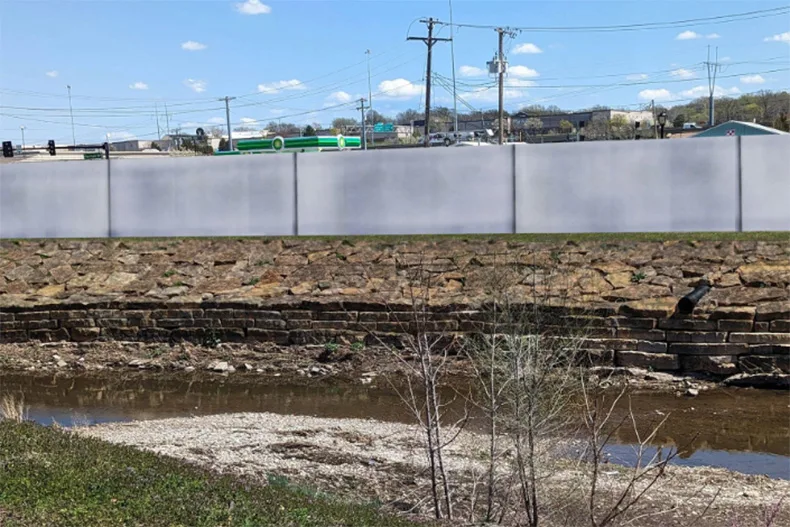
The Corps’ project included more than 6,000 feet of floodwall ranging between 6 and 12 feet tall; 740 feet of earthen levee, ranging between 10 and 14 feet tall; a 72,000 square-foot detention basin and the demolition of 17 buildings in the downtown area.
In June, some residents pushed back against the Corps’ project, calling it “devastating.”
Engel told the city council on Monday that aside from construction costs going up generally, the major increase from the 2015 estimate was attributable, in part, to the increase in the proposed detention basin from 20,000 square feet to 72,000 square feet, a plan to replace both the Johnson and Merriam drive bridges in downtown, and, in some cases, doubling or tripling the height of the proposed floodwalls.
Engle said the plan eventually grew to be “economically unjustified.”
To date, the city has paid $857,065 for the Corps’ feasibility study and design costs, Engel said. The city will retain all data and information that came from the years of study and designs, he said.
Councilmembers Whitney Yadrich and Chris Evans Hands agreed that it has been “disappointing” that the data is all the city has after nearly 30 years of work.
For others like Councilmembers Jacob Laha and Bruce Kaldahl, working with the Corps for as long as the city did made the most sense at the time.
“The reality of it is, if you’re going to do flood mitigation in this country, (the) Corps of Engineers is the people to do it,” Kaldahl said. “If we would’ve not played this option and gone off in some other direction, boy, there would be opportunity there to be second-guessed. I don’t really see that we had a lot of choice but to do what we did.”
Keep reading local government news: Leawood council rebuffs last-ditch effort to save historic city hall
 Thanks for reading! If you value having an independent news outlet keeping tabs on local government, schools and taxes, we're asking you to contribute to our Education Reporting Fund.