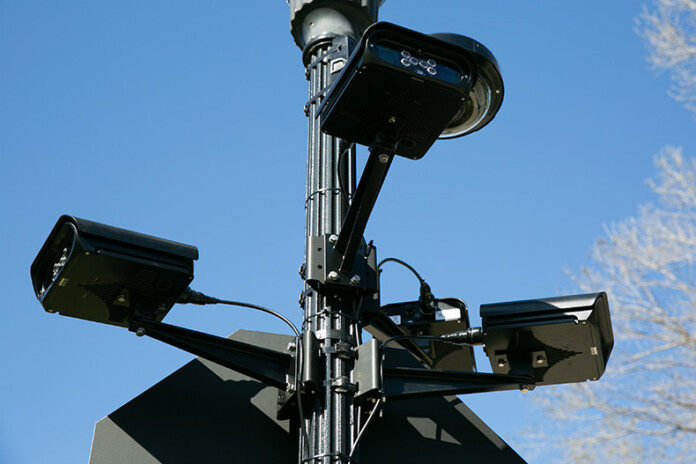
Shawnee is adding 11 more license plate readers around the city, courtesy of a federal grant.
On Monday, the Shawnee City Council voted 5-1 to approve a nearly $70,000 purchase of License Plate Recognition equipment from the Merriam-based Electronic Technologies Inc. Councilmember Tony Gillette was in dissent. Councilmembers Kurt Knappen and Sierra Whitted were absent.
The purchase is the result of an $83,000 federal grant under the COPS Technology and Equipment Program Invitational Solicitation for Fiscal Year 2023, which allows police departments to purchase equipment to assist in responding to and preventing crime, according to city documents.
About $11,000 of the grant was previously used to purchase mobile license plate readers, said Capt. Nick Pike of the Shawnee Police Department during the meeting.
Shawnee Police has been using readers since 2010
The Shawnee Police Department started using mobile license plate readers in 2010 and installed about 11 fixed cameras in 2019.
The cameras have been instrumental in helping track and prevent crime, Chief Sam Larson said at the meeting.
“We use them daily to prevent (crime) and when crime occurs, we use it to help catch the people and get property back to the owners,” he said.
The cameras will be placed in “strategic locations based on crime data,” according to city documents.
During the past decade, the technology has also been adopted by other police departments in cities like Prairie Village, Roeland Park and Merriam.
How the license plate readers would work
The automated license plate readers use cameras to rapidly photograph license plates on vehicles going through an intersection.
The plate numbers are run through a database and flagged if they are registered as stolen or the vehicle is connected to an alleged crime or public safety concern, like an Amber or Silver Alert.
The Shawnee Police Department stores the data on its servers for a limited time. Once the retention period ends, the images are deleted.
A councilmember expresses skepticism
While Gillette praised the police department and clarified that his thoughts were not meant to disrespect their service, he questioned the effectiveness of the cameras.
“Can you give us a percentage of the crime that has been solved by these devices that you can attribute to, annually, over the last 11 years?” he asked Larson.
Larson responded: “No, I can’t. We don’t look at (that), percentage-wise. I can tell you that any major crime that occurs in Shawnee, the system is utilized for that. We have used this system to track suspects on very serious … felonies, that would include sentencing, could include life sentences, and we were able to quickly arrest subjects around the area and also track them to locations well outside of Kansas City.”
While Gillette still voiced his support for the police department, he didn’t see the need for more cameras.
“This is not a knock on the department in any shape, matter or form,” he said. “I believe it’s just better that we have more feet on the street than more cameras on the corners.”

Councilmembers worry about personal freedoms
Gillette worried that more cameras around the city would lead to “Big Brother spy tactics” and more rights being taken away from residents.
“As we continue to see personal freedoms erode and constantly chipped away at every government level, I can’t help but be reminded by the presumption of innocence, as recognized as an individual’s Due Process rights under the Fifth Amendment of the Constitution,” he said. “Our justice system is based on the foundation that you are innocent until proven guilty, not the other way around.”
Not completely sold on the potential purchase, Councilmember Mike Kemmling questioned Larson on how data is stored and how long police hold onto it.
“It is stored locally on our system,” Larson said. “It is not tied into another system that is searchable by whoever. It’s on our system that [only] we can search.”
Larson added that the images are kept on Shawnee police servers for a limited time before they’re erased.
“My biggest question on this was just the privacy and the data of the individuals that are not committing crimes, that are just driving around,” Kemmling said. “If you’re telling me the data taken is not transmitted outside of Shawnee and is only stored for a short period of time, I think I feel somewhat better about it, just having that explanation.”
Other license plate reader news: Mission Hills adding more license plate readers — Find out where