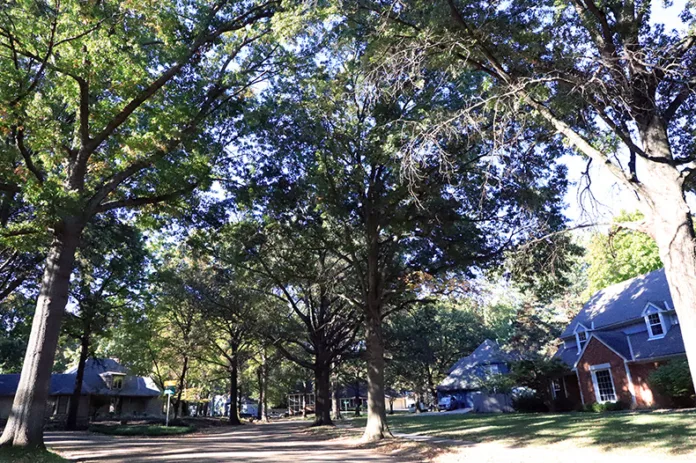
Cities across Johnson County have spent the last several years and millions of dollars removing doomed ash trees that were dead or dying from emerald ash borer infestations.
Now, some local foresters and arborists are warning that another illness could pose a threat to mature trees that line streets and provide shade in local yards.
Oak wilt is a fungal infection that can rapidly wipe out an oak tree after it becomes infected. It harms a tree’s vascular system, tricking it into blocking its own water vessels, and the disease can spread to other trees through insects or underground root connections.
“The big problem with oak wilt is that when it gets in a huge population of oaks, it can spread,” said Mike Katzer, a forester from the city of Olathe.
At a recent Overland Park Community Development Committee meeting, forestry staff and members of the city’s Legacy of Greenery Committee warned that oak wilt was an emerging concern for the city’s trees. It’s particularly lethal for varietals of red oaks, like the pin oak that Overland Park has long considered its official city tree, and makes up the majority of some cities’ tree canopy.
Bailey Patterson, an Overland Park city forester, said the illness is not widespread locally, but it is certain death for an oak tree that gets infected.
“There’s no coming back from that,” she said, adding that she and her colleagues are especially concerned about finding a case in one of the many neighborhoods that have their streets lined almost exclusively with oak trees. “If one tree goes, then it could impact the next tree, and then that one’s infected and can infect the tree next to it.”

Multiple cities have seen cases of oak wilt in the last several years, including Overland Park, Prairie Village, Mission Hills and Leawood. Overland Park has had at least three cases confirmed this September alone, two of which were at the Indian Creek Recreation Center.
Prairie Village hasn’t had any confirmed cases this year as of late September, but Bridget Tolle, Prairie Village’s city arborist, said the city has had some recent years with multiple cases.
What does oak wilt look like?
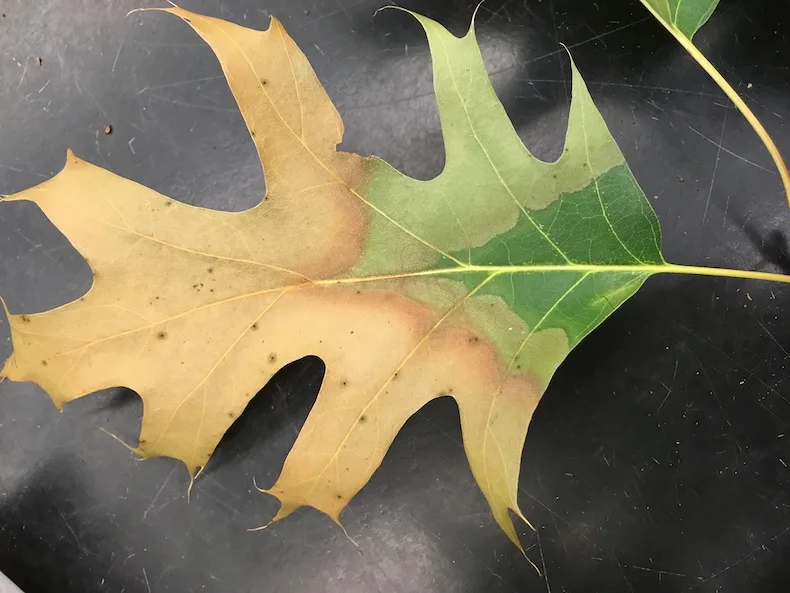
The first sign of oak wilt is usually the premature turning and dropping of leaves from the upper canopy, Tolle said.
Patterson said large sections of a tree’s leaves will quickly start to turn brown. Trees infected by oak wilt will see their leaves turn brown and fall off more suddenly than is typical with annual autumn leaf-falling.
Individual leaves on infected trees will also tend to be only half brown. Shad Hufnagel, the forest health coordinator for the Kansas Forest Service, said oak wilt-infected leaves will have a “scorch appearance.”
The only way to confirm oak wilt is through laboratory testing via the Kansas State University Diagnostic Lab.
People who suspect a tree is infected should contact their city’s forestry or arborist division, especially if it is a street tree in the public right-of-way. If it’s a tree on private property, you will also need to contact a tree care company with a certified arborist to take samples for testing or the Johnson County Extension Office.
More severe infections of oak wilt will result in fungus being visible on the bark, which has a “fruity smell,” said Katzer, the Olathe forester.
Oak wilt can take as little as a year to kill a tree
Unlike with ash trees, proactive removals aren’t on the table since the spread from tree to tree is less certain with oak wilt. For one thing, the beetle that transports it can’t fly, like the emerald ash borer can.
“With this being a fungus, there’s no guarantee that it’s going to be transported,” Patterson said. “If that oak tree is just alone in the front yard and there are no other oak trees at the neighboring properties, oak wilt might just die with that tree and never be a problem.”
Still, Patterson said it takes about one year from the first symptoms for a red oak to succumb to oak wilt. Other varietals of oak trees might hang on for a few more years, but they will also eventually die.
These trees and their residual stumps need to be removed after oak wilt is confirmed to keep the fungus from spreading. Additionally, the resulting wood needs to be hauled off, and it’s best not to use it for firewood since the fungus can linger, Tolle said.
There is an injectable fungicide prophylactic for oak wilt, but it’s only recommended if a nearby tree has already been confirmed to be infected with the fungus, said Dustin Branick, Leawood’s superintendent of parks, in an email. Those treatments are costly and can be intensive to administer.
Hufnagel with the Kansas Forest Service said “the best course of action” is to prevent the infection in the first place. The easiest way to do that is to make sure you’re pruning your oak trees at the right time.
Trees that are pruned in the growing season — usually between April and October — are more susceptible to infection due to an open wound that the spreading beetle can be attracted to and enter through, Patterson said.
Tolle said the best time to prune an oak tree is during the winter, when the beetle is not active. That would also give the tree time to heal before the beetle comes back around.
More tree diversity will lessen pest impacts, experts say
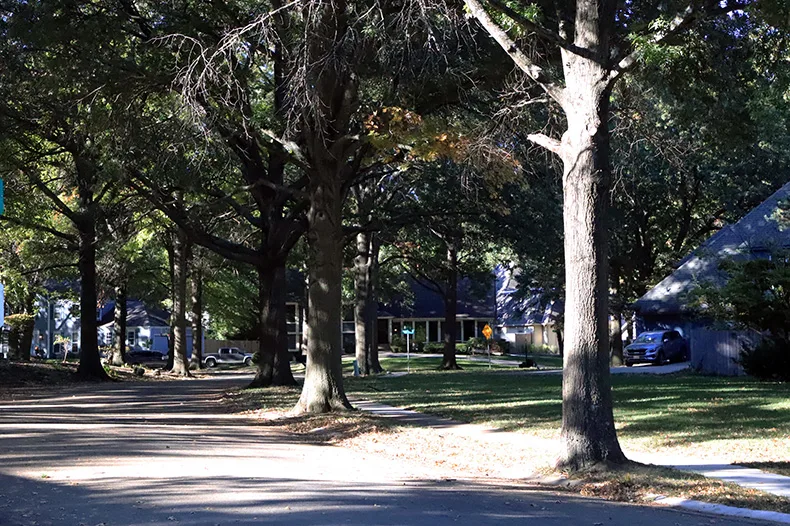
Tolle from Prairie Village said the threat of oak wilt and other pathogens and the risk they pose to the wider tree canopy are a reminder that species diversity is important and “helps with resiliency.”
“Genetic diversity is what we need,” she said. “So when we are planting new trees to replace any oaks that we are losing due to oak wilt or other diseases, and it’s a good idea to plant something new, something more diverse.”
She’s not alone. Jim Dunn, former chair and current member of Overland Park’s Legacy of Greenery Committee, offered a similar sentiment.
“It’s another reason why having a variance in the population of our canopy is so important,” Dunn said.
He is glad to see cities — particularly his hometown Overland Park — planting more diverse tree species as they’ve replaced dead or dying trees since a more varied canopy will keep pests or illnesses from wiping out the entire tree canopy in neighborhoods and wide swaths of the community.
“We won’t prevent the pests, but the devastation will be more manageable,” he said. “What we can do is have enough variance in the healthy tree canopy that we are able to avoid the devastation that we’ve seen with the emerald ash borer.”
Keep reading: Overland Park has replanted thousands of trees. Now, officials worry they aren’t getting the proper care.