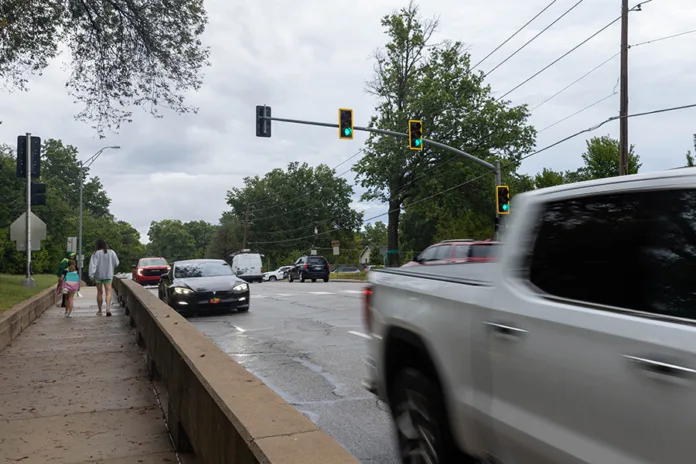
It keeps happening. A youngster is riding a bike or a scooter or maybe just walking on the sidewalk to school and something goes wrong. The child wobbles near traffic just a couple of feet away, or maybe gets hit by a driver hooking a turn.
In August, a 13-year-old boy on a motorized scooter on a sidewalk was involved in a crash on 143rd Street in Leawood while attempting to cross the entrance to an elementary school, according to police.
He was sent home from the hospital to recover. But almost a year ago, the outcome for another boy on a scooter was far worse. Duke Ommert, 10, died from his injuries Oct. 17 after being hit by a car, also in Leawood.
Duke’s death was a catalyst for a long conversation about pedestrian safety that Leawood is still having today. One of the results of that was on display in early September at an open house for the city’s participation in a federal program aiming to reduce the number of traffic fatalities and serious injuries to zero.
With a $452,000 federal grant augmented by state and city funds to $565,000, Leawood has been working on the Safe Streets For All program. It involves a study of all aspects of city traffic from sidewalks to crossings to street lights to bike lanes and beyond.
The aim is to find ways to make the roadways and sidewalks safer and then set an action plan to start making those changes.
The project so far has included some research by consultants Burns & McDonnell and Kimley-Horn. Now the city is in the public input stage.
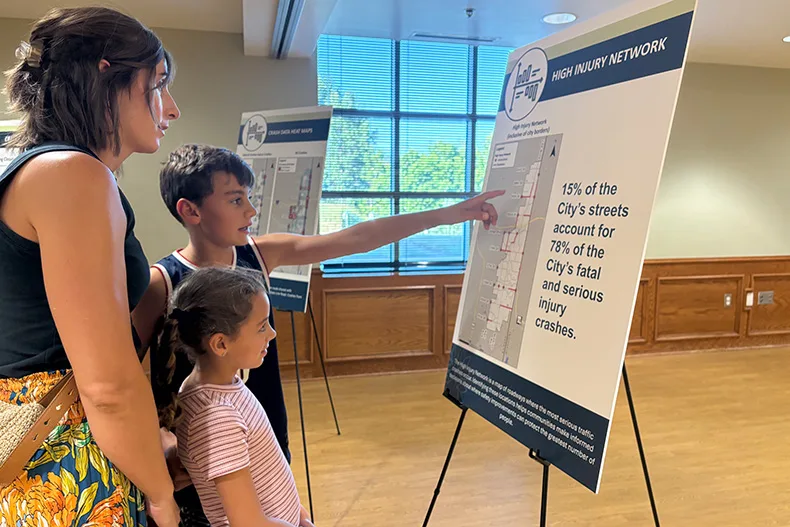
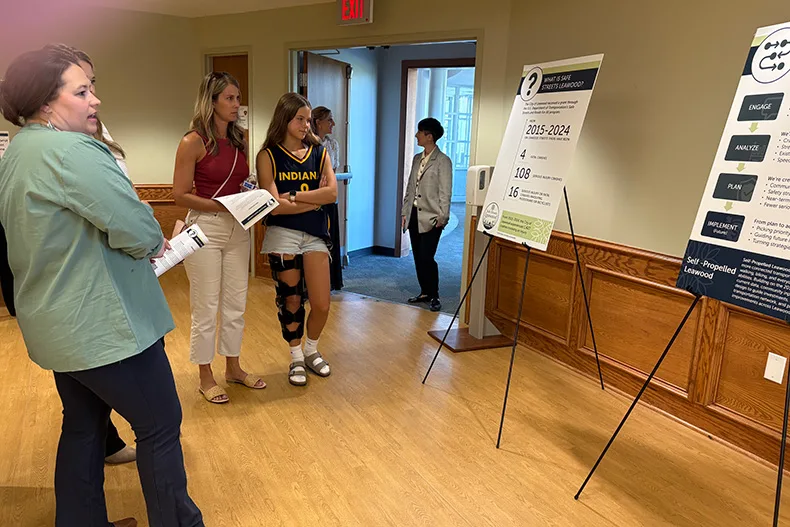
Easels around the open house meeting room in Leawood City Hall showed some key statistics:
- 15% of the city’s streets account for 78% of the fatal and serious injury crashes.
- Vulnerable road users (walkers, bike and scooter riders and anyone not protected by the metal shell of a car body) are disproportionately represented in the fatal and serious crashes. They are involved in only one percent of all crashes but 15% of fatalities and serious injuries.
- Young drivers are involved in 43% of all crashes but only 28% of the crashes that result in fatal or serious injuries.
- Heat maps for fatal and serious accidents showed the most red dots at Lee Boulevard and on 135th Street.
Turnout was light, with fewer than 30 visiting by the time the open house was more than half over.
Beth Strobel and Shana Horseman, who each have first-graders at Brookwood Elementary, said their current route to school along 103rd Street has no margin for error because the cars are so close to the sidewalk.
Horseman said a car popped up on the curb dangerously close to her just a few days before the open house as she was walking back from the school. “I would hope that the sidewalks could be safer,” she said.
Strobel’s older daughter, Sloane, said she knew Duke Ommert. “I just feel like people shouldn’t have to worry about being hit or something tragic happening,” she said.
“We’re just looking for a more modernized approach to pedestrians moving around the city,” Beth said. She hoped that the data collected by the Safe Streets project will inform better choices in the future. “The time for change is right now, not ten years from now.”
Leah Maugans, who has two elementary-aged students, said she is excited for the improvements the project could bring. Specifically, she’d like to see safe ways for children to get around town and to their friends’ homes. “This process is a very holistic and well-rounded process, and I think it’s a really important opportunity.”
Rob Bruce said the traffic and limited sidewalks make it difficult to get from his home to church or shopping areas. “And if you want to do it on a bike, it’s even trickier,” he said.
Bruce remembered taking his child to day care on his bicycle and taking a roundabout and hilly route to avoid being yelled at by drivers. He still bikes, and he said he wants kids and adults to be able to get around, “without being terrified of being hurt or killed in traffic, and to be able to get places in a reasonable amount of time without a car.” He added he’d like to see sidewalks more separated from the streets and bike lanes swept and maintained clear for riders.
Mitchell Krasnopoler, also a bicyclist, said he rides recreationally and for errands and is the coordinator for the Kansas City Ride of Silence, a slow group ride honoring cyclists who have been hurt or killed on public roads.
Krasnopoler, whose 20-year-old son, Nathan, was killed in a bicycle crash with a car in Baltimore, said he came to the open house to see what kinds of improvements were being talked about.
“I think they’re doing pretty good,” he said of Leawood’s bicycling opportunities. He said the Leawood Loop, a neighborhood cycling route, has low traffic and good signs. But some bike lanes could use a refresh on the pavement markings. He’d also like to see a bike left-turn lane into a trail at 123rd Street and Mission Road.
Ron Slepitza said he was interested in safety education, particularly for young riders who have not had to learn traffic rules or take a drivers test.
“There’s a big difference between people who have taken and completed a driving test and those who put on a helmet and go out riding around,” he said. He added he’d like to see protected bike lanes and consequences for parents if their children were repeatedly ignoring traffic rules.
The Safe Streets for All program is one of several steps Leawood is working on to improve pedestrian safety, after hearing from concerned parents over the past year. The city is also scheduled to begin a “road diet” on 103rd Street cutting out a lane for cars and making more room for bikes and sidewalks.
Also the speed limit on part of Lee Boulevard was lowered, and councilmembers approved a helmet requirement for riders under 18 on electric-powered vehicles.
Some parents have also been asking for sidewalks to be installed on the east side of Lee Boulevard. Currently the street has sidewalks only on the west side.