Editor’s Note: This story is part of our series “Helping Hands”, which aims to spotlight Johnson Countians doing good in the background of their community. If you have an idea for someone to spotlight in a future “Helping Hands” story, email us at [email protected].
When someone pulls into the parking lot of Trinity Lutheran Church for their groceries, Lynn Kring and Rhonda Synovec don’t know what their circumstances are.
They don’t know the details of the person’s finances, or what else their families might be struggling with. And ultimately, Kring and Synovec said, they don’t need to.
What they do know is that those people are hungry, and that they’re part of a growing number of people across the region who lack access to food when they need it.
“It doesn’t matter where you live; your zip code doesn’t matter,” Synovec said. “Hunger is everywhere, and it’s as prevalent in Johnson County today as it is in many counties around us.”
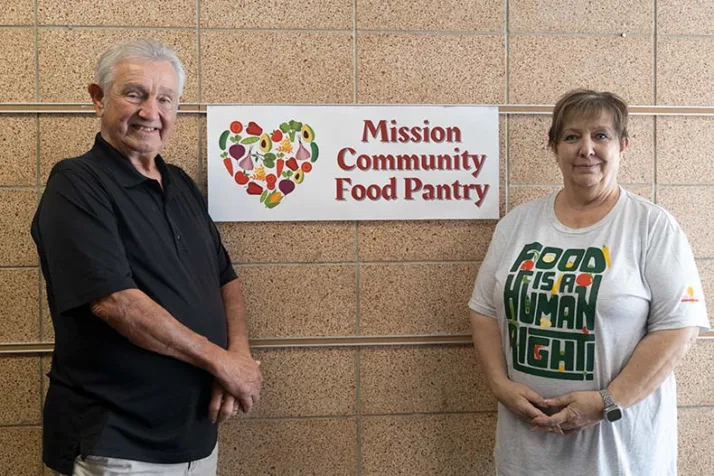
All that matters to Kring and Synovec in the end is changing that, in their own backyard. That’s why they launched the Mission Community Food Pantry — which, since its inception, has served tens of thousands of people in need.
The food pantry launched in 2020
The idea for the food pantry came out of a conversation between Kring and the late Suzie Gibbs, both Mission residents, and Synovec, a Mission resident at the time (she now lives in Shawnee).
Gibbs, a former Mission city councilmember who Kring and Synovec remember as “one very determined lady”, died in 2022.
In 2020, both she and Kring had been working with Mission’s Holiday Adoption Program, which provides food and gifts to northeastern Johnson County families during the holidays. As Kring remembers it, Gibbs wanted a more permanent version of that.
“Suzie was always saying, ‘We need to do something to make people happy more than once a year or twice a year,’” he said.
Then Gibbs and Kring learned about what Harvesters, a regional nonprofit, was doing to help families in Kansas and Missouri get the food they needed.
That included Synovec, who’d been helping with Harvesters’ “Kids Cafe” lunch program for students — which also entailed a summer food pantry for when school was out. The three of them sat in the Trinity Lutheran Church’s foyer, discussing their shared mission and how they could help each other carry it out.
From there, it was off to the races. The pantry’s first distribution served between 40 and 45 families, and that number quickly grew.
“Then it was November, a week before Thanksgiving, and all of a sudden we had over 100 families come through,” Kring said. “We thought, ‘We got a good thing going here.’”
The food pantry distributes twice monthly
The food pantry distributes twice a month — from 4 to 6 p.m. on the second and fourth Thursdays, in the church’s parking lot.
While some food pantries require guests to be below a certain income level or provide identification, that’s not the case at this one.
“Other places you may have to meet certain incomes, or you can only come once or twice a month,” Synovec said. “We have no qualifications, so you can come anytime we have a distribution.”
Today, the pantry has given food to more than 46,000 people, including those who have come by more than once. Broken down by pantry day, Kring and Synovec said that usually means more than 100 families per night — and sometimes more than 200 around the holidays.
Per the most recent Harvesters data, one in seven people across Harvesters’ 27-county service area (including both Kansas and Missouri) are at risk of hunger. For kids, that’s even higher: one in five are at risk of hunger.
“We know that we’ve done a lot, but we build on it every year,” Kring said.
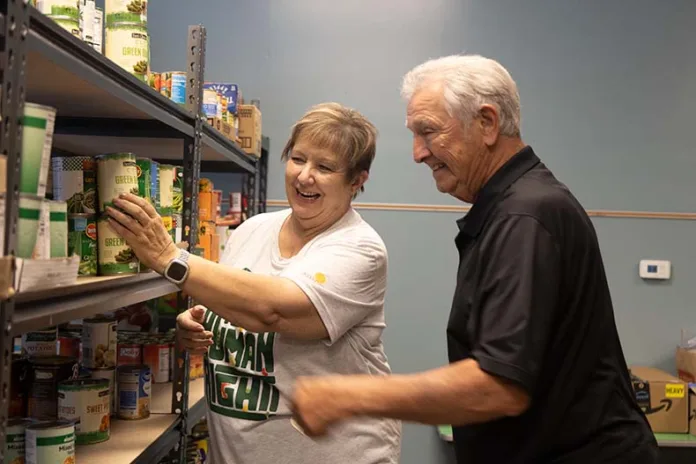
The shelves inside the pantry’s two-room space inside the church are stocked a variety of ways — including through partnerships with Harvesters and with Hy-Vee in Mission, and also through donations and food drives from nearby Mission neighborhoods.
Though people primarily leave with groceries like veggies, canned goods and snacks, Kring and Synovec have also added some extra items at the end of the pantry line. That includes books for both adults and kids, and sometimes some toys too.
Synovec said 95% of all dollars the pantry receives goes to the purchase of food, which means most of the labor is volunteer-led.
“The only paid position right now here at the pantry is our pantry manager,” she said. “Without that community participation, we wouldn’t be able to do what we do.”
As another added bonus, they like to host special celebratory events at the pantry to brighten guests’ days a bit more; things like volunteers dressing up as superheroes on “National Superhero Day”, giving out bottles on bubbles on “National Bubble Day”, and handing out coloring books on “National Coloring Day”.
“Every month we celebrate in some way, some special event or occasion, hoping to bring that little extra smile to people,” Synovec said “That’s something about us that I think sets our pantry apart from others.”
The pantry has grown as needs have grown
When they think about what they’ve built, Kring and Synovec know that even with how many families they see every month, there are still more who they don’t see. Not because those other people don’t need them, but because they’re homebound, or they live too far to walk home with all of the bags of groceries they need.
“In working with the different programs that we did, we knew the need was there,” Synovec said. “But we knew that we didn’t know how big that need was in either of our circumstances, because not everybody lets you know, and not everybody can get to you.”
That’s what Synovec and Kring hope to address next: things like adding more distribution days or finding ways to potentially bring food closer to people who can’t make it to the pantry.
“Until we go out of business, until hunger is solved across the nation, we do want to grow our services to meet those needs,” Synovec said. “Over these next five years, we’ll be analyzing where the needs are; (thinking about) are there ways for us to go into the community and serve those who can’t get to us? Are there other things, creative things that we could do to make sure that people just have food?’”
For Kring, the best part isn’t just the joy that comes during distribution; it’s the peace that comes after.
“I go home on those Thursday evenings and sleep well,” he said. “I know someone that was hungry is not (anymore) that night, and I can sleep knowing that.”
More Helping Hands: This JoCo man helps long-term animal shelter dogs find their forever homes