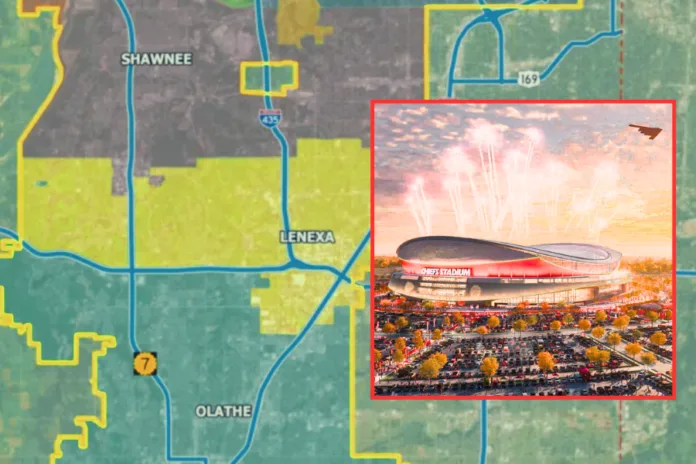
Kansas has set the final boundaries for the STAR bonds district that will use future growth in state sales taxes to help finance the Kansas City Chiefs’ new stadium and headquarters.
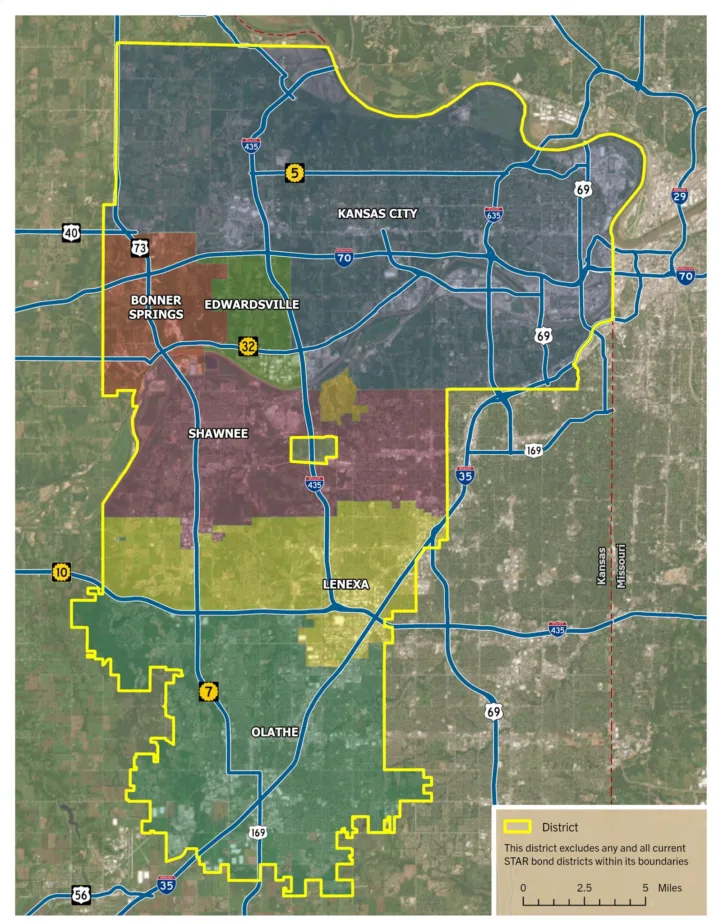
The district includes nearly all of the cities of Lake Quivira, Lenexa, Olathe and Shawnee in Johnson County, as well as areas of Kansas City, Kansas, Edwardsville and Bonner Springs in Wyandotte County.
That means future growth in state sales taxes collected within those cities will go toward paying off the bonds that will finance the stadium and team HQ project.
The team announced in December that it would be moving across state lines, building a domed stadium in Wyandotte County and a headquarters and practice facility in Olathe. Along with entertainment districts to be developed surrounding the facilities, the project’s total cost is estimated at $4 billion.
At that time, a panel of legislative leaders, the Legislative Coordinating Council, approved the STAR bond agreement that committed future state sales tax revenue to the project, but the district’s boundaries weren’t finalized then.
State Tax and Revenue, or STAR, bonds are a financing tool that uses Kansas sales tax revenues generated by a project to pay for development.
The state set the boundaries for the unusually large Chiefs STAR bond district with the goals of maximizing the economic impact of the project and paying off the bonds as early as possible, according to a release this week.
“This is a once-in-a-generation economic opportunity for Kansas and we will ensure that all Kansans enjoy the benefits of this new stadium for many, many years to come,” Lieutenant Governor and Secretary of Commerce David Toland said in a statement.
The use of STAR bonds to fund the Chiefs’ new facilities has been contentious. Supporters say the project will bring jobs and an economic boost to Kansas. Critics argue it’s not a good deal for Kansans and that the project, high-profile as it is, won’t pay for itself
Lenexa and Shawnee, included in the district, have maintained that they will not pledge any local sales tax revenue to the project.
“For Lenexa, nothing has changed since the original announcement. Sales Tax and Revenue Bonds will not affect the City’s local sales tax or other local revenues, nor will they impose any new sales taxes on Lenexa residents,” a city spokesperson said in an email to the Post.
Meanwhile, Olathe has separately pledged some of its municipal sales and hotel tax revenues at the team’s new training facility and HQ site.
What are STAR bonds?

STAR bonds were established by Kansas in 1999 to help finance developments intended to attract tourists and their spending.
Bonds are sold to pay for construction of such projects. The debt is then repaid using sales tax revenues within an established STAR bond district.
The Chiefs’ project, which spans multiple counties, will be the largest ever use of STAR bonds, dwarfing other projects that have come before it.
The Kansas Department of Commerce said the exact size of the STAR bond district will be outlined in the final project plan, but the initial map released last December covered an area of roughly 293 square miles, according to the Kansas City Business Journal.
In contrast, Halo Ridge, another STAR bond district in Olathe for a Hunt family-backed ultra-accessible entertainment district, is .2 square miles.
Before the Chiefs deal, the largest STAR bond district in Kansas was created for Sporting KC’s stadium, Children’s Mercy Park, in Kansas City, Kansas. That project received $150.3 million in STAR bonds in 2010.
For the Chiefs deal, public dollars will account for up to 60% of the cost of the Chiefs’ new stadium and Olathe facilities. The team will fund the remaining 40%.
Olathe pledges sales tax
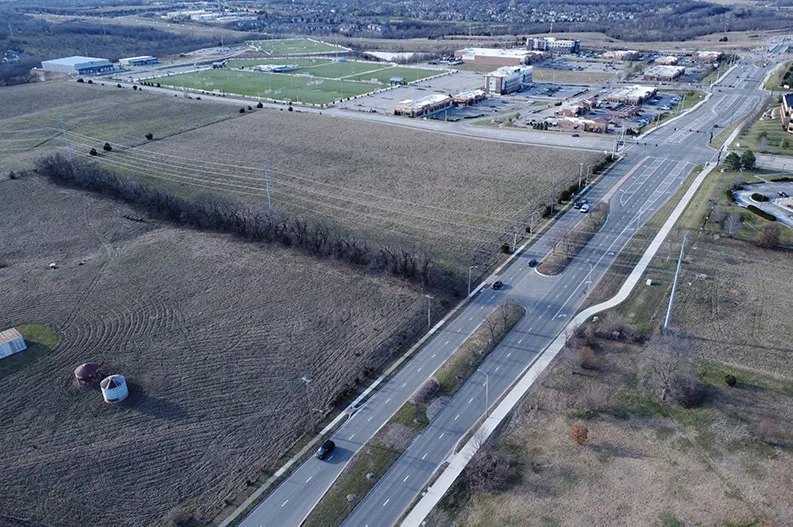
In February, the Olathe City Council unanimously approved the use of STAR bonds to help finance the headquarters and training facility, as well as the surrounding entertainment district. The project will be located at College Boulevard and Ridgeview Road.
Under the ordinance, the city also pledged:
- Its 1% general sales tax not already committed to other uses that is raised on the 165-acre site at College and Ridgeview
- Its share of county sales tax generated on the site
- 7% of the city’s 9% transient guest tax on hotels within the project area
Olathe’s commitment of local taxes applies only to the 165-acre headquarters and practice facility site at College Boulevard and Ridgeview Road, not the entire STAR bond district.
That means municipal sales tax revenue raised in other parts of the city won’t go toward the project, though the state’s portion of future sales tax growth in the city will.
“It is important to note that this is a decision made at the state level and does not impact the City’s local revenues and our existing STAR bond districts are not included in those boundaries,” an Olathe spokesperson said in an email after the map was finalized this week.
An exemption for Shawnee
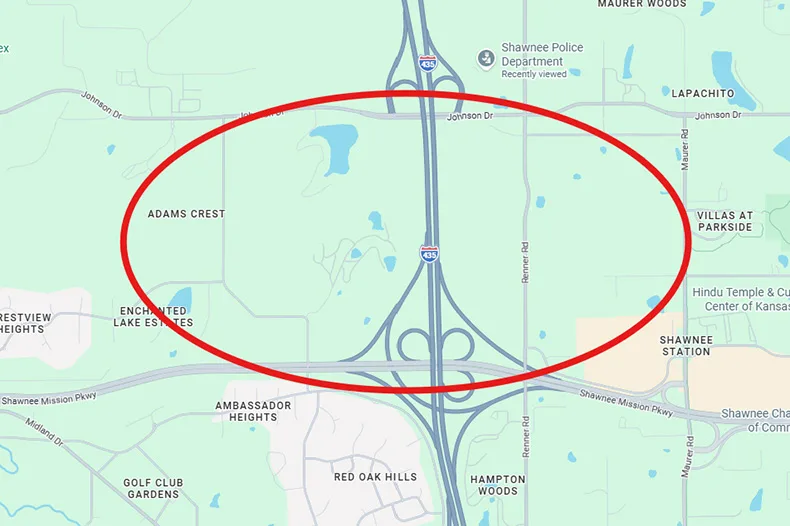
The state excluded three areas from the district, including the University of Kansas Medical Center in KCK, existing STAR bond districts (including Halo Ridge in Olathe) and about 500 acres of mostly undeveloped land in Shawnee.
The Shawnee exemption sits in the I-435 corridor with Johnson Drive to the north and Shawnee Mission Parkway to the south. The city requested that area be carved out for a potential future, unspecified project.
Shawnee city communications manager Doug Donahoo said that exemption gives the city some flexibility to develop its own STAR bond project in the future.
“That is a big win for the City of Shawnee,” he said in an email this week.
Representatives for both Olathe and Lenexa previously told the Post the cities weren’t requesting any exemptions within the Chiefs’ incentive district boundaries.
Donahoo said Shawnee was never asked to pledge a portion of its local sales tax revenue. The state also indicated it would not take the portion of state alcohol sales tax revenue directed to municipalities, he said.
“So, the overall impact to residents and the City’s budget should be negligible from our perspective,” Donahoo said.
The Unified Government of Wyandotte County released a statement Tuesday saying they are supportive of the Chiefs’ project but were displeased with the final STAR bond district boundaries.
“We are very disappointed to see that the Secretary of Commerce did not exclude other areas on the eastern side of Kansas City, Kansas, where STAR Bond potential and opportunities had been identified and discussed,” the county said in a statement.
Wyandotte County and Kansas City, Kansas also filed a lawsuit in district court last week aimed at wresting some control back from the state on the Chiefs project.
The lawsuit challenges several aspects of House Bill 2466, which allowed the state to make the deal with the Chiefs and established the Kansas Sports Authority governing the project.
“For one project, in one community, it removes the local government’s power to tax, to zone and plan, to set and collect local fees, and to provide utility service through the community’s own publicly-owned utility,” the complaint reads.
Unified Government officials emphasized that the lawsuit was not an attempt to stop the stadium from going forward but was meant to give residents of Wyandotte County a “voice” in decisions related to the project, KCTV reported.
Legislators are divided
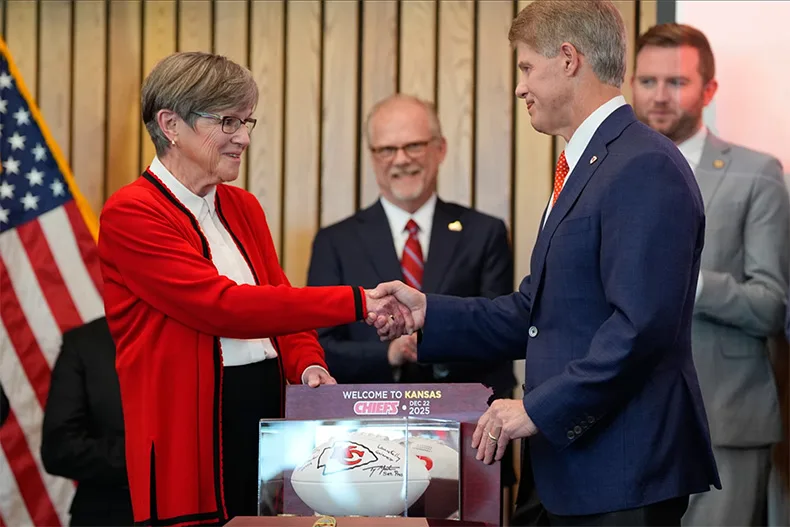
The use of local tax incentives to fund the projects has been a divisive issue among lawmakers and even played a role in this year’s gubernatorial contest.
Olathe City Councilmembers have defended Olathe’s commitment to add local tax dollars on top of the state STAR bond funds.
“I feel like this is an opportunity for Olathe,” Mayor John Bacon previously told the Post. “I think there is a real opportunity around sports event development, sports facility development. And it’s kind of a hot market right now.”
Republican gubernatorial nominee and Kansas Senate President Ty Masterson defended the incentives used to attract the team, calling the move a “generational opportunity” for the state, in a candidate survey conducted by the Post.
Masterson said the project will generate construction jobs, long-term employment and new economic activity that will repay STAR bonds.
“The project imposes zero new taxes and does not divert existing state revenue,” Masterson said in his survey response. “This pay-as-you-grow mechanism ensures no impact on essential services and carries no risk to taxpayers.”
Democratic gubernatorial nominee Cindy Holscher, a Kansas state senator from Overland Park, originally supported legislation that allowed the state to pursue a deal with the Chiefs but said she is opposed to the ultimate financing package that was approved by legislative leaders, including Masterson, last year.
“Kansas should absolutely compete for jobs and investment, but not by making everyday families foot the bill while new developments provide nothing to local economies,” Holscher said in her response to the Post’s candidate questionnaire.
Democratic state Rep. Rui Xu has been one of the most vocal opponents of the deal among Johnson County’s legislative delegation in Topeka, saying there’s no real benefit to the deal for his constituents in northeast Johnson County.
“They will be going from driving 20 minutes east to attend Chiefs games to 20 minutes west to attend Chiefs games. To me, it doesn’t make sense to spend any amount of new public money to do that,” he wrote in his own candidate survey responses.
What economists say
J.C. Bradbury, an economics professor at Kennesaw State University who studies stadium subsidies, called the Chiefs deal a “net money loser.”
He said the project will only benefit the team.
“As a public policy project, what Kansas is doing is completely and totally indefensible,” he said.
Bradbury has studied Atlanta Braves’ stadium and surrounding development in Cobb County, Georgia, which was also funded using public incentives.
He said it’s made the team a lot of money, but hasn’t benefitted the general public.
“It costs county taxpayers about $15 million a year,” he said. “ It doesn’t pay for itself.”
The Kansas Department of Commerce, however, contends the project will create 4,000 permanent jobs and generate $1 billion annually.
The state hasn’t determined which year will be used to determine the sales tax growth increment.
 Thanks for reading! If you value having an independent news outlet keeping tabs on local government, schools and taxes, we're asking you to contribute to our Education Reporting Fund.