By Grace Hills
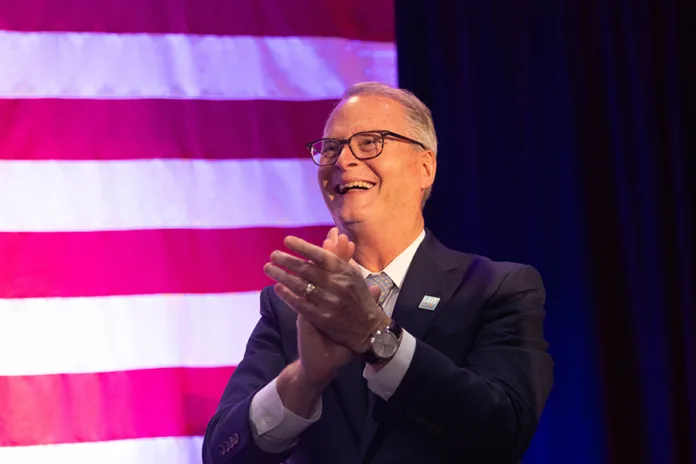
Kansans are sending Democrat Adam Hamilton to the U.S. Senate, the first time they’ve elected a Democrat to the chamber since 1932.
Hamilton, the pastor of the largest United Methodist church in the country with seven campuses across the Kansas City metro, preached a moderate approach, and emphasized listening to both sides.
“We are better together, Republicans and Democrats,” Hamilton told a crowd of supporters after the Associated Press called the race. “Thoughtful Republicans and thoughtful Democrats coming together to solve problems.”
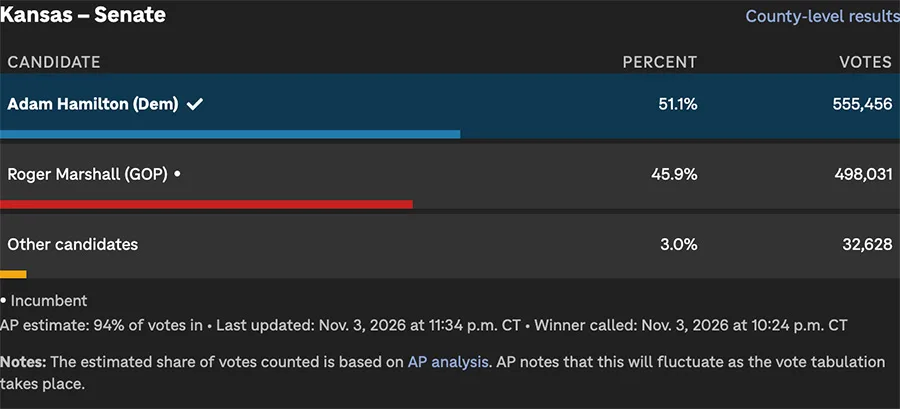
President Trump won Kansas with a double-digit margin in each presidential election since 2016, and he made two visits to the state to support Marshall. Vice President JD Vance also arrived twice to rally for Marshall.
But even that full-court press wasn’t enough to overcome headwinds that Republicans faced in the midterm election.
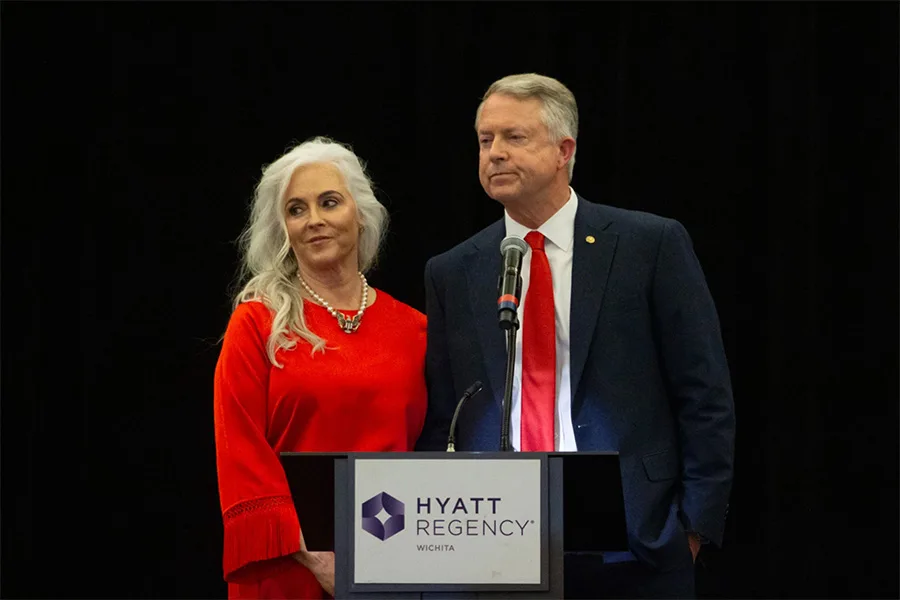
Marshall called the defeat “humbling.”
“I don’t have any answers,” Marshall told a crowd in Wichita. “It’s been the great honor of my life to serve the state of Kansas for 10 years, and just love this state. Love this country.“
While Trump has easily won Kansas three times, Kansans also elected moderate Democratic Gov. Laura Kelly to the governor’s office, then reelected her in that same time period.
Kelly and Kathleen Sebelius, the Democratic governor elected before her, endorsed Hamilton — as did most living former governors except for Sam Brownback, who endorsed Marshall.
Prior Senate elections in the state were sleepier. Marshall coasted to Washington with a more than 11-percentage-point margin of victory in 2020, despite some predictions for a more competitive race.
The polls showed Hamilton being tied or slightly ahead of Marshall. Marshall frequently pointed to his 2020 race against Democrat Barbara Bollier, which flip-flopped between Marshall and Bollier winning, as a defense against the polls.
Both Hamilton and Bollier set fundraising records, but this year’s contest ended up being the most expensive in Kansas history, with Hamilton breaking multiple records.
Hamilton flirted with running as an independent, but decided to run as an “independent-minded Democrat” after his statewide listening tour. Supporters worried if he ran as an independent, he’d split the votes with the Democrat and ultimately send Marshall back to Washington.
Andi Welch, from Johnson County, Kansas, doesn’t always vote for the Democrat on the ballot, but she voted for Hamilton on Election Day.
“I think he’s going to be fair,” Welch said. “I think he’s running as a Democrat for the reasons he states, and I think he really is going to be looking out for Kansas citizens.”
Hamilton’s call for term limits, critiques of the national Democratic party and endorsements from prominent Kansas Republicans resonated with Kansans.
But the race also delved into personal attacks.
A major bombshell in the race was the New York Times reporting that Marshall, who worked as an OB-GYN before going to the U.S. House in 2016, sued 700 of his former patients for medical debt.
Marshall repeatedly redirected attention on the lawsuits to say he gave hundreds of patients free care, but the day before the election he produced a video — apparently without his top advisor’s support — addressing the lawsuits. He defended sending people to collections as a necessary part of business.
“We did have to keep the lights on,” Marshall said in the video.
Hamilton’s campaign used one of those former patients in an attack ad, and five days before Election Day that patient sued Marshall for allegedly charging a predatory interest rate.
Marshall’s campaign, for its part, bet heavily on an attack ad surrounding claims that Hamilton protected a pedophile. A church camp volunteer reportedly attempted to sexually abuse boys at one of Hamilton’s church camps, and returned the following year where he did so again.
Court records show the church’s initial investigation into the boys’ report was inconclusive, and Hamilton later said in a debate he was not involved in the decision to allow the volunteer to return. Church leaders called the authorities after the second report, but Hamilton said they should’ve called police after the first.
National Republicans also turned their focus to the state, betting that the remaining undecided voters — which made up about 8% of the electorate in September, according to an Emerson College poll — were Trump voters who just needed encouragement to get out and vote. The president and vice president each visited the state twice this election season.
Still, polls trended in Hamilton’s favor — Emmerson’s by a wider margin than before their visits.
Hamilton notably avoided association with national Democrats. Though his campaign took $5 million from a political action committee associated with U.S. Senate Minority Leader Chuck Schumer, Hamilton said he wouldn’t support Schumer in another leadership position.
In their final debate before Election Day, Marshall sought to tie Hamilton to Schumer 15 times.
Hamilton, meanwhile, leaned into a Kansas-first approach, a message that appealed to voters.
Grace Hills reports on politics for the Kansas News Service.
 Thanks for reading! If you value having an independent news outlet keeping tabs on local government, schools and taxes, we're asking you to contribute to our Education Reporting Fund.