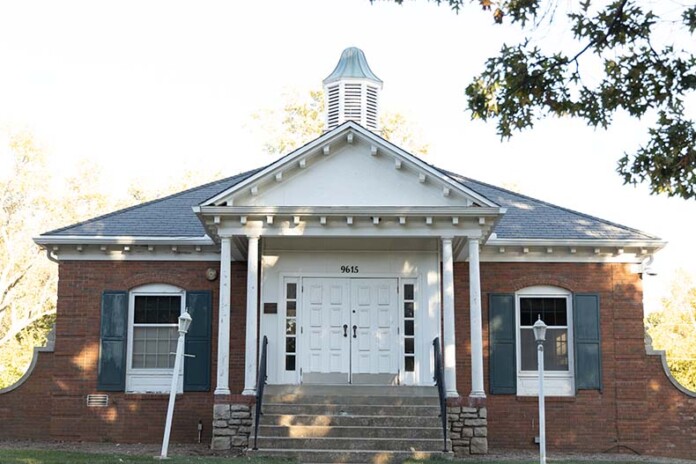
Leawood City Council members on Monday rebuffed a last-ditch request by a former councilmember to allow fundraising to save the 73-year-old former city hall building.
Former councilmember Debra Filla presented the city council with a request to set up a working committee of city staff, residents, the Leawood Foundation, city council and commission members that would seek pledges to raise $1 million in the next year and a half toward repairs and remediation needed to keep the building.
On Monday, she brought along a letter of support from the head of the Kauffman Family Foundation.
But the majority of the current council said they were happy with the compromise master plan that had been arrived at after more than a year of discussions with a consultant and public input.
That plan envisions a park and green space in the area at 9615 Lee Blvd. that is now occupied by the city hall, the original fire station and a new modern fire station next door to the south.
The master plan puts the emphasis on converting the original fire station into a community gathering space. The old city hall, however, was deemed too impractical to keep due to the cost of dealing with its asbestos, mold, lead paint and accessibility problems.
“It just doesn’t make any sense to me to abandon this plan,” said Councilmember Mary Larson. “I don’t think it works on the property to have both buildings.”
Other councilmembers also balked at the idea because, so far, no donors have informally expressed interest in giving to such a project.
How we got here
In June, the city council opened the door to razing the old structure by unanimously approving a master plan for the grounds that did not include a use for the former city hall. That decision was the product of years of agonizing over costs, use of greenspace, pedestrian safety on Lee Boulevard and the best use of two of Leawood’s historical buildings.
The plan included a playground, greenspace, and a high-intensity activated crosswalk requested by residents who worried about children’s safety as they crossed busy Lee Boulevard to get into the park. It also called for a community gathering space in the revamped fire station, a walking trail and an ornamental garden.
Rehabbing the old city hall was not part of that plan. Councilmembers had discussed it and concluded the estimated $630,000 cost of stabilizing it to preserve it for future development made it impractical.
But the master plan did not come with a budget and construction timeline, and supporters of keeping the old city hall saw that as an opening to bring it back for discussion Monday with their request to begin raising funds.
Former city councilmember advocates to save old city hall
Filla, who frequently defended keeping the old city hall at previous meetings, noted that the idea of using it as an ice cream or coffee shop garnered over 1,000 signatures in an online petition.
She presented the fundraising idea with letters of support from Julia Irene Dennie-Kauffman, chair and president of the Muriel McBrien Kauffman Family Foundation, and from the city historic preservation committee.
Kauffman’s letter called the former city hall a “cherished landmark” whose charm and unique character contributed to the town’s identity.
“It is more than just a building; it is a symbol of Leawood’s heritage and a beloved fixture in the neighborhood. I was most impressed coming from Toronto, Canada, at such a quaint little building,” her letter said.
Kauffman noted the city spends on public artwork and called the old city hall “an artwork of a different kind.” She also expressed surprise that none of the councilmembers voted in support of the building.
“Are they all so young, they have no appreciation of the past?” she wrote.
Another letter of support, from Leawood’s historic preservation committee, also urged the building’s preservation as “connections to Leawood’s origins, embodying the vision and perseverance of our founders.”
“Once these landmarks are gone, they will be gone forever,” the committee wrote.
Years of discussion
The 4-acre grounds and their buildings have been on the radar of more than one city council for a couple of decades. On the north side sits the city’s original Fire Station 1, which was used as a fire station until 2023 and still houses a 1949-era pumper truck once used as a model for a Hallmark Christmas ornament. It has not had a public use in three years.
Just to the south is the former city hall, a 1,100-square-foot building that was small enough even in its day that stories still circulate of townspeople gathering outside the windows to witness city meetings. It has been vacant since 1994.
Both Colonial-style buildings were erected at about the same time in the early 1950s.
Filla told councilmembers that she wanted to “keep history alive in three dimensions.”
“The reason I’m here is to say if we could show you the money, could we exchange that piece of grass for maintaining the old city hall?” she said.
Filla said fundraising could be supplemented by grants and possibly city spending on public art, if the city council agreed the building was a type of art. She also suggested using the $150,000 saved from demolition to establish a maintenance fund.
Current councilmembers focusing on fiscal responsibility
Councilmember Julie Cain questioned whether Filla’s timeline and fundraising plan were workable and whether there were donors waiting to contribute.
Other councilmembers said they would hesitate to ask for donations when there wasn’t a firmer plan in place for the building. They also questioned whether the city should ask staff and the Leawood Foundation for their time on it without a more detailed plan.
Councilmember Lisa Harrison said she was not convinced the old city hall building was more uniquely significant than the old fire station, which was built three years before.
“I love this cute little building, I think it’s darling,” Harrison said. But “The phrase ‘historical significance’ is actually misleading because if it were historically significant, it would already be protected by some kind of historical commission.”
“I believe we have a responsibility to make decisions up here that are financially responsible for the future of this city and not just what a small group of people might want right now,” she concluded.
In the end, Cain offered a motion to ask old city hall supporters to come back in three months with a more detailed plan and pledges, if possible, before the city council would reconsider. Councilmember Alan Sunkel seconded it, and those two were the only yes votes.
But the other six members — Harrison, Larson, and Councilmembers Steve Kaster, Sherrie Gayed, Matt Peppes and Rachel Rubin — voted against it.
 Thanks for reading! If you value having an independent news outlet keeping tabs on local government, schools and taxes, we're asking you to contribute to our Education Reporting Fund.