Shawnee’s governing body is looking to ease restrictions on the city’s controversial co-living ban that was approved more than four years ago by a different city council.
On Monday, the Shawnee Council Committee directed city staff to make amendments to the municipal co-living ordinance that, among other rules, allows for three or fewer people to live in one house who aren’t related by blood, marriage, or adoption.
The changes being considered ease that restriction slightly, allowing for a maximum of four unrelated people to live in the same dwelling. Any number larger than that would be considered a co-living group and still considered illegal.
In addition, the recommended changes would remove a rule that classifies an entire household as unrelated if even one unrelated adult was living there, even if the other residents were related to each other.
When the city enacted the ban in April 2022, it garnered national headlines, with some critical commenters deriding the measure as a “ban on roommates.” The ordinance also triggered a federal lawsuit in May 2023 filed by Shawnee resident Val French and Prairie Village-based property management company HomeRoom, Inc.
The lawsuit was dismissed earlier this year by a federal appeals court, and the U.S. Supreme Court declined to take up the case, said Shawnee City Attorney Jenny Smith.
Despite the controversy and outcry the co-living ordinance engendered, there have been no documented complaints about residents in Shawnee breaking the law, city spokesperson Doug Donahoo said in an email to the Johnson County Post.
“Now we’re in a position that the [legal] case has been resolved, and we need to make a decision where we go from here,” Smith said to the council committee this week.
The process of amending the co-living ban might take some time, as any amendments to the city code have to be taken up by the Shawnee Planning Commission before the city council can vote on it, Smith said.
Shawnee City Council approved the co-living ban in 2022
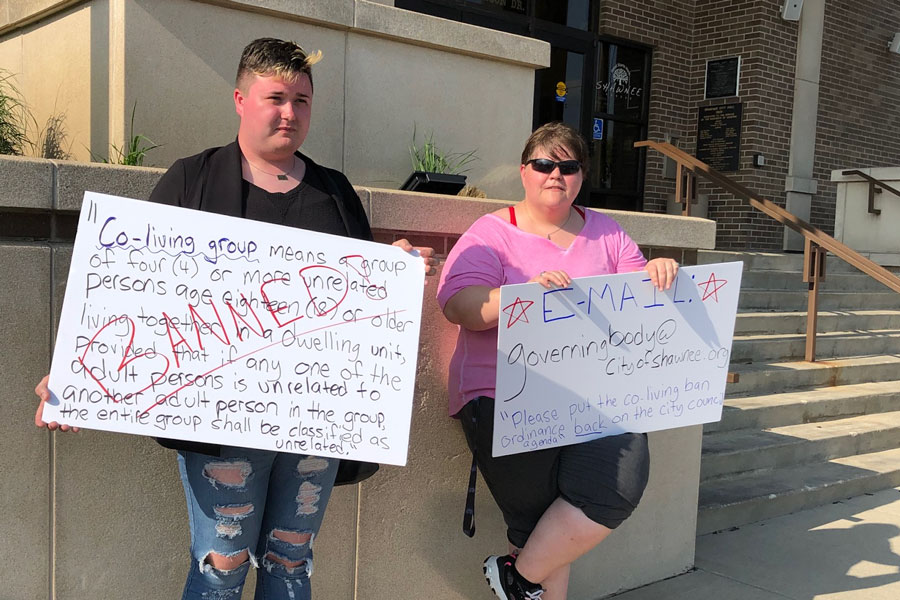
When the Shawnee City Council approved the co-living ban in 2022, then-councilmembers said they were trying, in part, to address out-of-town investors buying up properties and renting them out.
Councilmember Kurt Knappen, the sole remaining councilmember still on the city council from that time, reiterated its purpose during Monday’s meeting.
“The point of why we did it is — everyone knows — is we had capital venture groups coming in and buying houses, and then making as many rooms (available) as they can, and renting them out to individuals. And as a result, you had a lot of traffic. You had a lot of complaints, traffic on the streets, other complaints. And so, we tried to address that this way,” he said.
Facing legal challenges, the city stood steadfast in its argument that the co-living ban was legal. In total, it spent about $27,000 fighting the lawsuit, Smith said during Monday’s meeting.
The nonprofit Pacific Legal Foundation, which represented the plaintiffs suing the city over the co-living ordinance, argued that high housing costs were causing more people to share homes and that the ban took that option away.
“The problem is that when you so restrict the kinds of people who can live together in a single-family home, you make housing affordability much more difficult,” David Deerson, an attorney with Pacific Legal Foundation, told the Johnson County Post in a previous interview. “You sort of intrude into the private lives of people who should be allowed to structure their own homes in the way that they see fit.”
Pacific Legal Foundation did not immediately return the Post’s request for comment this week following the city council’s discussion.
Current councilmembers support easing restrictions

During Monday’s discussion, Councilmembers Steele Reynolds, Erin Aldridge and Jeanie Murphy all agreed that housing costs are too high to prohibit more people to live together legally.
“While (it’s) legal, in this time of housing shortages and people not being able to afford housing, I don’t know if it’s the kindest way to deal with our residents,” Murphy said. “As we’ve known from the very beginning, this is where they say ‘The Golden Girls’ would have been illegal.”
Reynolds agreed.
“I think that the city doesn’t have any business kind of determining who can live in someone’s home. So I think something like [what] is proposed here is a good start,” he said.
Aldridge suggested the 2022 ban was city government overstepping its boundaries.
“I think putting this kind of restriction is an overreach. So I am in support of going back to where we were,” she said.
Knappen defended the previous city council that approved the ban but said he also saw the need to now loosen the restrictions.
“If we want to relax it a little bit and make some of the wording better, I’m supportive of that. I think it still accomplishes the main goal of why we put it in to begin with,” he said.
What’s next
The Shawnee Planning Commission will likely take up the amendments to the city ordinances in December or early 2027, Smith said.
 Thanks for reading! If you value having an independent news outlet keeping tabs on local government, schools and taxes, we're asking you to contribute to our Education Reporting Fund.