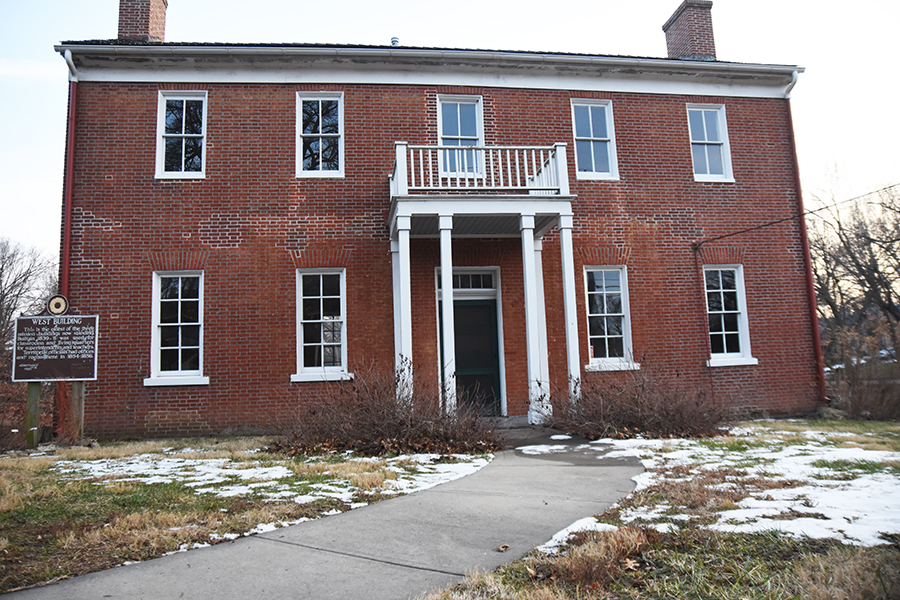
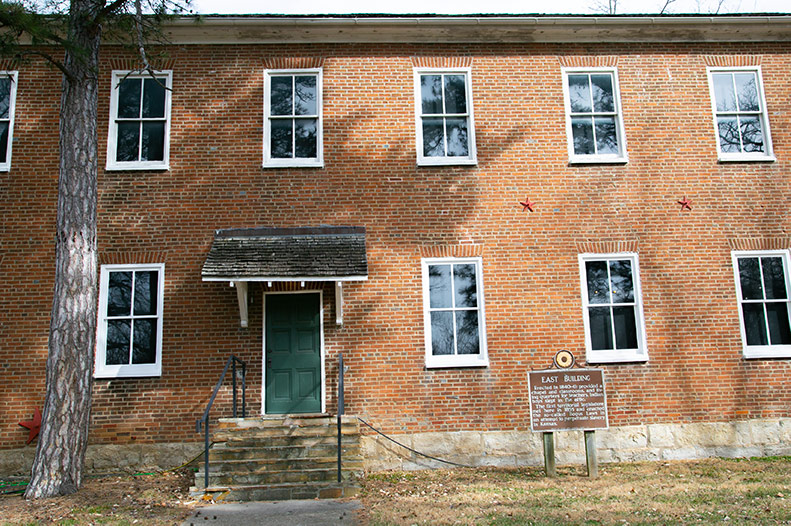
A bill in the Kansas Legislature that aims to transfer the ownership of the Shawnee Indian Mission from the state to the Shawnee Tribe is already gaining more traction in 2024 than it did a year ago when it was first introduced.
While the long-term prospects for the measure ultimately passing and becoming law remain uncertain, it’s already exposed a growing rift between tribal leaders and Fairway city officials currently charged with maintaining one of Johnson County’s most historic sites.
What’s the latest?
The Kansas House Committee on Federal and State Affairs heard testimony Wednesday from both supporters and opponents of the bill, HB 2208.
Those who testified included representatives from the Shawnee Tribe, as well as other tribes, and also Fairway city officials and leaders of the Shawnee Indian Mission Foundation, the nonprofit that partners with the city to help oversee the site.
At times, the testimony Tuesday turned personal, particularly between city officials and Shawnee Chief Ben Barnes, which is reflective of a rift that has grown over the last couple of years between the city and the Shawnee Tribe regarding ownership of the site.
The tribe argues the Mission, which is owned by the state, is in disrepair and is seeking to take ownership in order to restore it.
The city has maintained that it is in the best interest of both history and the public’s benefit for the state to maintain ownership and for the city to continue to help oversee the property.
How did we get here?
Despite discussions in 2021 about a city and tribal partnership that would dive into the history of the once Methodist-run “manual labor school,” the two parties are now at odds over ownership of the Mission.
The Shawnee Tribe released a study in early 2023 that found the Mission to be in disrepair and, since then, has called for ownership of the site to be transferred to the tribe.
The city of Fairway, through a series of email newsletters to residents, has questioned the validity of the tribe’s study and its conclusions.
HB 2208, alongside a mirroring version SB 117, was introduced to the Kansas Legislature last year but did not get a hearing.
The bill includes language that says the Mission land would remain a historic site should ownership be transferred to the tribe, but the city of Fairway maintains its position that conveyance would throw the future of the site into uncertainty.
Who is behind the bill?
Rep. Adam Thomas, an Olathe Republican, introduced HB 2208 to the House Federal and State Affairs committee in January 2023.
Thomas did not immediately respond to the Post’s requests for comment for this story.
But when the bill was introduced last year, Thomas told the Post at that time that as someone who identifies himself as having Native American heritage, he sympathized with the Shawnee Tribe’s claim to the land. (When asked by the Post for proof of his tribal affiliation, Thomas said he is not enrolled in any tribal nation.)
What does “convey” mean?
That’s the term the bill uses.
A land conveyance is a technical term meaning that a property is transferred from one individual or entity to another, according to the Cornell Law School’s Legal Information Institute.
Typically, a property conveyance can be done through a deed or contract and usually involves an agreed-upon purchase price between the parties.
In this case, if HB 2208 becomes law, the state would be transferring the Shawnee Indian Mission property to the Shawnee Tribe.
At the beginning of the committee hearing for HB 2208, Mike Heim with the state Office of Revisor of Statutes told the committee that the state typically conveys land with a quitclaim deed. This means that the state gives the entity it is conveying land to everything it has, Heim said.
Who supports HB 2208?
Chief Ben Barnes of the Shawnee Tribe, which helped introduce the bill last year, spoke in favor of HB 2208 at Wednesday’s hearing.
Barnes said the Mission is “in grave distress” and the passage of HB 2208 will allow “the Shawnee Tribe to save this site.”
“I can understand those charged with caring for this site and its structures would be naturally defensive and seek to oppose our efforts. However, the truth is that the site is in peril,” Barnes said.
The Shawnee Tribe, he said, wants to expand historical exhibits at the Mission and shares the value of public education and benefit the site offers.
Barnes told the committee that the Shawnee Tribe will not use the Mission for anything other than preservation.
Joseph Rupnick, chairman of the Prairie Band Potawatomi Nation based in northeast Kansas, also spoke in support of HB 2208.
Rupnick said the Potawatomi, along with three other Kansas tribes (including the Iowa, Kickapoo and Sac & Fox Nation) have discussed and agreed that there needs to be some tribal oversight alongside the owners of the Mission.
He said such a tribal consultation needs to be codified in writing, otherwise “it’s not going to happen.”
Additionally, Rupnick said statewide many Kansans don’t know the history of tribal nations in their state and fail to realize that there are tribes in the state to this day — including some legislators.
Who is against HB 2208?
Shawnee Indian Mission Foundation representatives, as well as state and city officials all spoke against HB 2208 at Wednesday’s hearing.
Fairway Mayor Melanie Hepperly said it is her goal to expand the exhibits at the Mission, including a historical account of the state and the 22 tribes who had children at the Shawnee Indian Mission Manual Labor school in the early 1800s.
City Administrator Nathan Nogelmeier said in regards to the tribe’s study of the Mission, it is inaccurate to say the Mission is in need of $15 million worth of repairs, as the Shawnee Tribe’s study published last year contends.
Nogelmeier said more than half of that $15 million is for new exhibits, displays and additions.
“I can tell you as operators of the site, the roofs do not leak, the foundations are dry and the buildings are protected from the elements,” Nogelmeier said.
Additionally, Nogelmeier said there are ways the Shawnee Tribe could claim the land as sovereign if it is conveyed to them, which could potentially allow the Tribe to do more with the property than maintain it as a historic site.
Did any tribe speak against the bill?
Yes, Ken Bellmard, the government relations director for the Kaw Nation — which, like the Shawnee Tribe, is based in Oklahoma — said their tribal nation opposes HB 2208 because it feels strongly about the land in this area.
Bellmard said the land in the area belonged to the Kaw Nation for hundreds of thousands of years before the Shawnee were forcibly moved there by the American government from further east in the decades before the Civil War.
Was there any conflict at the hearing?
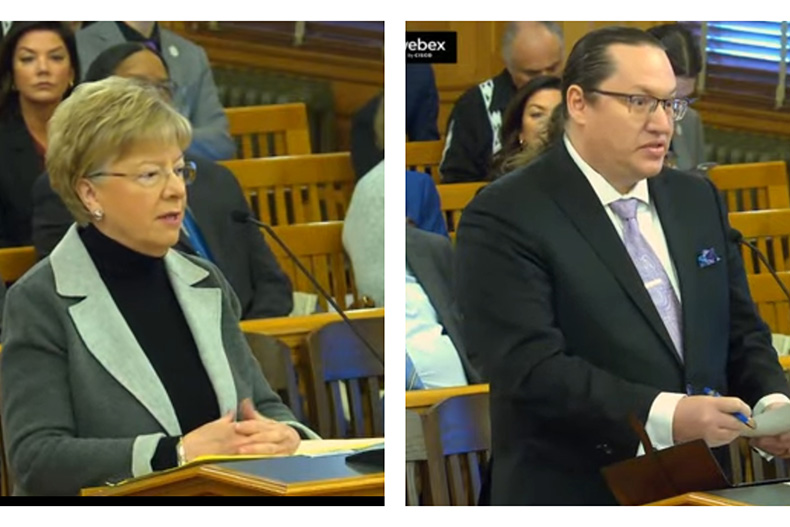
Mayor Hepperly’s testimony took more of a personal turn after representatives on the committee began asking her questions.
Democratic Rep. Christina Haswood of Lawrence, who is a member of the Navajo Nation and one of only a handful of Native individuals ever elected to the Kansas Legislature, asked why the city is hesitant to give the land back to the Shawnee Tribe.
Haswood said it sounds “like you’re all afraid the Indian problem is going to come back.”
Hepperly responded saying she is “not convinced the Mission will continue to operate in sharing its history with the public,” citing what she said was the poor condition of the Shawnee Tribe’s culture center in Oklahoma.
That reiterated a point made in an email newsletter the city sent last week urging the public to provide testimony for Wednesday’s hearing (read more here).
Republican Rep. Clarke Sanders of Salina asked when the relationship between the tribe and city went south, and if Hepperly had concerns that the tribe would not follow up on restoring the Mission despite what Barnes had said earlier in the hearing.
Hepperly said that in a previous one-on-one meeting with Barnes, he told her: “I want the land.” She said she does have concerns and that she is “very disappointed in the Chief,” but Chairman Rep. Will Carpenter, a Republican from El Dorado, cut her off at that point, saying testimony was not for “impugning anybody else.”
Carpenter then gave Barnes the opportunity to respond to some of Hepperly’s comments.
Barnes returned to the lectern and pointed out that the rift began to grow when the Shawnee Tribe learned about paranormal tours and seances that had happened years ago at the Mission.
The Tribe, Barnes said, found such events offensive given the history of the site, but when the tribe approached the city about it, Barnes said, “they [officials] were numb to even understanding that seances were reprehensible” and never formally apologized.
Barnes said the tribe is willing to pledge to spend money to restore the Mission over a certain number of years and report it to the state.
He said the tribe is also willing to add language to HB 2208 that would require the Shawnee Tribe to loop in other Native tribes on what is going at the Mission site.
Later on, David Boutros, secretary of the Shawnee Indian Mission Foundation, disputed the idea that the partnership between the city and tribe went south in part because of the seances.
Boutros said there were two seances that occurred with the city and a third that was unsponsored, all of which were immediately discontinued when the city and foundation learned that the tribe considered them inappropriate.
Are local lawmakers supportive of HB 2208?
No, two local legislators who represent Fairway and the Mission site are unsupportive of bills that would convey the Mission to the Shawnee Tribe.
Democratic Rep. Rui Xu said nearly 100% of the constituent emails he’s received on the issue oppose the Shawnee Tribe taking over the Mission.
Xu told the Post that he is unsupportive of HB 2208 because “job number one is to represent my constituents.”
Democratic Sen. Ethan Corson, whose district also includes Fairway, said he thinks the whole history of the Mission can be best told with the state maintaining ownership.
“I think we can tell a better story and have a more diverse range of perspectives if it remains in control of the state, which it currently is,” Corson said.
Additionally, Corson said he has yet to hear of any interest in this issue in the Kansas Senate.
The hearing is over. What happens next?
Connie Bahner, the committee’s assistant, told the Post on Wednesday that it is up to the committee chairman to advance HB 2208 to the next step in the process, which is to be “worked” in another committee meeting.
If the chairman decides to move it to this step, then the committee will discuss it, offer amendments and either pass HB 2208 to the full House or reject it.
It is up to the chairman if it gets to the next step and, if so, when that next step takes place, Bahner said.
Rep. Xu and Sen. Corson both said the committee hearing is a first step in a lengthy process.
While a bill getting a committee hearing shows interest in it from that specific committee, Corson said, a hearing is really only the second step after introducing the bill.
Go deeper: Watch the entire hearing in the embedded video below.