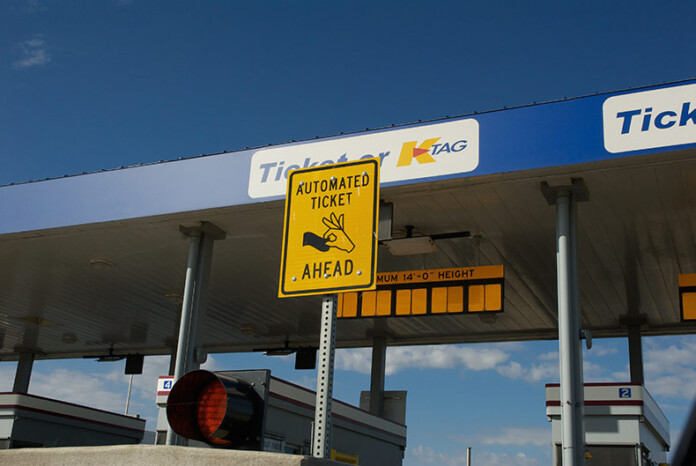
If you’ve driven the Kansas Turnpike any time in the past few months, you’ve seen the signs. A new toll collection system is coming that will eliminate toll booths and special lanes, making it possible to drive Interstate 70 without stopping as you enter and exit the turnpike.
The plan, which will cost $102.5 million to implement, has been in the works for a few years, but this will be the year it finally happens.
Toll booths will be a thing of the past sometime this July — the Turnpike Authority has yet to give a firm date. From then on, you will get a bill for the trip, based on data collected by a KTAG transponder or a camera image that captures your license plate.
As the time approaches, turnpike officials have been fine-tuning the details for the millions of drivers who use it (turnpike spokesperson Rachel Bell said there were about 37 million drivers on the road last year, but the authority doesn’t have a county-by-county breakdown of users.)
Here are a few basics along with some of the ways the cashless system will work for things like rental vehicles and multiple family cars.
How cashless tolling will work on the turnpike
Nothing much will change for regular commuters who are already using KTAGs. But the cashless system will be a new world for those who occasionally drive on I-70 to Topeka or Lawrence for move-in days at the University of Kansas.
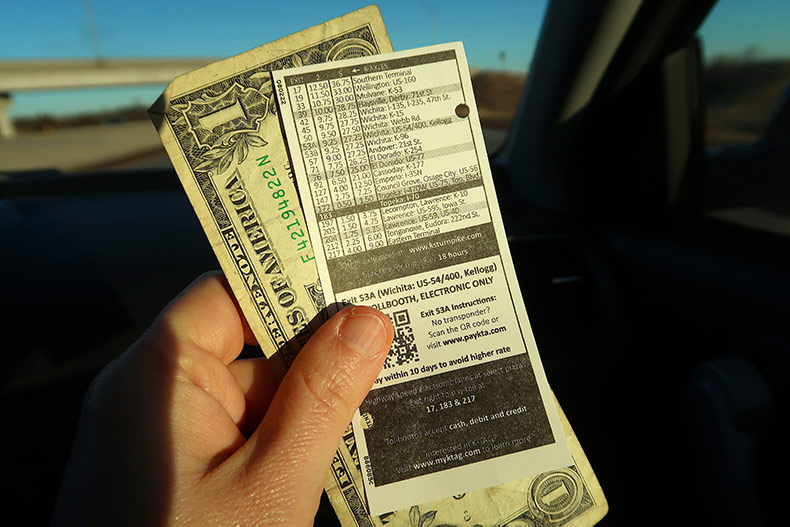
The typical KTAG is a small windshield sticker that can be read electronically at various points along the road. As things now stand, KTAG drivers are allowed to go through toll entries and exits without stopping, while those without pull into specified lanes to take a ticket at the turnpike entrance and pay as they exit. KTAG users must set up an account to pay their tolls.
When the new system goes live, no one will have to stop because cameras will take pictures of license plates of drivers not using a transponder and send the bill to vehicle owners.
Someone driving from Lenexa to Topeka without a KTAG could expect to pay $0.096 per mile, or about $5.47 for the 57 turnpike miles of that trip, Bell said. A toll calculator and rate chart is in development for the turnpike website.
Drivers won’t be required to get a KTAG under the coming system, but the turnpike authority recommends it because it’s cheaper. The tags are free and have no monthly administrative fees. Also, KTAG users pay up to 35% off the cash toll rate for two to four axles and up to 25% off for five-plus axles, according to the turnpike authority webpage.
The tags are available at myktag.com or by calling (316) 652-2650.
The new system billing will look a little different. Instead of basing the payment on entries and exits, the new system collects data each time a car passes under a gantry that can collect KTAG signals or a picture of the license plate. There will be 21 overhead gantries along the 236-mile length of the turnpike. So the trip will be broken down into the charge per each bit between gantries.
Why is the turnpike going cashless?
The change is primarily for safety, said Bell, who answered the Post’s questions through email. Lanes change and traffic comes to a standstill at the booths, creating a crash danger as drivers slow down or speed up and merge lanes.
“We have had both customers and employees killed when vehicles struck toll booths,” Bell said. This has happened at the eastern terminal near Kansas City as well as the southern terminal near the Oklahoma border, she said.
Eventually, the toll booths will be removed and the roadway reconfigured to streamline the drive, according to the turnpike authority website.
The move away from toll booths also seems to be a national trend.
Special circumstances allow flexibility in tolling
Changes are afoot in the KTAG account management system that will allow for multiple vehicles on one account, Bell said. Coming soon will be the DriveKS account system that allows a customer to put as many vehicles on the account as they want.
DriveKS will allow as many KTAGs as there are vehicles on the account. Users can opt out of the tag and have the cameras identify their license plates instead, but Bell said they will save 50% by using the tags.
Accommodations also are being made for visitors’ license plates to be added to an account temporarily. Rental vehicles also fall into that category, Bell said.
To add them to the account, customers need to provide a license plate and the dates of usage, she said.
Rentals will vary according to the company. Some already use KTAGs or other compatible transponders in their vehicles. If that’s the case, the toll is charged back to the rental company, presumably to be passed on. Bell advises customers who plan to use the turnpike to check with the rental company ahead of time about their toll policy.
For visitors, it might be worth asking whether they already have one of the compatible transponders. Besides KTAG, the Kansas Turnpike accepts:
- BestPass, used in multiple states
- Pikepass, Oklahoma
- PrePassPlus, in multiple states
- EZ TAG, Texas
- TxTag, Texas
- TollTag, Texas
- SunPass, Pro and Mini, Florida
What about toll booth workers and data sharing?
Bell gave no number on how many toll booth operators will be affected. The turnpike authority has been working to move cash collectors who weren’t already planning to retire this year into other positions, she said. The plan is to keep the booths running until the change and transition those employees afterward.
License plate cameras and additional KTAG users will mean more data about individual trips on the turnpike. Bell said, however, that customer account information is only shared in response to legal subpoenas, warrants or court orders.
The turnpike, which runs from Kansas City to Topeka before angling through Wichita to the Oklahoma border, comprises four interstate highways. The turnpike is funded 100% through tolls.
For more information, check out the turnpike’s FAQ page.
Keep reading: Olathe may forego $18M federal grant for ‘high priority’ 119th Street project — Here’s why
 Thanks for reading! If you value having an independent news outlet keeping tabs on local government, schools and taxes, we're asking you to contribute to our Education Reporting Fund.