Each week during the 2024 Kansas legislative session, we will provide Johnson County lawmakers the opportunity to share their thoughts about what is happening in the state capitol.
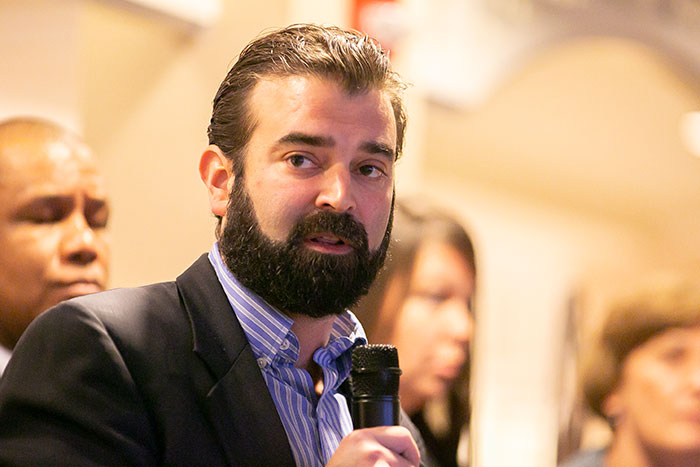
Below is a submission from Democratic Rep. Jarrod Ousley, who represents House District 24, covering parts of Merriam, Mission and Overland Park.
Republican Rep. John Resman and Republican Rep. Adam Thomas, both from Olathe, have also been offered the chance to submit columns later this week.
The views expressed in each Capitol Update are solely those of the lawmaker.
Last week, the Kansas House voted on three major pieces of legislation deserving mention.
“United” on tax reform in House
First, the House unanimously passed a tax package eliminating the lowest bracket and lowering property tax breaks. The rare and united position should give the House the stronger position in the conference committee between the House and the Senate where the chambers will negotiate the differences in their two tax plans.
However, immediately after the House passed its tax bill, Senate President Ty Masterson sent the Senate’s tax bill back to committee. Since the Senate could have passed their bill with its differences or passed the House bill as written, the unnecessary delay with the referral of the Senate tax bill back to committee indicates there will likely be protracted disagreements in the tax conference committee.
It remains to be seen which tax relief plans will be hammered out in the conference committee.
An “attack” on health care for transgender teens
Second, the House passed the nation’s most regressive health care attack on children’s health care as it relates to hormone treatments or gender affirming care.
The House, a body without medical experience, has no business stepping in to dictate to parents or medical providers the treatments they are permitted to use or not use. The bill not only bans surgical procedures — which do not occur in Kansas — but also prevents doctors from prescribing puberty-blocking hormones that allow children to delay the onset of significant bodily changes as they seek counseling and therapy to determine their best course forward as they grapple with body dysmorphia.
Self-harm and suicide are at significantly increased risk for transgender children who cannot access the health care they need. This is a very small, vulnerable community, and parents and health care professionals should not be prevented from providing care that would delay the onset of bodily developments that could increase the risk for self-harm.
A bill to fund special education with “voodoo math”
Finally, the House participated in some “voodoo math” to quote Republican Rep. Dave Younger, a former school superintendent, referencing the House’s education finance bill.
The bill does provide a small increase in state dollars for Special Education funding, roughly $70 million. However, the SPED funding shortfall is much higher than that, and both recommendations from the governor and the State Board of Education have laid out much higher spending plans, infused over several years, to meet the State’s deficit.
To meet the remaining shortfall, the bill reclassifies local option budget dollars as “state funding” and mandates local dollars are spent on Special Education, thus allegedly meeting the state’s statutory obligation to fund special education at the 92% of excess costs that state statute demands the state fund.
Up until this session, school districts’ Local Option Budgets have been understood to be both raised by local districts and under their control to cover expenses as the local boards see fit. “Option” is even in the name of the funding, although for years the state has mandated that districts raise at least 15% of their funds through LOBs, equalizing efforts for lower income districts, while higher income districts (like the Shawnee Mission School District) raise LOB dollars to the maximum amount provided under state law, at 33% of their budget.
LOBs are used by districts within their discretion, but with the state underfunding Special Education dollars by $170 million dollars this year alone, most Districts are already spending a significant portion of their LOB on meeting the needs of special education costs — because those costs must be paid as required by federal law. This is money that is already in use.
The “voo-doo math” portion of the bill is changing the categorization of Local Option Budget dollars to “state funding” and mandating that it be spent on Special Education. The districts will still have the shortfall, but their one local stream of funding will no longer be within their discretion, and additional funds won’t actually be coming from the state.
The bill also contained several pieces of questionable policy, including abolishing the Special Education Task Force staffed by education experts that earlier this year voted to support infusing more dollars into SPED so as to meet the state’s statutory obligation, and instead creates a different task force filled with legislators.
Rep. Kristey Williams, who introduced the bill, likened it to a parent putting restrictions on a child to make sure they could be responsible with their funds. A more apt analogy would be an abusive parent confiscating the money their child made at their own job to pay for their car and car insurance, and then only providing the child with a smaller portion of their money and claiming the “gift” of the dollars back came from the parent.
To recap, LOB dollars we raise locally through property taxes here in Johnson County, a portion of which are already being used to make up for the state’s failure to meet its statutory obligation to fund SPED, are now to be called state funding for special education.
What happens next?
Local Option Budget dollars were part of the state finance formula that satisfied the Gannon ruling, and since those dollars are no longer able to be counted as general education funds, the state is about to fail compliance with the funding requirements under the Gannon decision.
As the Kansas Supreme Court released jurisdiction on that matter last fall, the Legislature has created an environment ripe for another school finance lawsuit yet again.
We are simply voodoo mathing our way back into court.
 Thanks for reading! If you value having an independent news outlet keeping tabs on local government, schools and taxes, we're asking you to contribute to our Education Reporting Fund.