Earlier this summer, the Post asked our readers what issues you wanted to hear candidates in contested races address leading up to the Nov. 5. election.
Based on that feedback, we developed a five-item questionnaire centering the issues most important to residents across Johnson County.
Each day this week, we’ll publish the candidates’ responses to one question. Read the candidates’ responses to the previous question about test scores and student achievement, standards and curriculum guidance and school choice and privatization.
Today, we’re publishing candidates’ responses to the following question:
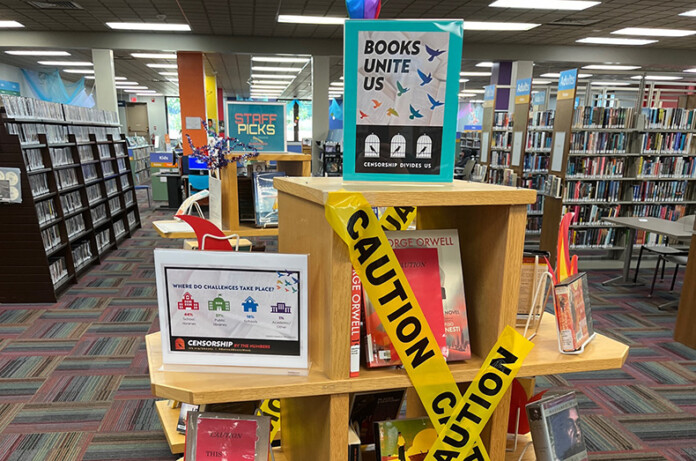
Districts in Johnson County have continued to see parent and community member challenges to library books and classroom materials they deem to be inappropriate or offensive, usually along the lines of being too sexually explicit or overtly addressing LGBTQ themes. What is your position on how schools and districts should handle such challenges? What guidance should the state board give districts on this matter?
Below are the answers the Post received from candidates on the issue:
Area 4
Connie O’Brien (Republican)
 No to banning books. Books must be age appropriate. No sexual explicit books or pornography. Parental guidance is important.
When a parent is concerned administration and school boards need to listen. Moral values are a parents job.
Kris Meyer (Democratic)
 I oppose blanket book bans and believe that local districts should handle challenges to library books and classroom materials through established processes that respect both parental input and students’ right to access diverse perspectives. Educational materials, particularly those addressing complex social issues like LGBTQ themes, should not be censored based on the preferences of a few individuals. Instead, districts should have review committees in place, consisting of educators, parents, and librarians, to evaluate concerns and make decisions based on educational value rather than fear or prejudice.
The State Board can provide guidance by reinforcing the importance of intellectual freedom and supporting policies that ensure districts follow a transparent, evidence-based review process. Schools should be safe spaces where all students see their authentic selves reflected in the curriculum, fostering empathy, understanding, and critical thinking. Limiting access to diverse content undermines these goals and denies students the opportunity to engage with the world in meaningful ways.
Area 2
Fred Postlewait (Republican)
 Such items that are of emotional importance should be the province, primarily the local district. Since these items are not in the mainstream of primary education, they are at the
edge of state control.
The state should insist that the district, under the direct review of the voters, committees that include parents that pay to have the child educated with those parental views as the child still lives in their house and the district should be mindful that the parents are the people they are working for, and who pay their salary.
It is wise for the contractor to follow the wishes of the patron/parent, not outside parties that wish to clutter the minds of people who are legally still children, not yet adults.
Melanie Haas (Democratic, incumbent)
 Efforts to ban books date back decades—centuries, even. The process of selecting or removing books falls very much within the domain of locally elected school boards. The only guidance I would suggest is, districts should have written selection criteria and clear challenge criteria. Beyond that, it’s a matter of local control because every community is different.
I’d like to note that school librarians are licensed teachers who have also trained in specific content areas and are therefore qualified to hold the title of teacher-librarian. In Kansas, it is a requirement that each school district employ at least one teacher who is licensed as a librarian. Kansas has state library standards, which cover instructional aspects only. These were most recently reviewed by the state board in 2023.
When you hear a book is being challenged as “pornographic,” that is simply not true. This latest wave has been orchestrated at a national level and focuses on books with LGBTQ themes, even attempting to ban books from kindergarten classrooms simply because a character has gay parents. It’s important that students learn to love reading, and they will do that when they follow their hearts (and librarians!) to find books that speak to them and inspire them. We should do everything we can to encourage students to read.
“Banning books is just another form of bullying. It’s all about fear and an assumption of power. The key is to address the fear and deny the power.” ― James Howe
Kiel Corkran (Independent)
Did not provide the Post with a response.
Coming up:
Tomorrow we will publish the candidates’ responses to the following question:
Some readers expressed their concerns about bullying and the seeming lack of an inclusive school culture, particularly for LGBTQ students, in their local schools. As a member of the state board of education, do you have a role in supporting and protecting the rights of LGBTQ and other marginalized students? What can the board do to ensure all students feel welcome at their schools and have their rights protected?