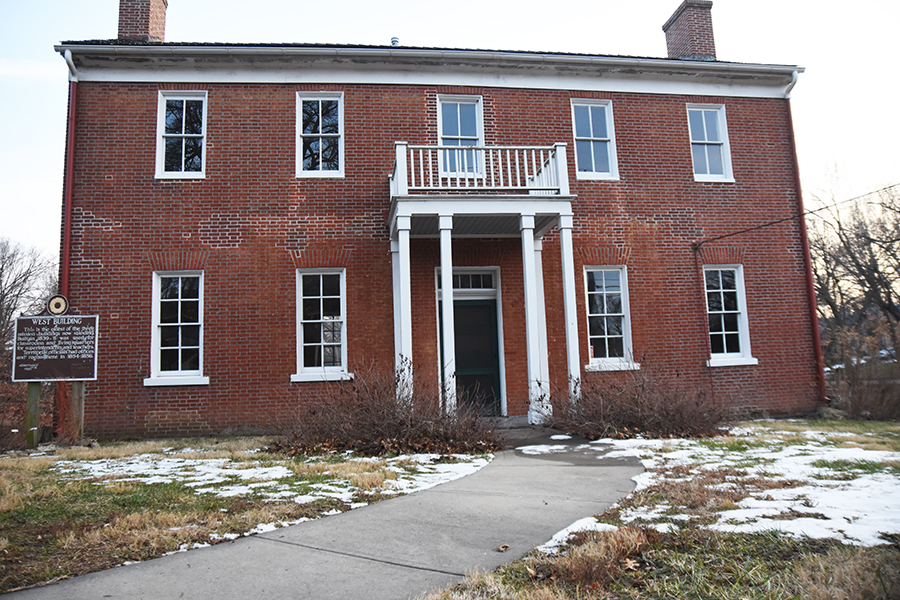
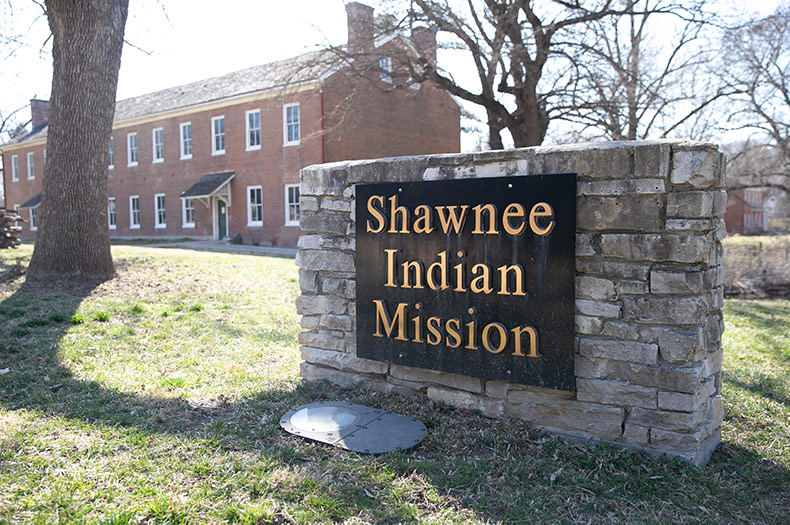
All parties with a vested interest in the Shawnee Indian Mission want to see the national historic landmark’s three buildings restored and maintained, with reinterpreted exhibits, for the public’s benefit — but there remains the argument over who should own the site.
Key stakeholders argued that question this week in a Kansas House committee hearing over a bill that would hand over one of the state’s most visited historic sites to the Shawnee Tribe.
The Oklahoma-based tribe that still gives its name to the landmark in Fairway wants to take over the 12-acre grounds from the Kansas State Historical Society.
On the other hand, the society, the city of Fairway, which maintains the site, and the nonprofit Shawnee Indian Mission Foundation, which fundraises for it, all want the state to maintain control.
House Bill 2384, which in legalistic parlance would “convey” the mission site to the Shawnee Tribe, has reignited the controversial question of who gets to own the Shawnee Indian Mission. For nearly the past 100 years, it’s been the state of Kansas.
A similar bill received a hearing in 2024 but was never voted on by a committee.
This year, many of the same individuals who testified for and against the transfer of the mission to the Shawnee Tribe returned on Tuesday during a hearing before the House Committee on Federal and State Affairs to rehash similar arguments.
This time around, HB 2384 has the written support of the four federally recognized tribes of Kansas: the Prairie Band Potawatomi Nation, the Iowa Tribe of Kansas and Nebraska, the Kickapoo Tribe of Indians of the Kickapoo Reservation in Kansas and the Sac and Fox Nation of Missouri in Kansas and Nebraska.
The committee is expected to take final action on HB 2384 later this week. If the committee approves the bill, the matter would then be taken up by the full Kansas House.
How did we get here?
The future ownership of the site has come into focus in recent years, in large part because of a growing rift between the Shawnee Tribe and the city of Fairway.
In October 2021, the Shawnee Tribe and the city announced a partnership to investigate the history of the Shawnee Indian Mission, particularly its early days when it operated as a Methodist-run Indian boarding school from the 1830s to 1860s.
That investigation included looking for potential unmarked graves of Native children who attended the Shawnee Indian Manual Labor School, which spanned 2,000 acres of land in what was then the territory of Kansas to which the Shawnee Tribe had been forcibly relocated from their original homes further east.
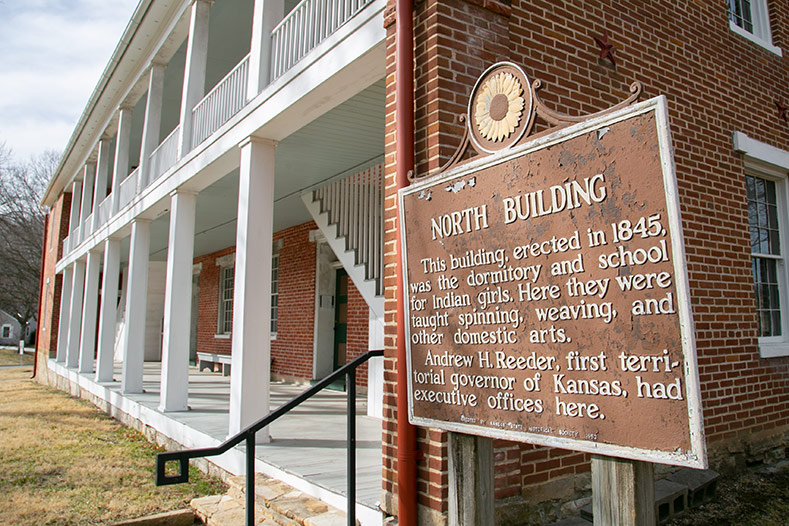
The three buildings that still stand near 53rd Street and Mission Road, just south of Bishop Miege High School, are all that remains.
But within a year, all hopes of a partnership fizzled out.
The Shawnee Tribe raised the alarm over concerns that the search for unmarked graves was not being handled with requisite cultural sensitivity.
Around the same time, a tribe-commissioned study concluded that the buildings at the Shawnee Indian Mission were in “deep distress” — a conclusion strongly disputed by the city. Upon release of that study’s findings, Shawnee Tribe Chief Ben Barnes began calling for the tribe to take over ownership of the site.
In January 2023, a pair of bills entered both chambers of the Kansas Legislature that aimed to transfer the Shawnee Indian Mission land from the state to the tribe.
Nothing happened with the bill in 2023, but the House version of that measure — which was alive for two years — did receive a hearing in 2024, but it died in committee.
Now, the new bill has the same goal: Transferring ownership of the land to the tribe.
This bill, like the ones introduced in 2023, states explicitly that the site cannot be used for gaming purposes, like a casino.
New language in the bill also requires the Shawnee Tribe to consult on the future of the site with the four federally recognized tribes of Kansas and any other tribes that sent children to the Shawnee Indian Manual Labor School in the 1800s.
Opponents say the bill jeopardizes public aspect of site
The overarching theme of opponents’ remarks this week was that the site of the Shawnee Indian Mission is a public space, which means it is for everybody and its upkeep also accountable to everybody.
Turning it over to the Shawnee Tribe potentially threatens that shared mission of allowing everyone to take part in the reinterpretation of the site, they said.
Speaking for herself at Tuesday’s hearing, Melissa Garrett, an enrolled citizen of Quapaw, Cherokee and Seneca-Cayuga Nations, said she believes the site needs to include not only the history of Native children, but its connections to the Black community and the state of Kansas.
After its decades as a boarding school, the mission briefly served as the Kansas Territory’s state capital and also was used as Army barracks for Union troops during the “Bleeding Kansas” era.
Garrett told the committee that her grandfather endured “assimilation and hardship” when he was taken to the federally-mandated Carlisle Indian Industrial School in Pennsylvania as a child.
Equating the Shawnee Indian Manual Labor School with federally-mandated schools like Carlisle “oversimplifies the history and diminishes the suffering endured” at federally-mandated boarding schools, she said.
The Shawnee Indian Manual Labor School “played a role in assimilation,” Garrett said, but students were allowed to return to their tribes for holidays and summer breaks.
“Comparing the Mission to the federally-mandated boarding schools that fought to kill the Indian and save the man distorts history for political and financial purposes,” Garrett said. “Historical trauma should never be exploited. The Mission’s past should preserve [sic] with honesty, not for profit or selective storytelling.”
For their part, the state historical society, the city of Fairway and the Shawnee Indian Mission Foundation maintained their positions that transferring ownership to any entity other than the state could result in the loss of significant state history and public educational opportunities.
Fairway City Administrator Nathan Nogelmeier told the committee on Tuesday that more than 12,000 visitors go to the Shawnee Indian Mission annually, making it the second-most visited state historic site in Kansas. The first is the state capitol building, he said.
Since the city and the state historical society entered a partnership in 2016, Nogelmeier said the city and the foundation have invested $945,000 into the site. In that time, the state historical society has invested more than $1 million in capital improvements, too.
Nogelmeier questioned who could be more publicly accountable than the state and city itself, and what problem the state is trying to solve by transferring the land to the tribe.
“This committee has an opportunity to affirm what the state of Kansas and its people have said for nearly 100 years,” Nogelmeier said. “That is that the Mission’s stories are too big and too historically significant for any one group or any one segment of the population.”
“Come to the Mission and let the buildings speak for themselves, because these buildings have a lot to say,” Nogelmeier added.
Proponents say the site needs restoration, tribal consultation
Barnes, the only proponent of the bill who spoke to the committee on Tuesday, restated previous arguments he’s made saying the Shawnee Indian Mission has “suffered from years of neglect” while in the hands of the state and under the city’s management.
Barnes told the committee that there is “no meaningful, long-term restoration plan” and that the site will continue to decline without a clear plan. Recent repairs to the site are “too little too late,” he added.
Aside from making physical updates to the buildings, including the West building that has been deemed unsafe to enter, the Shawnee Tribe wants “to tell the full story of the site’s role in Native history.”
That would include enhancing the historical programming and helping visitors understand the historical significance of the site.
Barnes said some opponents have misrepresented the bill’s intention by stating that transferring the site to the tribe will jeopardize history outside of the site’s time as a boarding school.
“The reality is that history is already being lost,” Barnes told the committee. “Every day that the site is left to decay, we lose irreplaceable parts of our shared past.”
Patrick Zollner, the executive director of the Kansas State Historical Society, told the committee on Tuesday that the West building has never been open to the public because it was housing for site administrators up until the 1990s.
The building’s interior needs to be restored, he said, but it is weather-tight, the brickwork has been repaired, and the HVAC systems are updated.
Chairman Joseph Rupnick of Prairie Band Potawatomi Nation, one of the four federally recognized tribes in Kansas, spoke neutrally about HB 2384 on Tuesday.
Rupnick said his tribe would support HB 2384 if the bill is amended to include a clause that states the bill “ensures all tribes with historical ties to the school have a voice in its future.”
Barnes asked the committee to include both of the points Rupnick mentioned in an amended version of the bill.
Rupnick said the four Kansas tribes believe it is important for them to be consulted on key decisions at the site moving forward and that the site be under ownership of a federally recognized tribe (no matter what tribe that is).
The bill is up for final action on Thursday
- The committee is anticipated to take final action on HB 2384 on Thursday, Feb. 27.
- Final action means the committee can vote the bill out of committee, potentially moving it forward in the legislative process.
- Last year, the bill got only so far as a hearing — no final action.
Go deeper: Watch the entire hearing in the embedded video below, starting at 56:30.