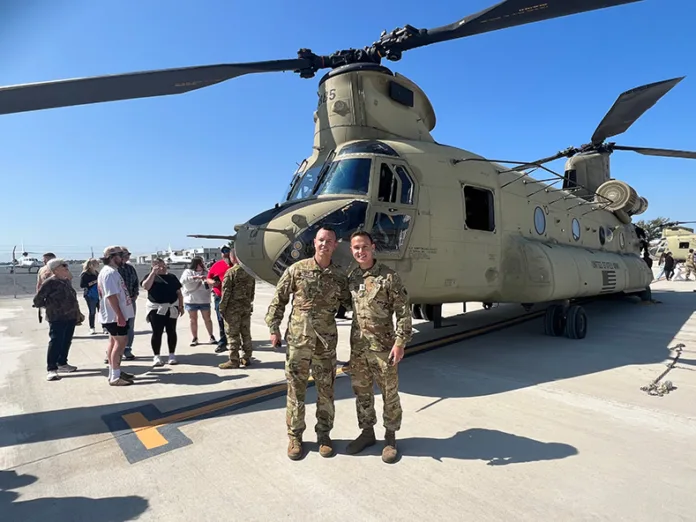
The sound of Chinook helicopter engines filled the skies over Johnson County one final time this past Sunday.
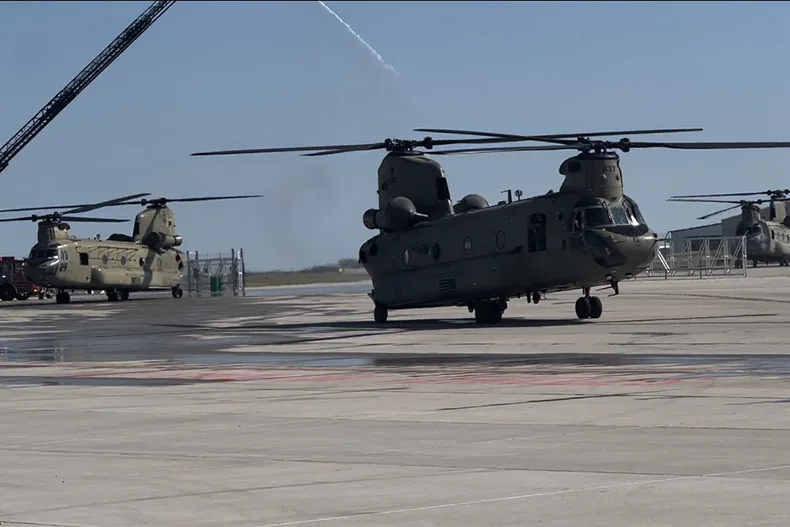
Dozens of families, friends, the Gardner community and retirees united at New Century AirCenter for an emotional last liftoff and showcase of the U.S. Army Reserve’s iconic twin-rotary helicopter.
Eleven Chinooks lifted off together for a 45-minute farewell flight around the southern part of the Kansas City metro and returned to New Century greeted by a water salute from Johnson County Fire District #1 and applause from spectators, marking the end of an era.
The Chinooks came to the area in the late 1970s and are the last military aviation unit stationed at Johnson County’s New Century AirCenter.
Why are the Chinooks going away?
As the result of a directive by the Trump administration in April to reorganize the military under Secretary of Defense Pete Hegseth, the Army Reserve Aviation Command unit based at New Century AirCenter was ordered to deactivate all rotary-wing units and assets in accordance with the Army Transformation Initiative.
It’s part of a larger reshuffling that will deactivate all of the Army Reserve’s helicopter units, impacting some 4,600 reservists and support personnel nationwide in states from California to Texas, according to Military.com.
The Bravo unit had been based at New Century for about four decades. Officials said the unit is losing its budget and flight hours with an official end date set of Sept. 15, 2026.
“The Army wants a more leaner and lethal force,” Lt. Ryan O’Neil told the Post. “But it might be reactivated one day. It has played a super important role over the year in the Army’s military operations.”
O’Neill rode on the lead Chinook on Sunday and said the flight was bittersweet.
“It was awesome, though, and extremely rewarding seeing the amount of people out there,” O’Neill said.
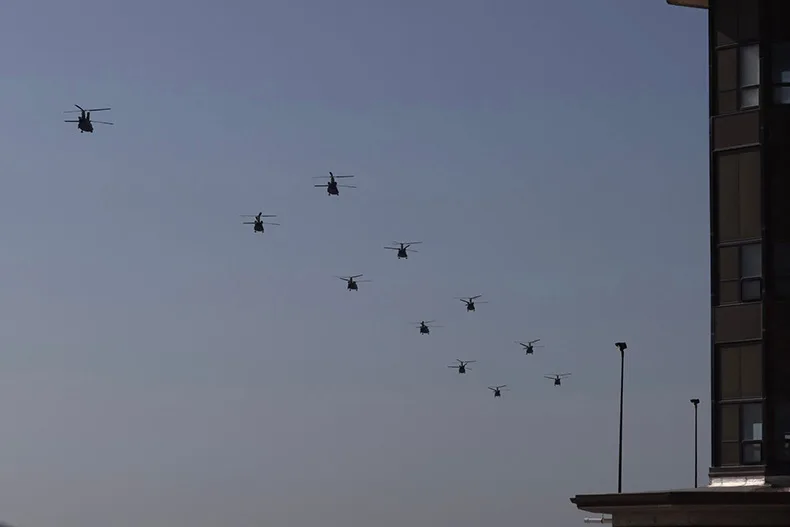
O’Neill added that the Army Reserve aviation will push the pilots into other directions, like flying for commercial airlines or joining different military branches with aviation units.
One of those pilots is Chief Warrant Officer 3 Brandon Williams, who has over 20 years of experience and wanted to keep flying.
“It is hard to know it’s all ending, and it’s heavy on the heart,” Williams said. “I thought I had another five years.”
Military.com reported that many aviation reservists were caught off guard by the air units’ deactivation notice and some face the prospect of months of retraining for new roles in different specialties.
Two brothers and pilots Amos and George Bechthold both went into aviation growing up, but have found future opportunities. Amos and George were both on Sunday’s lead Chinook.
Amos said he joined the unit as a mechanic, but a certificate he earned years before from his flight instructor Bob Robinson allowed him a few years later the ability to fly out of his first airport. He has been hooked on flying ever since.
“It’s been emotional — a lot of people have been here a long time,” Bechthold said. “It has been fantastic to be a part of something that means so much to Gardner.”
Amos said he has plans to fly Sky West Airlines, but the history and experiences of flying a Chinook will always live within him.
“On the final approach it sinks in,” Bechthold said. “You step off and you’re not getting back in.”
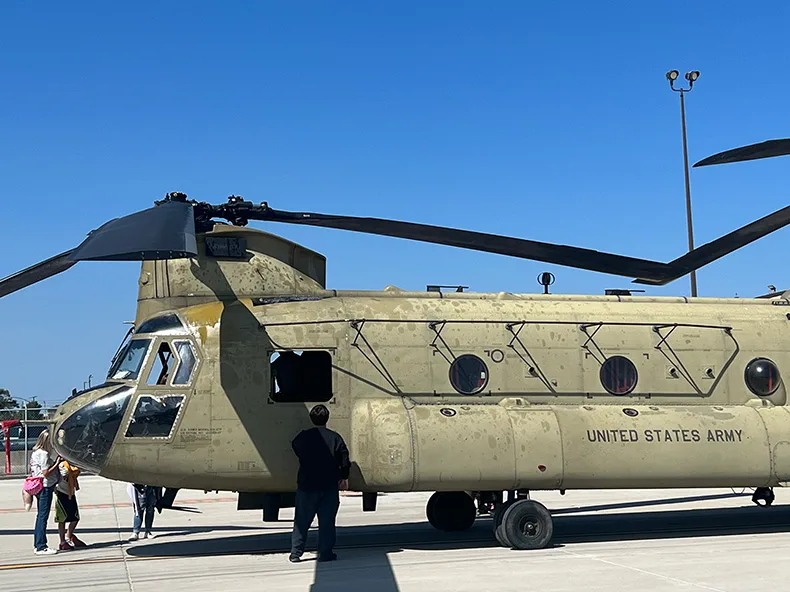
His younger brother George said he has other future options for his flying and military career.
“But some people may never fly again,” Bechthold said. “It’s sad it (the Chinook) isn’t going to be around again, because it is a different experience.”
“I feel like I have lost a close friend”
Standing by were the local residents who have watched Chinooks depart and fly over the Gardner and neighboring skies for decades. Tiffany Leigh Reynolds lived in Gardner for 16 years and said she had to come say goodbye as the deactivation personally hurt to witness.
“The Chinooks have been an everyday part of life for us,” Reynolds said. “We are sad to see them go, and this deactivation will have quieter skies, but the sounds will live on in many lives in this community.”
Reynolds’ children would dart in and out of their front door trying to catch a glimpse of the aircrafts as they flew above their house over the years.
“My kids’ love for all things military aircraft started with their love for Chinooks,” Reynolds said. “When they run outside and always yell either, ‘Mama, it’s a Chinook, or ‘Mama, it’s Papa’s helicopters,’ I am sure going to miss that.”
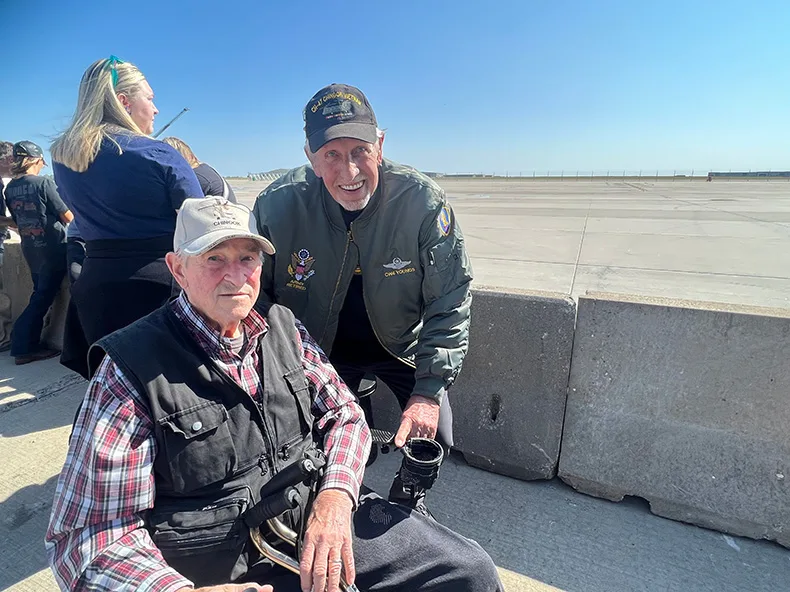
Retired veterans Robert Youngs and Dudley Beck from Bravo Company 7-158th GSAB smiled through tears as they nostalgically reminisced about their times together as “Spartans” and friends.
“I love that aircraft,” Youngs said. “I knew that’s what I wanted to fly. The CH-47 is a workhorse and one of the best heavy lift rotary wing aircrafts. There is no aircraft like it, and it had to be in the Top 10.”
Youngs flew Chinooks during the Vietnam War in 1969 and 1970 for the Boxcars 178th ASHC. He retired from the Army in 1999. He married his wife, Rose, at New Century in 1987 on a Chinook in their flight suits.
“He saw me in a flight suit and fell in love,” Rose Youngs said. Robert Youngs smiled, shrugged and then jokingly quipped that flying a Chinook was “the most fun you can have with your clothes on.”
Beck said he wasn’t a pilot, but the crew chief who helped “get the bird ready to go.” He was assigned to the 190th Aviation Company and retired in 2000.
“It is like having a beloved pet, and then that pet dies,” Beck said. “I feel like I have lost a close friend.”