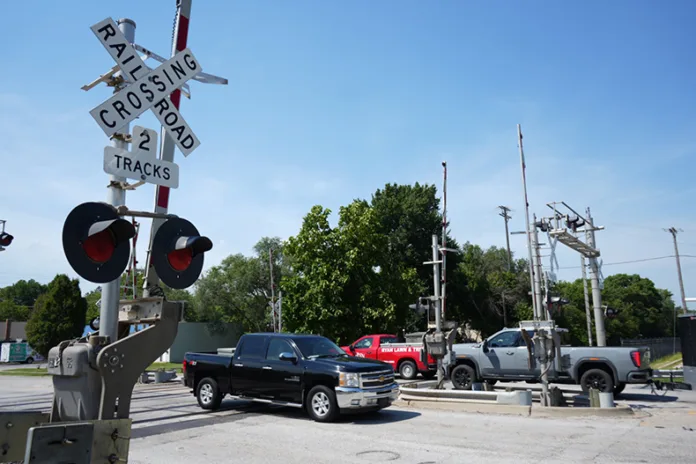
Olathe will soon begin a long-awaited study of nine railroad crossings on the city’s west side. The study will be the first step in improving traffic delays and safety concerns.
In August, the Olathe City Council approved the study as well as grant funding for the project. Originally set to begin last year, the study was delayed in order to seek a grant from the Federal Railroad Administration, which it received.
Olathe will contribute $500,000 to the study — which was laid out in its capital improvement plan — while the FRA grant will cover $1,750,000 of it. The remaining $100,000 will come from BNSF Railway, bringing the total to $2,350,000.
The city will use the study to determine its priorities when redesigning the crossings, as not all crossings will be improved at the same time — if at all. Other goals for the city and BNSF are to look at safety improvements, traffic flow, affordability, and efficiency.
City Engineer Nate Baldwin, who presented to the city council at last week’s meeting, said he often hears concerns from the public about travel time reliability. Around 80 to 90 trains pass through western Olathe every day — stopping traffic for an average of four minutes.
The study is set to be completed in early 2028.
“It’s going to take some time to get through this process and figure out what we want to do, what we want to do first, and what’s the best thing we can do for Olathe,” Baldwin said at the meeting.
The crossings are located at:
- Dennis Avenue
- Elm Street
- Loula Street
- Park Street
- Santa Fe Street
- Mulberry Street
- Harold Street
- Woodland Road
- Spruce Street
Eight of the crossings are at-grade — meaning trains and vehicles are at the same level. The crossing at Spruce Street is low-clearance — vehicles pass underneath the track. However, trucks get stuck underneath the bridge several times a year.
The study isn’t a guarantee that changes will be made to each crossing, but will help the city to make those environmental assessments.
“This also gives us a better chance to take a deeper look into each of the projects, do some preliminary engineering on them,” Baldwin said at a previous city council meeting.