Johnson County — like many parts of the United States — has experienced a housing shortage for years now, and a 2021 housing study released by United Community Services of Johnson County quantified the problem.
The study had a detailed profile of the unique housing needs and conditions in each Johnson County city, and went so far as to call out specific annual unit construction needs through 2030 for the majority of these cities, including Overland Park, Olathe, Prairie Village and Lenexa.
Some cities, like Westwood, Fairway and Lake Quivira, called small-tier communities and didn’t have specific number recommendations, but more qualitative suggestions to update codes, prevent some of the teardown-rebuilding activity, increase opportunities to age in place and encourage redevelopment.
Some individual cities have made strides in new housing over the past couple of years. However, deficits in other cities widen the housing shortage felt across the county.
Here’s a breakdown of how cities across Johnson County are doing on their housing unit number goals:
De Soto
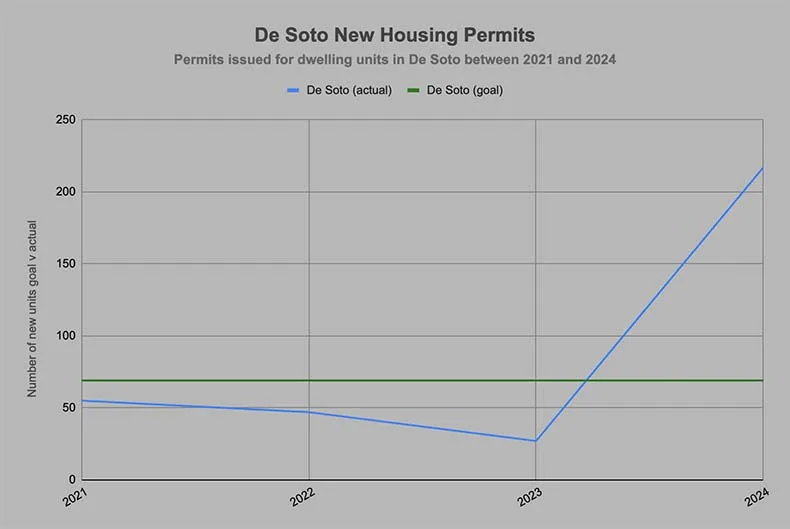 De Soto has stayed on track with the goals set out for it in the housing study.
With an average annual construction need of nearly 70 units, De Soto needed to add about 280 housing units between 2021 and 2024. The city has surpassed that goal, adding nearly 350 units during that time. That being said, De Soto was bolstered by the single-year approval of more than 200 units in 2024, making up for some slower years previously.
A major caveat to all of this, however, is that the housing study came out before Panasonic announced its plans to open a new electric vehicle battery facility that promised to bring thousands of new workers to the region. As such, it does not ponder what kind of housing needs those employees may have.
De Soto’s Community Development Director Brad Weisenburger will be the first to admit that there is a gap, but says the city has tried to “keep a pretty open mind” when it comes to new housing projects.
“We’ve encouraged the workforce housing,” he said, though the city wants a variety of housing types, including more single-family homes.
Edgerton
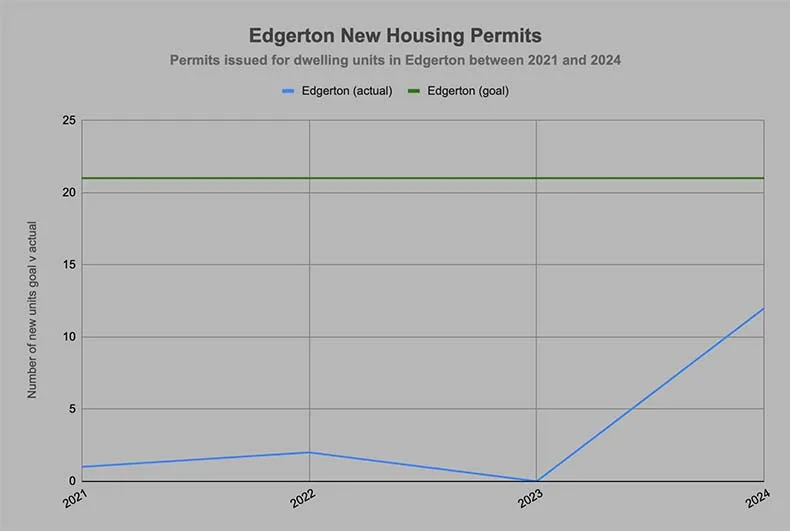
Edgerton has stayed pretty on track with its goals, albeit falling behind somewhat.
All told, Edgerton had an average annual unit construction need of about 20, putting the amount of new units needed by 2030 around 80.
Over the past few years, the city has approved the most permits in 2024, with 12. In 2023, it approved no permits.
The city of Edgerton declined the Post’s request to speak to the city’s community development or planning officials for this story.
Gardner
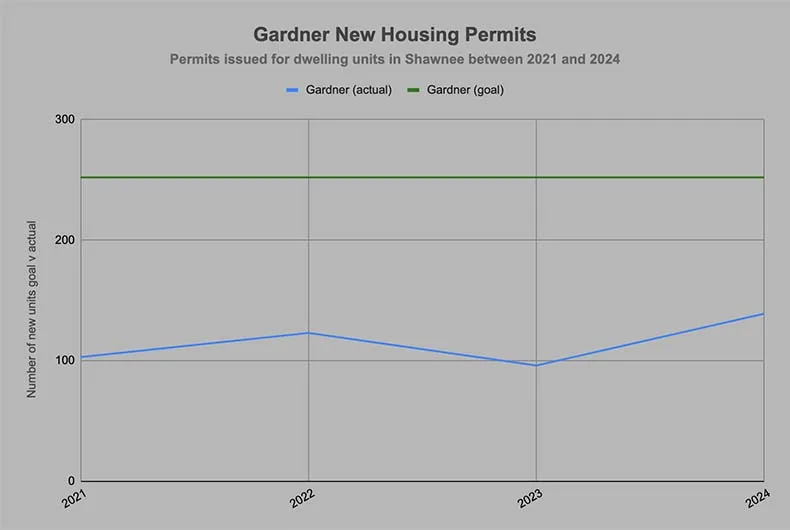
Gardner, though it is one of the Johnson County cities with the most growth potential, has struggled to keep pace with its housing study goals in the past few years.
By the end of 2024, the city had issued about 460 housing unit permits, about half as many as it would have needed to in order to stay on track.
That being said, city staff have said the city is interested in adding more housing to the area and including multifamily options as well.
“What we’re seeing in our housing market is a growing market, but also a market that is bringing a variety of different housing types to the community,” said David Knopick, Gardner’s community development director.
Additionally, he said the city is using the housing study “as a base point,” driving a focus on affordability and a variety of housing types beyond traditional single-family homes.
Leawood
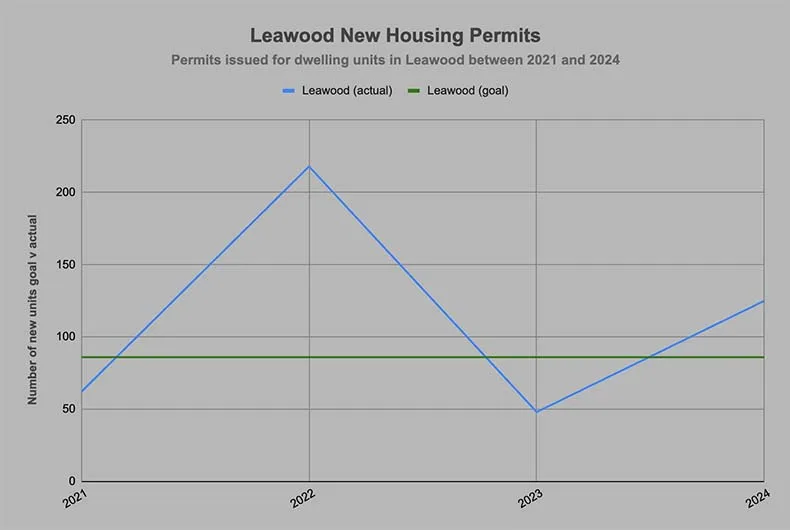
For Leawood, the city has stayed pretty on par with its housing study goals despite a couple of slow years due to large numbers of permit approvals in both 2022 and 2024.
The city has an annual average construction need of nearly 90 units, bringing the amount needed by the end of 2024 to 350 or so. Instead, the city had issued roughly 450 permits, more than 100 units in excess.
Mark Klein, Leawood’s recently retired planning director, told the Post in an interview last year that the city is interested in attracting housing options of all varieties to the city. He said they’ve been putting an eye toward affordable options for young professionals and long-term residents who want to downsize.
“I think part of our working with developers is to try and get a variety of different types of housing,” he said.
Lenexa
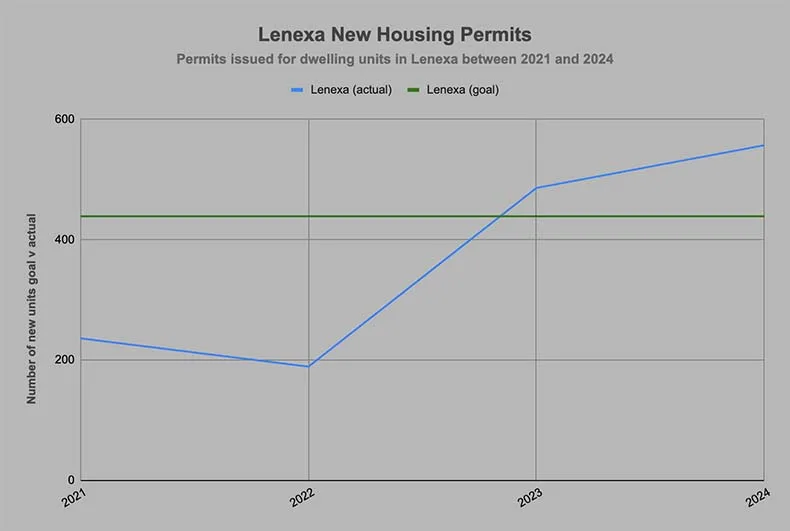
In Lenexa, the city straggled behind in the first couple of years out of the pandemic, approving just about 190 permits in 2022, but had nearly tripled that number in 2024 to almost 560 permits.
With an average annual unit construction need of 440, Lenexa would need to build nearly 1,800 units between 2021 and 2024 to stay on track. However, at about 1,500 units, the city is almost 300 units behind.
Lenexa’s Community Development Director Scott McCullough said the city is looking toward more types of housing options.
“It’s healthy for the city to have diverse housing,” he told the Post in an interview in late 2024. “Our role is to create a regulatory environment that accommodates what the market is trying to do, what the market needs, what the market is trying to supply.”
Merriam
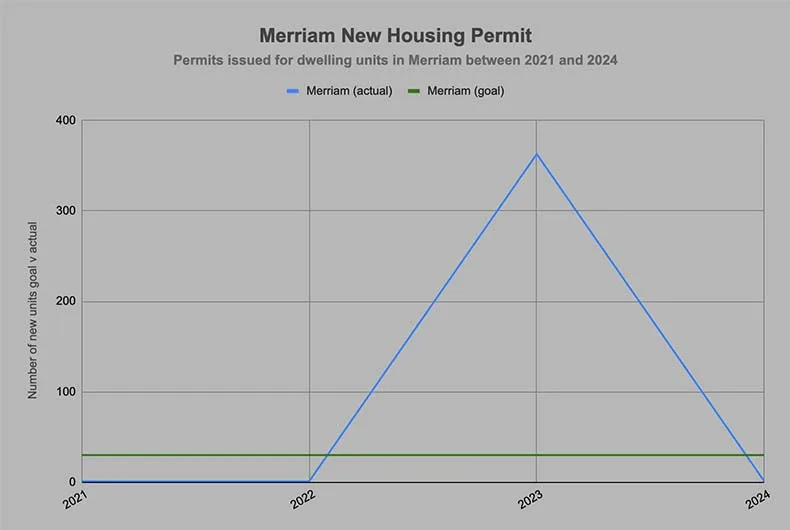
Merriam is on top of the goals laid out for it in the study, thanks in part to a major redevelopment project that promised more than 350 new multifamily units near Shawnee Mission Parkway and Antioch Road.
The city has an annual average construction need of 30, putting the number of new housing units needed by the end of 2024 at 120. At more than 350 new units in that timeframe, the city is about 250 units above its housing study goals.
When contacted for this story last year, a city spokesperson highlighted the Merriam Grand Station project but declined to answer the Post’s further questions about the city’s housing outlook at that time or respond to the Post’s request to speak to the city’s community development director.
Mission
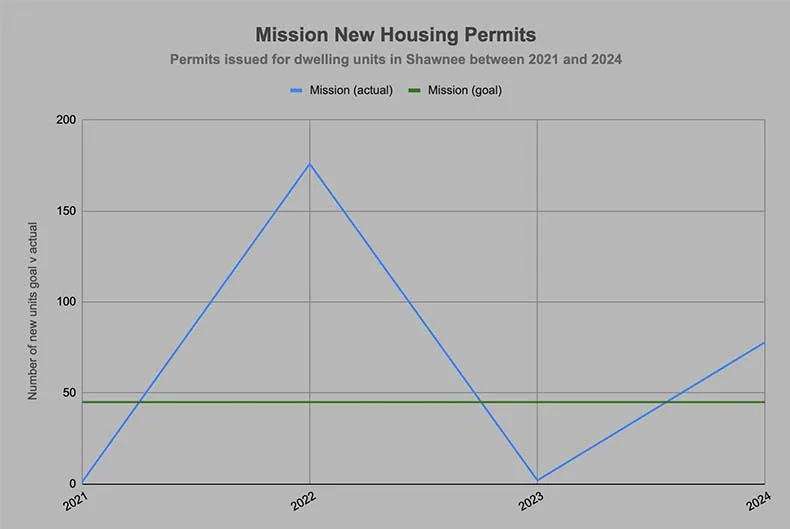
Mission, over the past few years, has stayed fairly on track with its goals.
The housing study says Mission needs to build, on average, nearly 50 new housing units each calendar year, which would make the number needed by the end of 2024 roughly 200. Instead, Mission has added nearly 260 new units, putting it at a slight surplus.
There have been a few years of slower permit approvals, but the city approved more than 175 units in 2022 and nearly 80 units in 2024 to buoy the city.
The city of Mission did not return the Post’s request for comment on this story.
Olathe
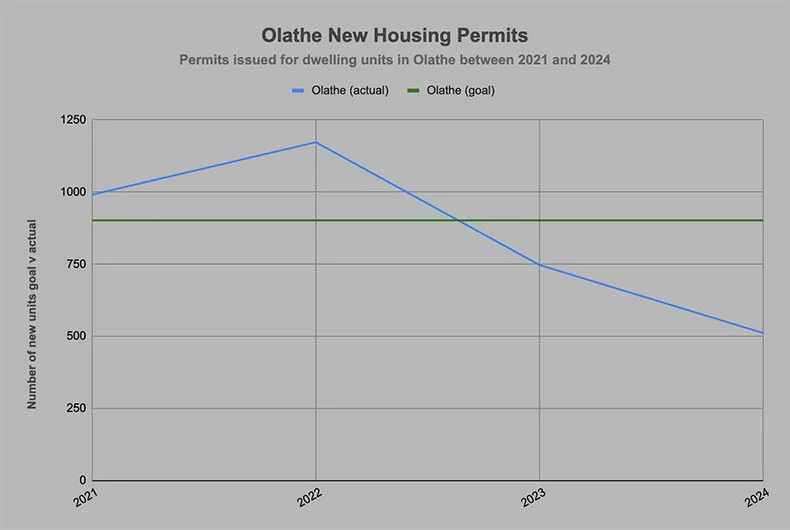
Olathe is starting to fall behind its goals, in part due to a slow year for housing unit permits in 2024.
The city has an annual average construction need of about 900, putting the total amount estimated to be needed by the end of 2024 at 3,600, of which Olathe has fallen short by about 200 units.
However, with a combined total of approximately 3,400 permits between 2021 and 2024, Olathe issued more permits than any other city in Johnson County for new housing units during that same period.
Additionally, unlike some other Johnson County cities that rely on redevelopment or infill development projects to bring new housing, Olathe has more space both inside current city limits and on the potentially annexable rural fringes.
“There’s certainly growth and things to come,” said Cody Kennedy, Olathe’s spokesperson. “But we’re trying to make sure that regardless of who you are, Olathe is a viable destination for you to live here.”
Overland Park
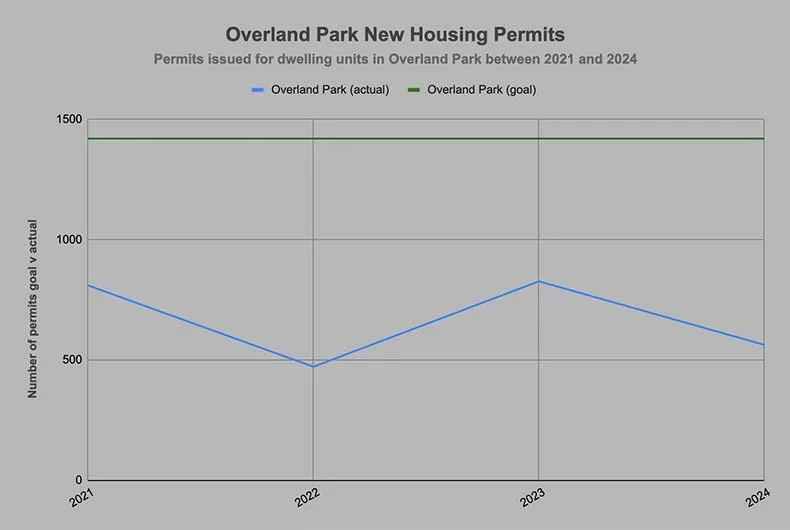
Of the housing unit goals set in the 2021 housing study, Overland Park’s goals, as the largest city in the county, were the highest.
So, though the city approved more than 2,500 units between 2021 and 2024, it is falling well short of its goals.
The study said Overland Park had an annual construction need of about 1,400 units, bringing the total estimated to be needed by 2024 to more than 5,600. Instead, the city permitted about 2,700, putting it at a deficit of roughly 3,000 units — the largest deficit.
However, Overland Park, like Olathe, has space in city limits and beyond to develop housing to some degree, though officials say they need developers to propose projects for those areas.
“We’re relying on the private market to bring housing to the community, and there are factors outside of our control that are influencing the private market,” said Leslie Karr, Overland Park’s planning and development director.
Prairie Village
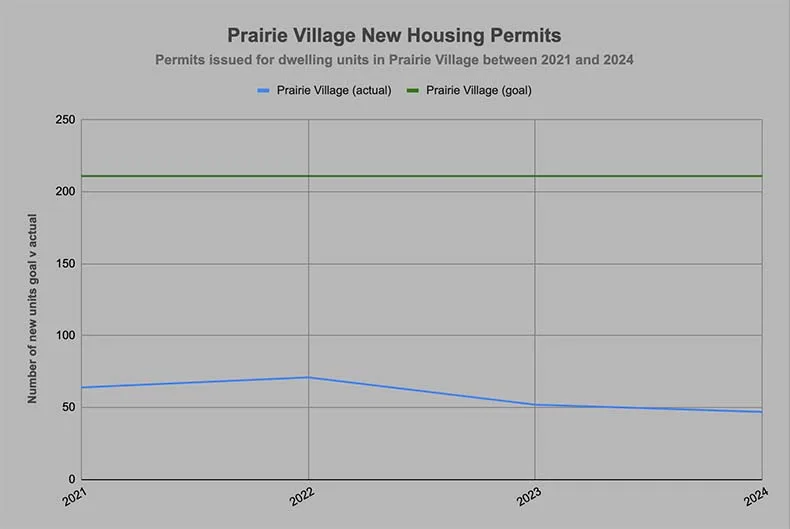
Prairie Village, where housing and what to do about its growing unaffordability has become an increasingly hot topic, is falling behind the goals.
In the housing study, Prairie Village was given an annual average construction need of 210 or so units, putting the amount needed by 2024 at around 840.
But, during that time, the city approved just around 230 units, putting it at a roughly 600-unit deficit.
Initially, the city was one of the first to publicly tackle the recommendations in the housing study, looking at ways to make it easier for people who help run a successful community, like teachers, firefighters, service workers, etc., to find a place to live.
However, fierce opposition from a group of residents who saw these conversations as a threat to their way of life halted those efforts.
Now, a few years later, Prairie Village is falling behind its goals, and city staff say they’ve backed off the issue entirely.
“I think it’s safe to say they have moved away from it,” said Wes Jordan, the city administrator. He also said the city is no longer working on anything related to the findings of the housing study at this point.
Roeland Park
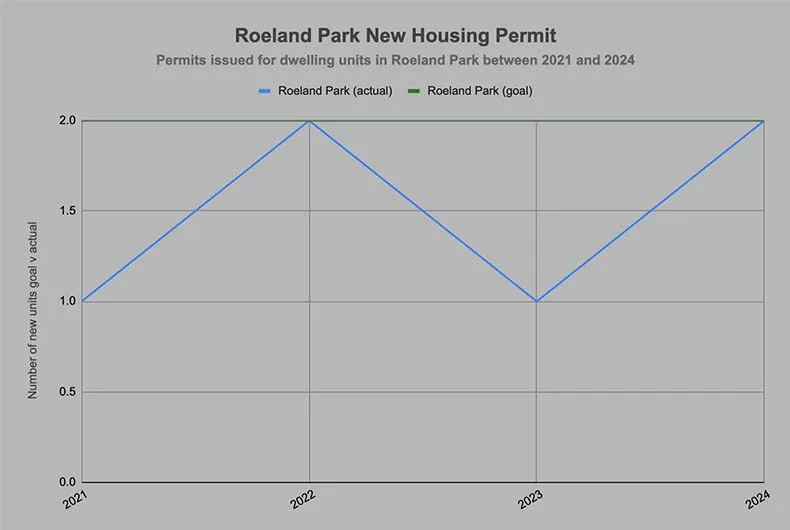
Roeland Park has, by far, the smallest per-unit goal recommended in the housing study. That being said, the city has been able to stay on par with it.
The city has an annual average construction need of two units, which, aside from a couple of years with just one permit, it’s managed to keep on top of.
City Administrator Keith Moody said the city isn’t seeing anything in the way of new construction because it is completely built out and “there is no greenfield land available.”
“New construction entails displacing existing construction, and the cost associated with this makes it challenging for developers to find profit in such projects,” Moody said in an email.
He also noted that it can be hard to pull together the parcels to do those projects in the first place if a developer did have the capital or financing to advance them.
That being said, the city long sought a developer for what is now The Rocks mixed-use project at 4800 W. Roe Blvd. That contains upwards of 200 apartment units with a specific carve-out for affordable units, on a property that was once a city pool.
Moody said he thinks that project “will add housing variety that is currently not available in Roeland Park,” which is something residents have expressed a desire for in past long-range planning efforts.
Shawnee
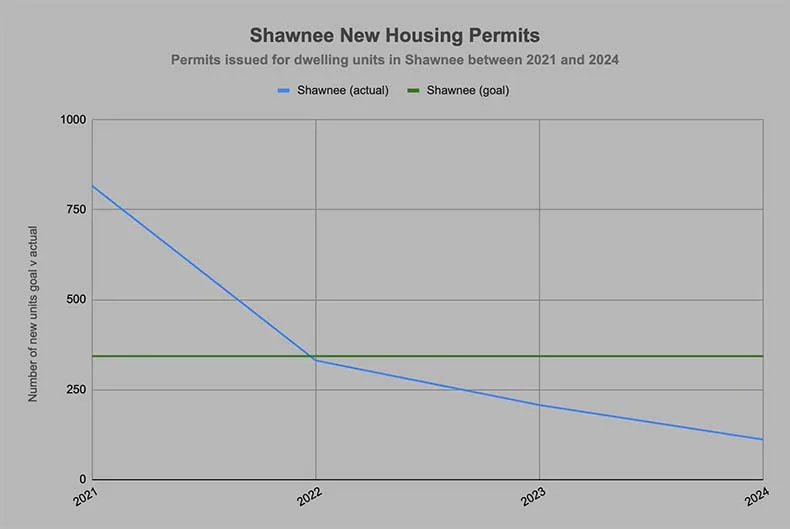
The city of Shawnee is pretty on par with its housing study goals, helped in part by an early boom in permit approvals.
Shawnee has an annual average construction need of 340 housing units, which would make the amount needed by the end of 2024 nearly 1,400. That’s about where the city landed, approving slightly more units than that in that window of time.
That’s because the city signed off on more than 800 permits for new multifamily and single-family housing units in 2021, putting them ahead early. So, in subsequent years, even as the number of new unit permits dwindled and bottomed out to roughly 100 in 2024, they stayed pretty on target.
The city of Shawnee declined the Post’s request to speak to the city’s community development or planning officials for this story.
Spring Hill
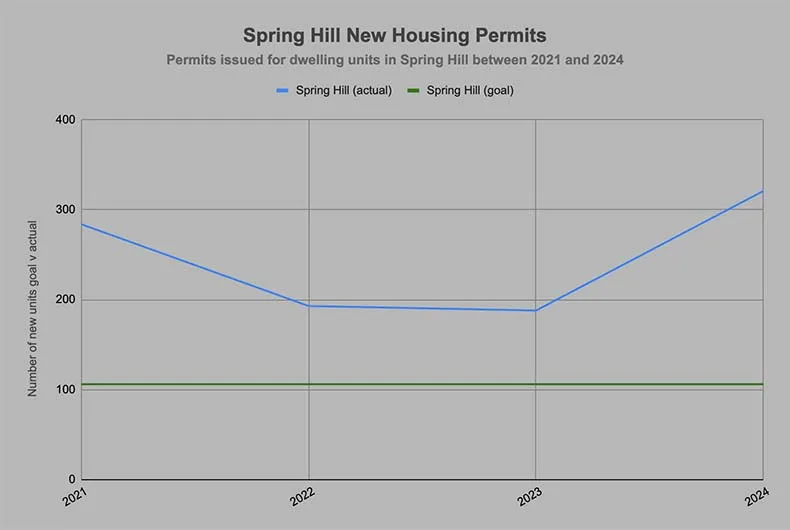
For Spring Hill, which partially lies in neighboring Miami County to the south, the city has gone above and beyond its study goal, putting it well in surplus.
The city has an average annual construction need of 100 or so units, putting the total needed by 2024 around 400. However, the city has signed off on more than double that number of new housing permits, approving nearly 1,000 new units in that time.
That tracks with a recent report from the county assessor’s office that depicted Spring Hill as one of the hottest growth areas in Johnson County.
The city of Spring Hill did not return the Post’s request for comment on this story.
Keep reading: A Johnson County couple feels squeezed by housing market. Data shows they’re not alone.