Editor’s note:
This story is the final of a four-part series about housing challenges in Johnson County.
Read our first part introducing the county’s housing shortage here. Read our second part about costs for developers to build housing here, and read our part about the impacts of neighbor opposition on housing projects here.
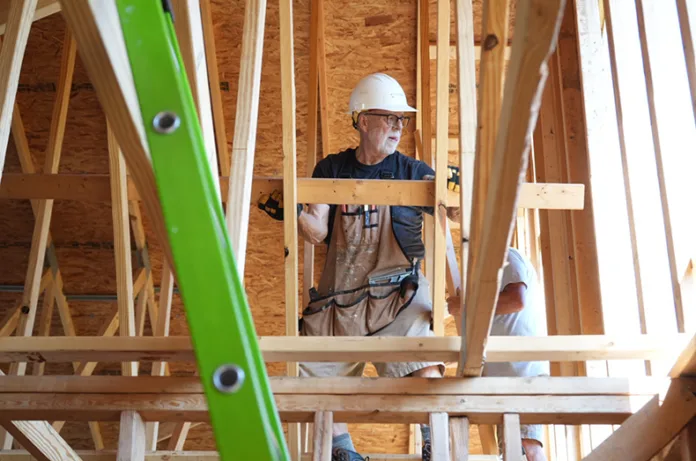
It was ripping hot out, and there wasn’t much shade offering respite from the sun that was blazing down.
But still, volunteers were out braving the summery conditions, tools in hand, helping to build one of the 14 single-family homes Habitat for Humanity of Kansas City is building in southern Olathe as part of its Pathway at Heritage Park affordable neighborhood in partnership with Pathway Community Christian Church.
This project, located around 159th Street and Black Bob Road, is one of Habitat KC’s biggest efforts to date in Johnson County.
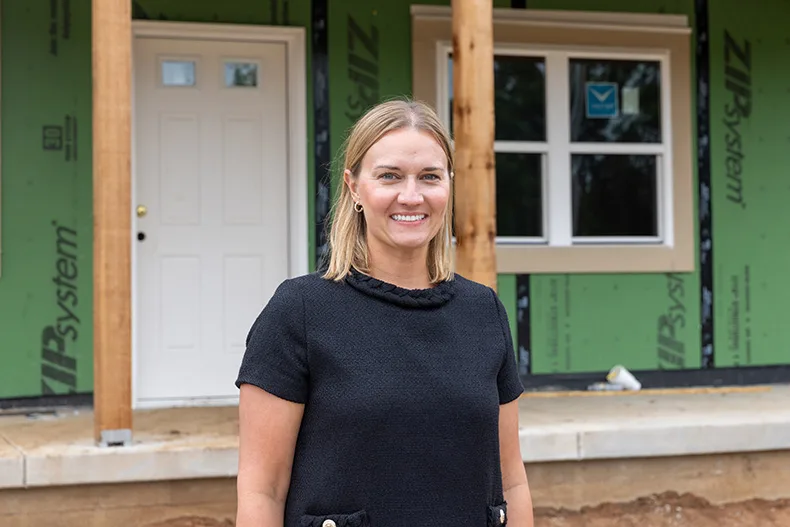
Aside from some infill projects “here and there,” said Lindsay Hicks, CEO for Habitat for Humanity of Kansas City, it was the first major construction project Habitat had embarked on in Johnson County. Now, construction is well underway.
All of that comes as the nonprofit has started to put more focus on supporting homeownership and housing access in Johnson County, but there’s still more to be done.
So far, it has initiated a donor-backed down payment assistance program, deployed its housing counselors to the area, and secured more than $1 million for an income-qualified home repair program within the community.
Plus, after a plan to convert a Lenexa hotel into the county’s first low-barrier, year-round homeless shelter fell through last year, the county commission reallocated some of the federal pandemic relief money that was earmarked for that project to Habitat KC for more pocket neighborhoods like Pathway.
Even so, Habitat is finding it needs to grow its footprint in Johnson County and put more priority on this community to help address more of the gap when it comes to housing, Hicks said.
“We knew there were big gaps,” she said, “but once that program and once that project went live, just the outreach and the number of folks calling, we recognized that we need to pour more of our resources into Johnson County as well.”
Habitat’s neighborhood projects and its other initiatives in Johnson County are some of the ways local groups, cities and nonprofits are trying to address the housing gaps in the community.
However, these small-scale efforts to add a few units here and there can come up well short of meeting the county’s widening housing shortage. Still, this story, part of the Post’s wider coverage of housing, seeks to highlight these efforts that may be small-scale, though potentially life-changing for some individuals and families.
Addressing housing shortage will require a “menu” of solutions
Throughout Johnson County, local officials have emphasized the need for development of all kinds of housing, from workforce housing to higher-end single-family homes, across the spectrum, though they acknowledge there’s still much more to be done.
County Chair Mike Kelly has repeatedly emphasized housing as a key goal for the county, but he notes that all levels of government must be involved in the process to address the housing shortage, which he views as a “generational need.”
“Wherever you look on the housing continuum, there is opportunity to step in,” he said.
Julie Brewer, the former head of United Community Services of Johnson County, who is now on the Board of County Commissioners, said it’ll take several different types of solutions to address the challenge of housing, likening it to a menu.
“There’s not an ‘or;’ it’s a menu. … Each of those menu items helps solve the big picture,” she said. “If we can’t intentionally figure out how we want to show up in housing, it will be an issue that only grows.”
Megan Foreman, Johnson County housing coordinator, who contributed to the county housing study while working for the Johnson County Department of Health and Environment, said collaboration and innovation among organizations, local governments, and other community groups would be a good place to start.
“It really is going to take all of us to make a difference in this space,” Foreman said.

Cities, local governments are exploring some housing solutions
With all that in mind, local groups and cities have taken steps in the past few years to address the issue of housing, some in response to UCS’s Housing Study findings and some of their own volition.
In Olathe, GRATA Development’s Travis Schram said the city convened a panel of developers last year with the express intent of talking about attainable housing and the barriers to it.
Though a lot of that conversation focused on the cost of utility access for some developments, Schram said he came out of the conversation inspired to make a previously frozen single-family home project in the Woodland Road corridor in northern Olathe work.
In March, the Olathe City Council paved the way for that project to move forward, amending a policy in the corridor plan to allow more single-family lots. While the estimated sticker price on the homes he plans to build is around $500,000 — and he acknowledges that wouldn’t be considered affordable to many homebuyers — that’s about $70,000 less than the average residential appraised value in Johnson County for 2025.
Still, Schram feels those types of neighborhoods can help with the shortage issue.
“We have a shortage of housing and generally, like most things, housing is simply a supply and demand,” he said. “Inserting supply at various price points will help unfreeze the housing market in Johnson County.”
Johnson County has also offered gap financing for multifamily projects in Shawnee and Gardner. The 144-unit Hedge Lane apartments on Kansas Highway 7 got $1 million in federal pandemic relief money, and the Prairiebrooke Townhomes project off of 175th Street got $1 million in HOME funds.
The county’s involvement in those projects helped add more units for affordable housing long-term, as terms of the funding agreement, said Jay Leipzig, Johnson County’s director of planning, housing and community development.
“We’re creating new units, and they’re tied up as affordable housing,” he said.

One large city is trying out new housing incentives
Overland Park is also looking at ways to encourage housing development. In the past year or so, the city has been workshopping its first Reinvestment Housing Incentive District policy, a tool to encourage housing development that’s been explored already in Spring Hill and De Soto.
Like a Tax Increment Financing, or TIF, this type of housing district sets a base year tax valuation, and all assessed tax on any increased value is returned to a developer for reimbursement of some infrastructure development costs.
Overland Park may have its first bite at the policy.
Logan Freeman, a senior broker from Midwest CRE Advisors, has proposed building a new neighborhood that would feature a mix of for-sale single-family and twin villa-style residences, roughly at 6630 and 6680 W. 151st St.
Though nothing is set in stone, Freeman wants to establish an RHID to help cover some of the expensive, up-front utility and infrastructure costs that can be cost-prohibitive in a new development or raise the end sticker price of a housing product.
Additionally, the neighborhood would be designed using plans from the city’s Portfolio Home program. That pilot offers a collection of pre-selected, nearly pre-approved designs to encourage the development of diverse housing choices and cut down on expensive pre-development costs.
“[In Overland Park], we’re really good at building really big single-family houses and really big apartments, and so we’re trying to find a way to encourage people to do things that might be somewhere in the middle,” Leslie Karr, Overland Park’s planning and development director, previously told the Post.
Cities are carving out “missing middle” housing in new plans
Over the past few years, several cities in Johnson County have also made housing a key priority as they revisit or completely overhaul their long-range development plans.
These documents, called comprehensive plans, are guides for ideal growth in jurisdictions like cities and counties for several decades. Cities build them as a tool to help them make decisions on where housing projects and other developments would be appropriate. Recently, the Kansas Supreme Court ruled in favor of a developer who claimed, in part, that Shawnee had violated its comprehensive plan in denying a multifamily project.

Olathe is in the midst of updating its comprehensive plan right now, and Kim Hollingsworth, the city’s planning and development manager, said the ongoing effort will help identify what type of housing is appropriate and where.
“We still have a significant amount of space, some currently within our city boundaries, and then along our fringes as well,” Hollingsworth said. “The comprehensive plan update will look at that, the opportunities for growth, and, from a land use standpoint, where we should be growing.”
Lenexa also put a focus on housing when it revised its comprehensive plan a couple of years ago, specifically “missing middle” housing.
That type of housing would include more mid-sized and moderately priced as well as denser options of all sorts that are absent from the market in a given area. For instance, smaller starter homes or owner-occupied duplexes could be considered missing middle housing.
Scott McCullough, Lenexa’s community development director, said the new comprehensive plan “stresses and encourages missing middle housing,” specifically with an eye toward ownership opportunities.
“What the comprehensive plan attempts to do is provide that support for the developers that do work in that niche of missing middle housing, and welcome them to the community and say, ‘We will help support you through a process of rezoning and development,’” McCullough said. “We want to help the market provide diverse housing by laying out that framework.”
“We need as many units as we can get”
But, in the end, none of these small steps are tackling the wider shortage on an impactful scale, and elected officials have alluded to that concern.
“This is an important step, a valid step, but it goes nowhere near the expectation” of addressing such a large need, County Commissioner Michael Ashcraft said during a vote on a low-income housing rehabilitation project earlier this year.
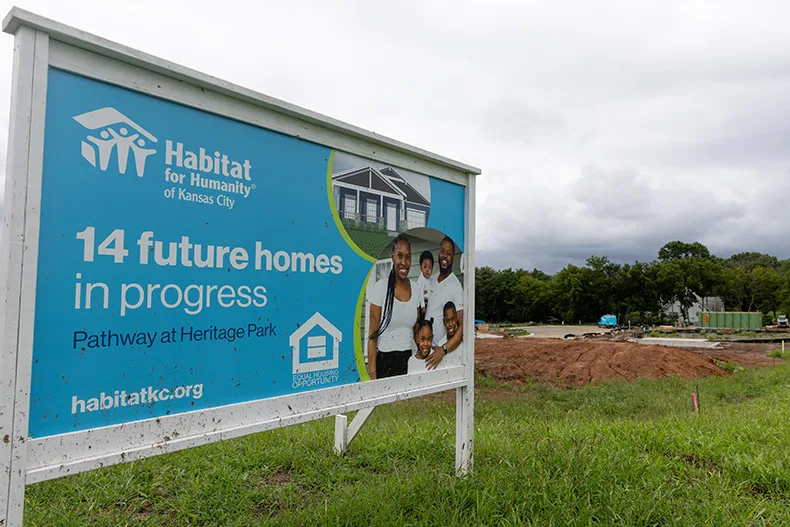
As for Habitat, the 14-home Pathways neighborhood in Olathe faced opposition from neighboring homeowners, and though several people were won over and the project advanced, resistance has persisted — a common barrier projects face in Johnson County.
“There’s just a lot of misunderstanding, and, quite honestly, a lot of just bias toward affordable housing and what people think it is,” Hicks, the Habitat KC CEO, said.
Still, Hicks sees it as a potential starting point or framework for more pocket neighborhoods elsewhere in Johnson County.
The sheer volume of interest in those homes was an “indicator” of sorts for Habitat, or a reminder that, as Hicks put it, “We need as many units as we can get.”
Keep reading: Neighbor opposition can be a barrier to housing development, officials say
 Thanks for reading! If you value having an independent news outlet keeping tabs on local government, schools and taxes, we're asking you to contribute to our Education Reporting Fund.