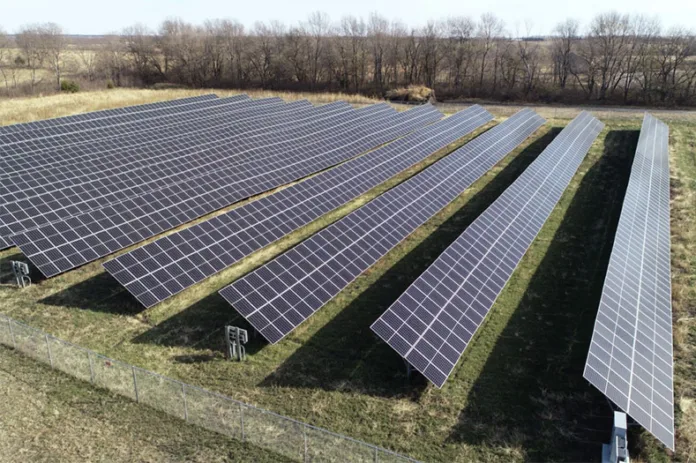
For more than three years, solar panels have provided Spring Hill High School with energy — producing enough energy each month to power 95 homes, wash 13,500 loads of laundry or charge 15 million smartphones.
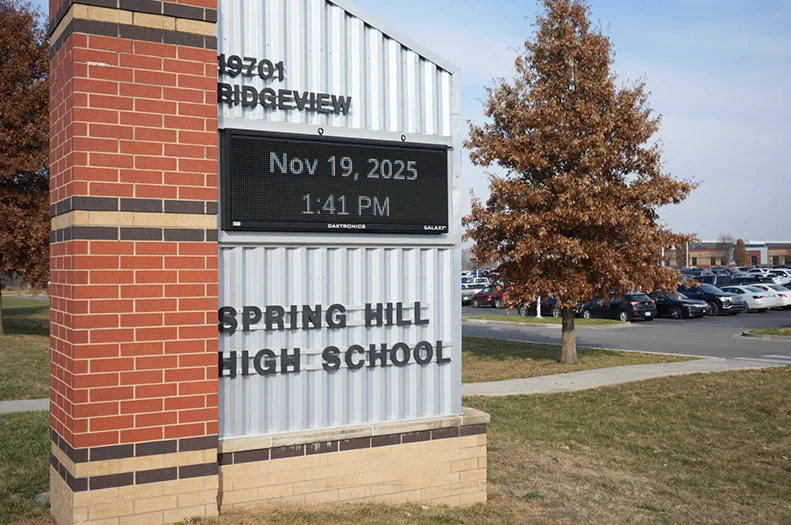
The solar array, which sits in a field just northeast of the school at 19701 S. Ridgeview Road, began operations in July 2022.
Since then, district officials say it has reduced the district’s energy costs by about $258,000, or between $113,000 and $116,000 annually, not including current 2025 figures.
“Utility bills are significantly reduced,” Director of Facilities Kyley Delphia said in a presentation updating the school board about the solar array during the board’s Nov. 13 meeting.
More than 1,800 solar panels
Spring Hill Schools partnered with utility Evergy and renewable energy company EnergyLink to design, build and operate the array that includes 1,872 solar panels and six inverters.
With federal funding, Evergy fully financed the $2 million project and inked a 20-year maintenance and operation agreement that costs the district $103,623 annually.
The district has the option to purchase the array outright after five years.
“The whole premise of the solar array is to save more than what you’re paying on a yearly basis,” Delphia told the board this month. “Our target is to save more than the $103,000 worth [what] we’re paying each year for the solar array.”
District says it’s saving $100,000+ per year
During the array’s first full year of operation in 2023, the district saved about $116,000 in energy expenses at Spring Hill High School compared to what the district had been paying before the solar array was installed, Delphia reported.
Subtract the $103,000 annual cost to operate the array, and the district was left with a positive cash flow of about $13,000.
The district reported similar savings in 2024, with roughly $113,000 saved in energy expenses, leaving roughly $9,400 in net cash flow.
“I know at the time, we felt like it was a really good decision,” said board member Sharon Mitchell. “I just wanted to see it follow up, and it seems like we’ve saved some money, not tons of money with the payout (to Evergy), but it could get better.”
Environmental and educational benefits, too
Beyond monetary savings, the solar panels help the environment, Delphia said.
“Obviously, there’s a large carbon reduction,” Delphia said. “The solar array reduces reliance on coal and natural gas power plants.”
The district noted that in the more than two years the solar panels have been up and running, it has saved more than 3.5 kilotons of CO2 emissions, equivalent to about 713,400 trees saved.
“It just demonstrates responsible stewardship of taxpayers’ funds and a strong commitment to sustainability,” Delphia said.
The array near the school also provides a unique opportunity for agricultural students, said board member Jon Chitwood.
“If ag class wanted to do an agrivoltaics project underneath it, they could do that,” Chitwood said. “There are some educational benefits and new and emerging agriculture perspectives that, quite frankly, we could offer our students that no other district could offer, as well.”
 Thanks for reading! If you value having an independent news outlet keeping tabs on local government, schools and taxes, we're asking you to contribute to our Education Reporting Fund.