
The condemnation of the Aspen Place apartments, which abruptly forced hundreds of tenants out of their homes in Gardner, shocked Johnson County when it happened nine months ago.
That shock continued to ripple on Wednesday in a Kansas Senate hearing room, as former Aspen Place residents and housing aid representatives shared their stories in support of a change in landlord-tenant laws aimed at providing more protection to tenants forced into situations like what unfolded in Gardner last year.
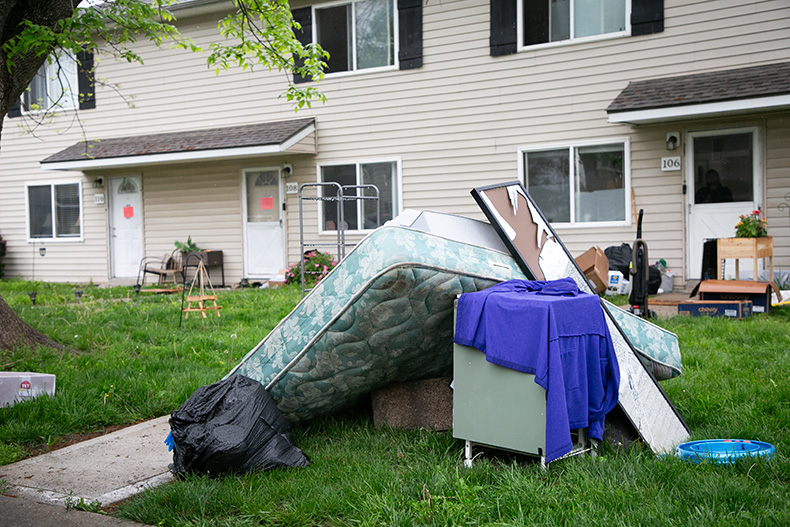
The city of Gardner’s last-ditch decision to condemn Aspen Place last May displaced hundreds of residents from 188 units at the complex at 101 Aspen Place.
The city cited, among other things, a deteriorated water system, which had created unsafe conditions at the complex, including causing a fire truck to collapse into a sinkhole. The crisis helped to inspire a flurry of proposals in the statehouse to adjust Kansas’s landlord-tenant law.
On Wednesday, the Senate Judiciary Committee heard testimony about one such bill proposed by State Sen. Doug Shane of Louisburg, who said the idea for it began to take shape as he worked with the people helping the displaced residents of his district.
Shane’s bill, SB 415, proposes a change that clarifies that tenants can pursue legal redress under the state’s consumer protection law when a landlord causes a property to become unfit for habitation. That had been unclear because of a 1979 state supreme court case.
The majority of the 13 speakers at Wednesday’s hearing were in favor of the bill, saying it opens up a legal way for tenants to get compensation for lost rent deposits, damages and other expenses after being displaced.
Two speakers who represented landlord associations spoke in opposition to the bill and asked for action to be delayed so there could be an interim study on about 20 tenant-landlord bills in the Legislature this session.
There was additional written testimony, as well.
Former residents say they have not been compensated
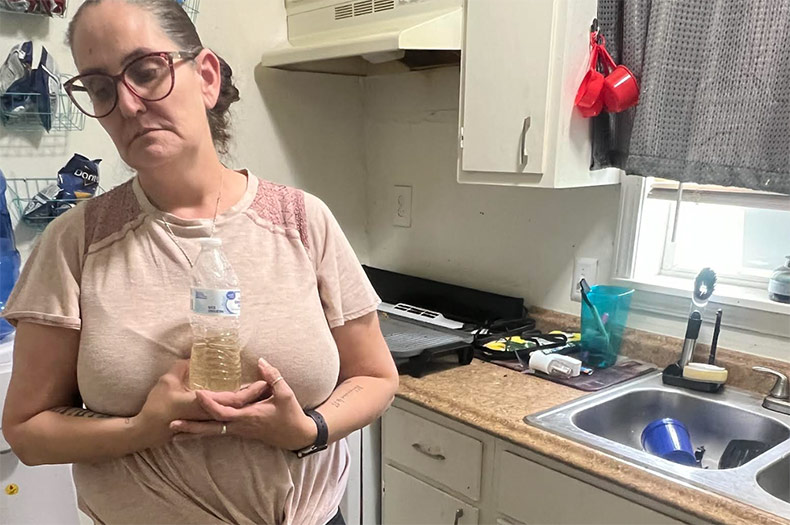
Among the proponents was Corey Thurman, a former Aspen Place resident with disabilities who said he was forced to move to Lawrence when fragile underground water pipes caused a fire truck to fall into the street last May, the event that immediately precipitated the city’s condemnation order.
Thurman had lived at Aspen Place for 13 years and endured numerous plumbing and cockroach problems there as well as water outages, he wrote in his testimony.
Like other Aspen Place residents, Thurman was given 48 hours to get his belongings out and move.
He said it took three weeks of temporary stays at four different hotels before he found his Lawrence apartment. He estimated he spent $5,000 on hotel stays, storage lockers and vehicle repairs but has not received any compensation from his former landlord, despite paying his rent on time.
Kristen Hattesohl, another former Aspen Place resident who is disabled, also appeared in person and provided written testimony.
She wrote that the apartment had numerous problems even before the water system failure. It took her just over a month to find permanent housing in Overland Park after the condemnation. That search cost her $580, according to her testimony.
Matt Keenan, executive director of the nonprofit Kansas Legal Services, said the bill is “a modest, measured approach that is sorely needed.”
He noted that about one-third of Kansans are renters.
“This is a great day for Kansans who rent and follow the rules. It’s a bad day for landlords who don’t follow the rules,” he said.
Rental landscape increasingly dominated by corporate landlords

Several of those who gave testimony referenced changes in the rental landscape.
Christina Ashie Guidry, director of policy and planning at United Community Services of Johnson County, said more rental housing in the past 20 years has been purchased by corporate investors who are more likely to defer maintenance and who evict tenants at higher rates than the small “mom and pop” landlords.
Katie Killen with Habitat for Humanity Kansas City presented written testimony saying corporate landlords own almost 80% of multi-family units in the Kansas City area, with over half of them being out-of-town owners.
“Too many times in the last year have Kansas communities faced corporate landlord properties that reach such abysmal conditions that Kansas families are given little notice of vacating the premises as the properties are condemned,” she wrote.
She added that similar situations have arisen at the Timberlee apartments in Topeka and Emery Gardens in Wichita.
Johnson County Housing Coordinator Megan Foreman testified in person with a written supplement. She noted that condemnations like the one at Aspen Place come at a financial cost to the community.
The county health department spent 250 staff hours, amounting to about $10,000, to operate a resource center for residents.
That was the “tip of the iceberg,” she said.
Other county departments, including Emergency Services, Mental Health and Planning, Housing and Community Development, were involved, as well as private community groups that provided aid.
“Had there been a mechanism under Kansas state law for tenants, the attorney general or the district attorney to work with the city and force the property owner to address habitability issues sooner, it’s likely this issue could have been prevented,” Foreman wrote.
Bill would make clear that landlords could be liable
The proposed law also got support from Kansas Attorney General Kris Kobach’s office, which gave a written statement.
The Attorney General’s letter said the change would provide clarification of a 1979 state Supreme Court decision that has left advocates unsure about whether tenant disputes were exempt from the state’s consumer protection law.
The Kansas Supreme Court’s decision in Chelsea Plaza Homes, Inc. v. Moore “has cast a shadow over tenant rights,” even though subsequent legislation dismantled it, the letter said.
Shane’s bill would remove the need for “legal gymnastics” by making it clear that landlords are liable “especially in situations where they have neglected a rental unit to such an extent that it is rendered uninhabitable.”
Landlord group pushes for a delay

Two speakers representing landlord groups opposed the bill, saying they would prefer to have an interim study on the numerous bills pertaining to the Kansas Landlord and Tenant Act.
Ed Jaskinia, president of the Associated Landlords of Kansas, acknowledged that, “there’s a lot of bad landlords out there, we know that.” But most of those “bad landlords” are out-of-state people running complexes, he said, though he did not provide any statistics in support of that statement.
He said the bill would replace the existing “fair and balanced” approach to housing with “a heavy-handed method that most likely will only hurt the supply of affordable rental housing across the state.”
Jaskinia and Martha Smith, representing the Kansas Manufactured Housing Association, said they would rather the lawmakers take a step back to study how the many changes proposed this session potentially overlap with each other.
“Evaluating them individually risks missing how they interlock,” Smith wrote.
What happens next?

Committee members took no action on Wednesday but did ask questions.
Most of them focused on how the bill would define “uninhabitable” and whether the landlords of fewer units would be negatively impacted.
Shane, who sits on the committee and also gave testimony, said he’d bring back a definition of uninhabitable.
He and others who testified sought to reassure committee members that the proposal is limited in scope and not a broad change, but would give tenants legal tools to seek compensation and could be an incentive for landlords to invest more in maintenance.
The committee’s next decision, due Monday, is whether to continue working on the bill so it can move forward in the legislative process.