Editor’s Note: This story is part of our series “Helping Hands”, which aims to spotlight Johnson Countians doing good in the background of their community. If you have an idea for someone to spotlight in a future “Helping Hands” story, email us at stories@johnsoncountypost.com.
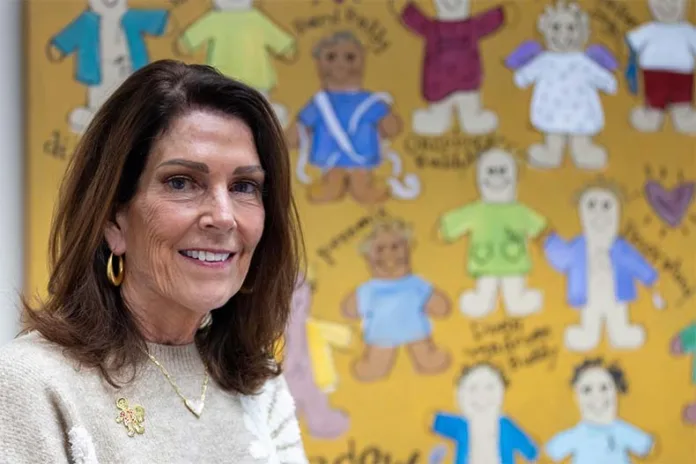
Marty Postlethwait remembers the moment she realized how isolating being sick can be.
While home from school one day more than 30 years ago, her son, Miles Postlethwait, told her that he just wished he could have a friend “just like me.”
Miles was 6 years old at the time, and he’d already undergone 27 major surgeries — including two open heart surgeries — due to multiple congenital anomalies he’d been born with. He did have friends, but he didn’t just mean any other kid.
He meant someone else with the same scars, the same medical devices, the same lived reality of long hospital stays and frequent surgeries.
“I encouraged him that he had a lot of great friends in the neighborhood,” Postlethwait recalled. “And he said, ‘Mom, I don’t have a friend that has a scar down his chest.’”
This made sense to Postlethwait. After all, during trips to the hospital with Miles, she’d seen the loneliness that could accompany kids as they were wheeled back to surgeries alone — or their parents, who sat alone waiting for updates.
So Postlethwait began to imagine something that could go with Miles (and other kids like him) into the operating room: a companion that quite literally reflected their medical journeys.
This idea became Shadow Buddies — a nonprofit that gives custom dolls to kids with severe illnesses and disabilities.
Today, the Lenexa nonprofit has been distributing Shadow Buddies for more than 30 years — with a reach now far beyond Johnson County.
Shadow Buddies mirror their companions
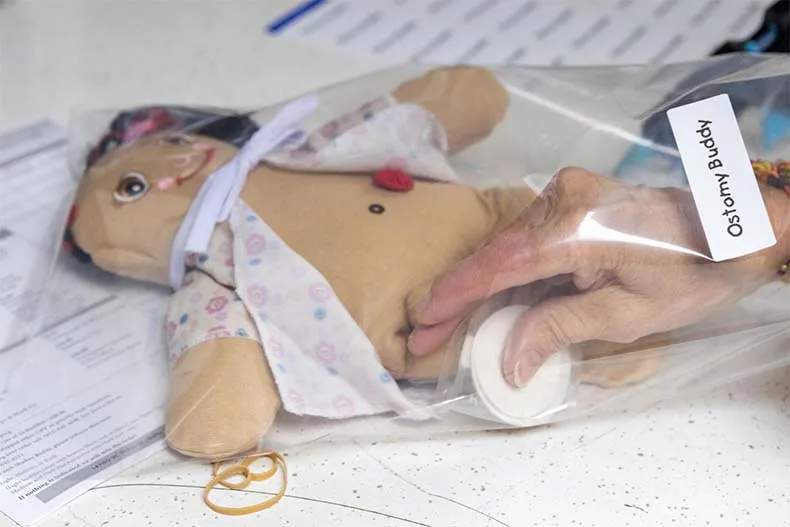
A “Shadow Buddy” is a a soft, child-sized figure that bears the same kinds of scars and medical features as the child who receives the Buddy.
There are more than 40 condition-specific Buddies to choose from. Buddies can come in light, medium or dark skin tones, and each Buddy comes equipped with a feature (or multiple) that tells people a little bit about the medical condition its companion has.
For example, Cancer Buddies come with thinning hair, a port and a mask. Other Buddies have surgical scars, leg braces or G-tubes.
Postlethwait said the name “Shadow Buddy” comes from the idea that the Buddy can follow its companion wherever they go; their “shadow”, so to speak.
Each year, the Shadow Buddies team designs at least one new buddy. This year’s addition is the “Brave Buddy” — a weighted buddy created to address mental health needs. This buddy warms to a child’s body temperature, offering sensory comfort and emotional grounding during stressful moments.
Every Buddy has heart-shaped eyes and a smile — a design choice Miles himself made when he was 6 years old.
“He wanted children to always look at themselves in a positive manner, whether they were battling a heart disease or had cancer or diabetes, whatever the illness,” Postlethwait said.
Shadow Buddies are prepared for their companions in Lenexa
Today, Shadow Buddies has four board directors, and eight board members — in addition to roughly 70 volunteers.
Postlethwait still serves as the chief executive officer of the nonprofit. Miles, now 37, serves in an advising role as a board member for the organization of which he served as the inspiration.
The dolls themselves are made in Nepal, through a manufacturing partner that employs women who have been rescued from sex trafficking.
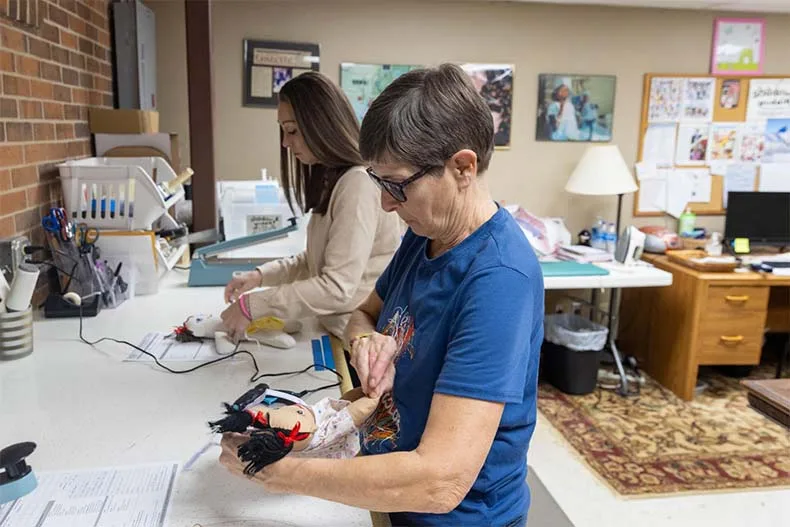
From there, the Buddies are sent to Shadow Buddies’ Lenexa office and warehouse to be dressed according to the recipients’ condition. About 70 volunteers sew for Shadow Buddies year-round, helping to dress and prepare the Buddies to head to their new companions.
Much of Shadow Buddies’ distribution happens through hospital child life departments, social workers and care teams, or corporate sponsors and pharmaceutical companies.
Families and community members can also request a Buddy for someone directly (or “adopt” one on behalf of a family in need they know) through the Shadow Buddies website.
The benefits of a Buddy, Postlethwait said, have proven to be plentiful. For example, they often give their companions a sense of understanding and control about their condition, and they equip them with coping skills during their recovery.
But they also give children and their parents hope during what can normally be a lonely and uncertain time.
“Hope is a powerful antidote when you’re dealing with sick children,” she said. “(The Buddy) mimics their condition. It gives them a feeling of comfort and having a tangible item to hold on to, and to help go through the different treatments and procedures, especially when moms and dads can’t be back there with them.”
Shadow Buddies help kids both locally and globally
While many Shadow Buddies have been delivered to hospitals in the Kansas City metro area, the nonprofit’s reach goes much farther than that.
Today, Shadow Buddies has sent more than 2.8 million buddies to hospitals and clinics in more than 22 countries.
In early 2025, the nonprofit celebrated its 30th birthday — a milestone Marty admitted she never expected when she first started Shadow Buddies.
Like many parents of children who have gone through medical struggles, she said, she remembers what it’s like to spend quiet moments bargaining during nights in the hospital, promising she would give back however she could if she could just have more time with her son.
Ultimately, Shadow Buddies became a way for her to honor that promise; by giving back to children and families in Kansas, then across the country, and ultimately around the world.
“It has been a remarkable journey,” she said. “We see the success of what we do as (being) for other people, not so much for ourselves. It’s a great way for us to give back.”
For Miles, now a father himself, the scale of Shadow Buddies’ impact is still astonishing. After all, he grew up alongside the project.
As someone who has also now undergone close to 52 major surgeries over his lifetime, it’s easy for him to imagine the comfort and relief that Shadow Buddies can bring. Some of the most powerful moments during his time with Shadow Buddies, he said, have come during hospital visits — when he sees that relief firsthand.
“When we hand out the Buddies to the child in the hospital, a lot of times it’s the first time that the kids have smiled in days or weeks,” Miles Postlethwait said. “As bad as it might have been when I was younger, there’s thousands and thousands of kids who have it a lot worse than I did. Just to be able to see them have a smile on their faces, it’s incredibly rewarding.”
More Helping Hands: This emerging poet at Blue Valley North forms ‘deep connections’ with fellow students through volunteering