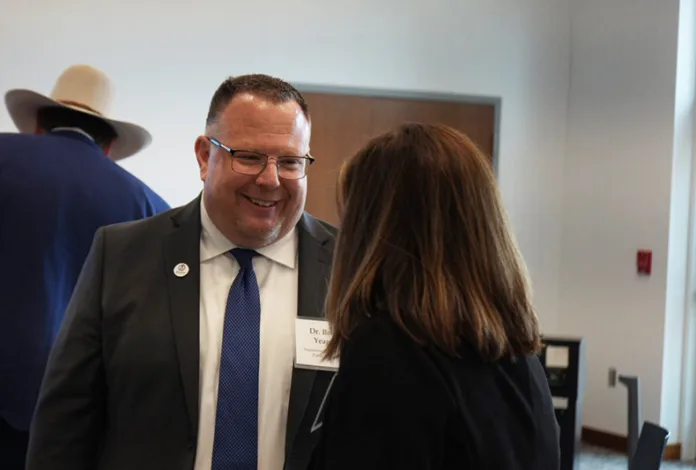
Improving teacher retention? Challenge accepted.
Educators, local officials and community leaders gathered Wednesday morning at MidAmerica Nazarene University to celebrate education and learn from speakers. The day’s theme: challenge accepted.
“I chose to accept the challenge of becoming an educator because I know the work is not easy, but it’s truly impactful,” said Devin Deprima, MNU elementary education student. “I’ve seen firsthand how patience, consistency and genuine care can make a difference in a student’s life.”
MNU School of Education’s third annual Local Education Influencers luncheon provided time for networking, a think tank activity and several speakers, including:
- event organizers Jill Gonzalez-Bravo, chair of MNU’s School of Education, and LeEtta Felter, Olathe city councilmember and MNU alumna,
- James Arkell, the developer behind Halo Ridge, a planned $320 million ultra-accessible development at 119th Street and Renner Boulevard built for everyone, including people with disabilities,
- Tim DeWeese, director of the Johnson County Mental Health Center,
- Brent Yeager, superintendent of Olathe Public Schools,
- Heather Schoonover, director of community development for Olathe Public Schools,
- and Dave McClung, Felter’s father, who told his story of trekking to the Mount Everest base camp at age 82.
Local attorney Jerry “Wally” Wallentine closed out the event, providing MNU’s education students in the room with a $250 scholarship.
Setting the example
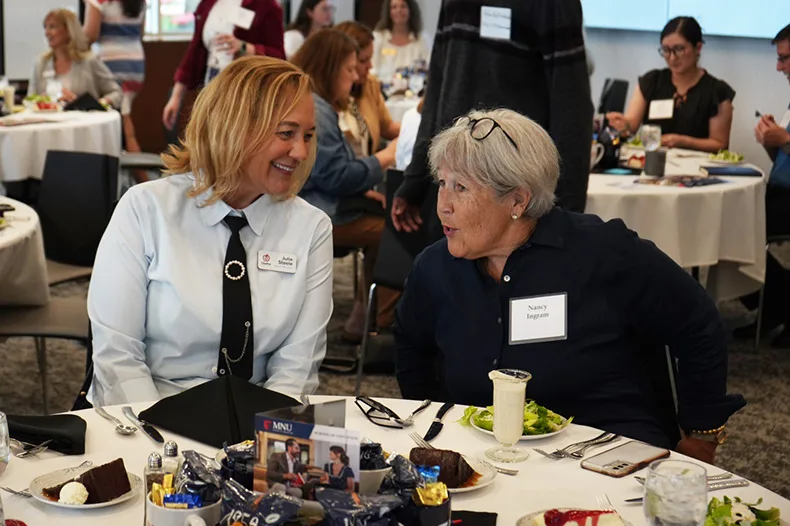
County Community College Trustee Nancy Ingram at the educators luncheon. Photo credit Margaret Mellott.
When Yeager sat down to write his speech, he asked ChatGPT to list all the things that should keep a superintendent up at night. It generated several items, all of which Yeager said he does have concerns about, but what keeps him up is something different.
“Fewer and fewer people are going into education,” Yeager said.
Educate Kansas, a service which connects educators and districts, states that the Kansas Department of Education fall 2025 vacancy report shows 1,747 teacher openings across the state.
Teacher shortages were increasing even before the COVID-19 pandemic. Experts cite low pay, challenging working conditions and public scrutiny as reasons for the shortage.
A 2025 survey from Educator Perceptions & Insights Center (EPIC), a data-driven educational analysis firm, asked more than 21,000 educators in Kansas about their jobs. According to the survey, Yeager said, only 15% of current educators feel like the public supports them. In Johnson County, it’s even lower at 14%.
“The solution is we have to change the narrative,” Yeager said about negative public perceptions of the field. “But that’s where the challenge comes from.”
It’s a culture shift, Yeager said, encouraging attendees to more frequently post positive messages and show support for local educators. It sets an example.
Setting the example, DeWeese said in his speech, encourages others to follow suit.
“I want to challenge you all to consider doing three things that I’m convinced will change the world,” DeWeese said. “It actually expands beyond three things, but bear with me.”
His challenges:
- Be a leader. It’s not about the title, DeWeese said. It’s how someone approaches tasks, connects with the people around them and chooses kindness. People follow those who lead by example.
- “We want to be leaders in the same sense that we influence the people around us,” DeWeese said, “whether that’s at work, school, church, in your neighborhood. Choose to be a leader. Choose to be kind and choose how you interact with the people around you.”
- Regulate your emotions. Individuals who effectively regulate their emotions and are resilient, he said, help the people around them better regulate their emotions and become more resilient.
- And lastly, practice self care. Regulating your emotions can be difficult if you don’t also practice self care, DeWeese said.
“If you, in turn, are going to be a good leader, you’re going to manage your emotions, then take care of yourself,” DeWeese said. “You will be a better, authentic human if you do that.”
The importance of partnerships
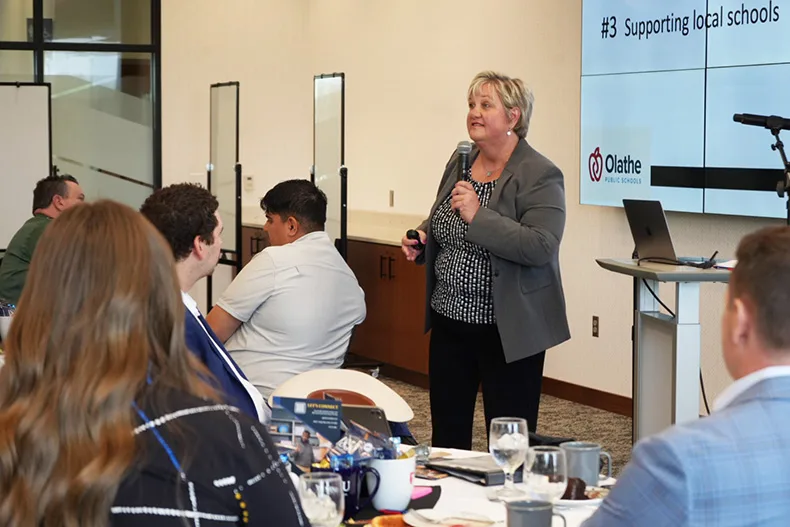
talked about forming community partnerships and how they benefit educational systems. Photo credit Margaret Mellott.
Other speakers, like Arkell and Schoonover, spoke to the importance of community partnerships.
Halo Ridge, Arkell’s 64-acre development, will be a place for both health care and fun. Services include:
- physical and behavioral therapy,
- dental and vision care,
- legal and financial planning services,
- and at the center, Michael’s WonderWorld. Named after Michael Arkell, the fully inclusive sports-themed amusement park provides access to people of all ages who use wheelchairs, allowing them to stay in their chairs while riding the attractions.
All of this, Arkell said, wouldn’t be possible without the partnerships he’s made.
“This project has evolved in so many ways and so many different directions,” Arkell said. “What it is becoming — even with all of our setbacks, we had a two-year title dispute that we inherited — over those two years, so much more has happened.
“It’s given people an opportunity to come together,” he added. “We’ve been able to put things together in a way that, if we had gotten it right then [two years ago], then it wouldn’t have happened that way.”
Similarly, Schoonover shared that Olathe Public Schools wouldn’t be able to provide the same way for students without its partnerships.
Her “challenge accepted” for the attendees was “why not?”
“I work with students who have seen more by 8 a.m. than I ever will in a lifetime,” Schoonover said. “This morning, I worked in one of our schools. A high school student drove in in a Mercedes and next to him is one of my kids that I work with through the homeless program, who doesn’t know where they’re going to be at tonight.
“So, we must all say: why not?” she added. “Why can we not help local public schools, or any school, to help create a safety net?”
For Schoonover, that’s why Impact Olathe is vital. Twice a month during the school year, Olathe Public Schools, along with several community partners, meet at one central location to help students and their families with basic needs like housing, transportation and food.
For instance, during the 2024-25 school year, Impact Olathe served 219 families, 377 students, 260 parents/guardians and 63 additional infants or adults. The services helped permanently house 11 students and prevent 59 families from losing their homes.
“Everyone can be a partner with a local school,” Schoonover said. “We need business. People thought ‘What is that school district doing talking to the faith-based community?’ It’s been a win-win … It takes us all.”