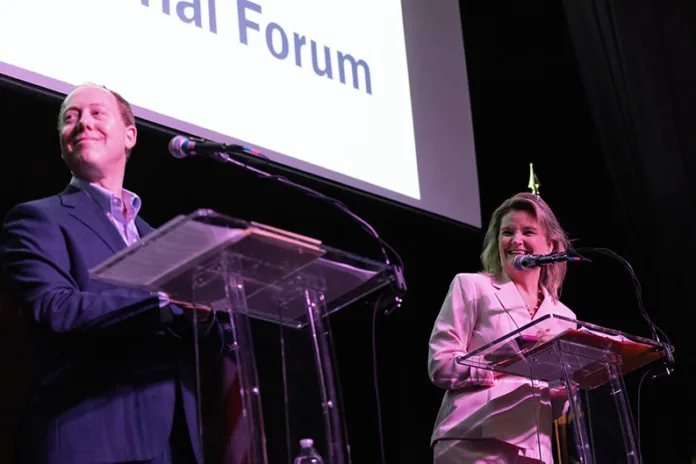
Outside Shawnee’s Aztec Theater on Sunday night, there was a tornado warning, accompanied by thunderclaps and the crescendo of rain.
Inside, as Johnson County’s two Democratic candidates for governor squared off in a forum, the weather wasn’t much different.
Ethan Corson and Cindy Holscher, both Kansas state senators, answered questions posed by Kansas’ Young Democrats about the housing shortage, ICE, transgender and abortion rights, and Medicaid expansion.
Under the surface, the message was more about style.
Corson, a Fairway lawyer who has also served as chief of staff at the U.S. Department of Commerce International Trade Administration, played up his endorsements from outgoing Gov. Laura Kelly, the two-term governor who is exiting at the end of this term, former Gov. Kathleen Sebelius, Planned Parenthood and organized labor.
“Kansans are looking to elect moderate leaders who are focused on results and willing to work across the aisle,” he said during his opening Sunday night.
Corson holds a big fundraising advantage. Per January financial disclosure reports, Corson has raised more than double the amount Holscher has: $902,641, compared to Holscher’s $397,952.
Meanwhile, Holscher referred to her ability to win in Republican districts and a Public Policy Poll that she said shows her ahead of Corson by 20 percentage points. (The poll she cited was from January and sponsored by her campaign. It showed a majority of those polled said they couldn’t decide who they’d vote for yet in a head-to-head matchup, though Holscher outpolled Corson among respondents who did declare a preference.)
As the forum progressed, Holscher also referenced successes in getting bipartisan support, while suggesting that Corson is an establishment candidate.
She said she has about 150 endorsements.
“Ultimately, I know that isn’t what makes a difference to people. Winning the top races and delivering results does. I’m running on my record, not the coattails of the establishment,” she said.
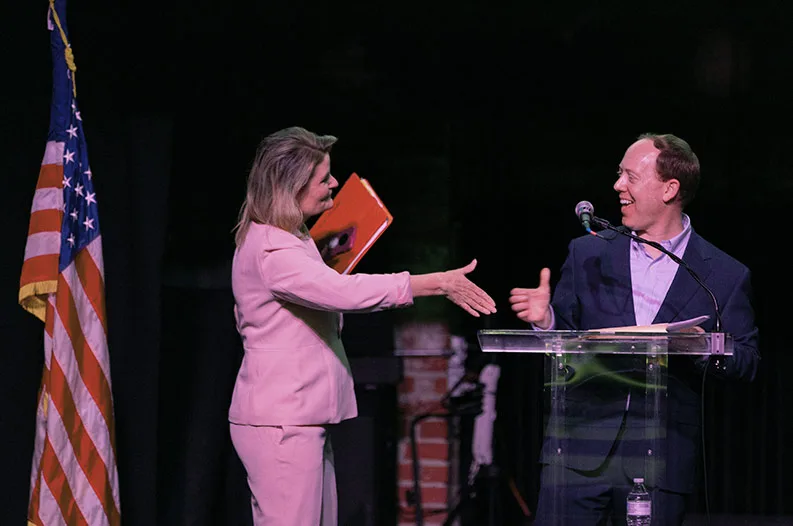
No JoCo Dem for governor in more than a century
Holscher and Corson are two of three Democrats vying for their party’s nomination to succeed Kelly. (The third is Lawrence teacher Marty Tuely, who was not at Sunday’s Shawnee forum.)
The winner of the Democratic primary will take on whoever comes out of the crowded field of Republicans.
Historically, Kansas has not favored Democrats or Johnson Countians for the governorship. The last Democrat from Johnson County to rise to the state’s top office was George Hodges, from Olathe, who served from 1913 to 1915. (The last Johnson County Republican from Johnson County to be governor was Robert Bennett, who served from 1975 to 1979.)
Still, Democrats have shown strength in other Republican-leaning states this year, and state Democrats have been pushing hard to organize in Kansas.
Before Sunday’s forum, Democratic state chair Jeanna Repass told the audience that her party is close to having organized the most counties for Democrats in state history, with 70.
The Aug. 4 primary will determine which candidate from each party will go on to the general election in November.
The evening got off to a rocky start shortly after the introductions, when the candidates withdrew offstage for a quick break to discuss rules. That break stretched long enough to cause a 45-minute delay of the forum, reportedly because of a misunderstanding over whether the candidates would be allowed to use notes.
Notes were evident once the forum began, but a few of the roughly 170 people in attendance left the theater during the break.
A clash over CoreCivic and ICE actions
Holscher sought to put Corson on the defensive on a question about immigration enforcement and ICE detention prisons.
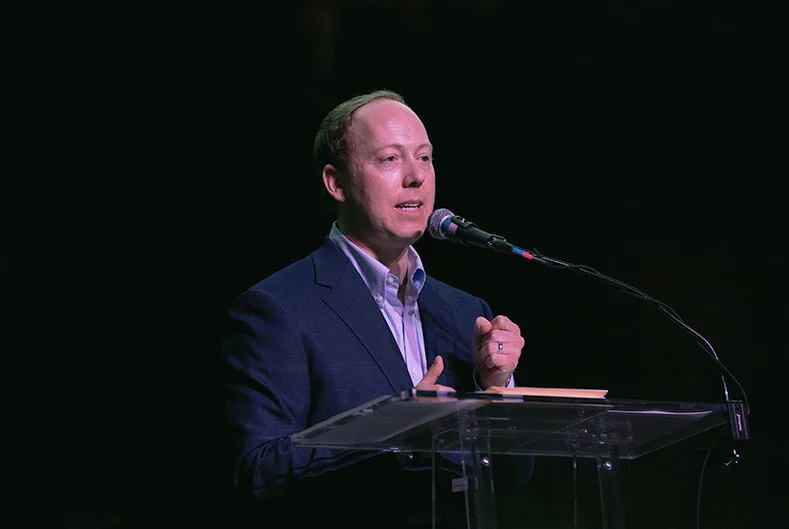
Corson had said he looks at it “through the eyes of an attorney,” meaning when ICE is operating in Kansas, it must use warrants and offer the right to counsel.
Constituents don’t appreciate the indiscriminate way ICE has been acting, he said, adding, “I will never support a private prison building in Kansas, I will never support an ICE detention facility being built in Kansas. The city of Leavenworth got it absolutely wrong when they approved that facility.”
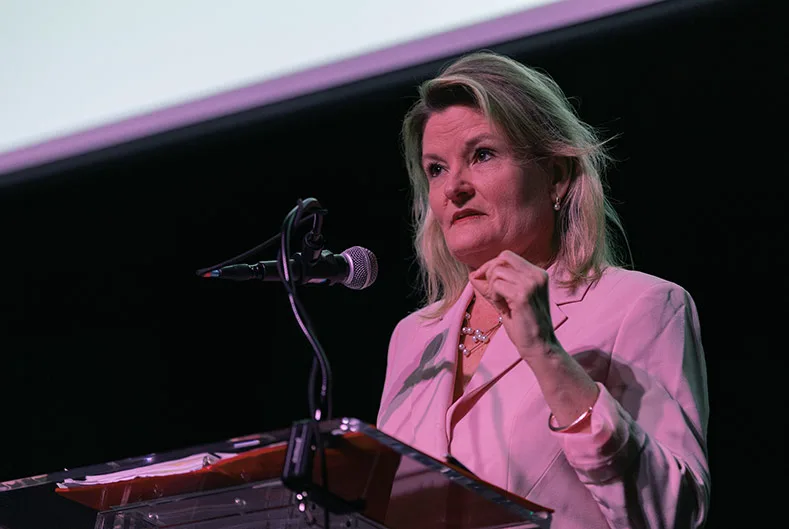
Holscher also said the immigration actions have been “alarming” and “wrong” but went further.
She said she showed up with faith leaders and members of the community against an ICE facility in Leavenworth.
“My opponent said nothing despite sitting on the committee that oversees corrections in Kansas. I stood with faith leaders, community members pushing back. And when I asked why, maybe it’s because he had previously taken the maximum campaign donation from CoreCivic for a 2024 campaign.”
She also said Corson took contributions from partners at a law firm representing CoreCivic. CoreCivic is a private prison operator that has partnered with ICE.
“You can’t say you’re against private prisons or ICE detention facilities when your campaign and personal life is intertwined with that very business,” she said.
Corson used some of his time to talk on an abortion question but then later returned to Holscher’s remarks.
“My gubernatorial campaign has never taken money from CoreCivic and never will take money from CoreCivic. I have always opposed private prisons. I have always opposed the ICE detention facility in Leavenworth and I have made that crystal clear from day one,” he said.
He added that his state senate campaign received a contribution from CoreCivic in 2023 that was processed with other donations. When it was brought to the campaign’s attention, the money was refunded, he said.
“As governor, I will never support a private prison. I will never support an ICE detention facility,” he said.
Affordability and campaign contributions
Holscher aimed at Corson again later, when speaking on how to engage younger voters. She said young voters are becoming fed up because “too many electeds are tied to establishment politics serving billionaires and not fighting to make life better for regular people.”
“You can’t talk about affordability when you’re working for attorney firms defending corporations,” like BP, Phillip Morris and predatory banks, she said.
“My opponent has been pretty quiet about his background in terms of who he’s been fighting for. You can’t fight for regular people when you’re fighting for and propping up the very establishment that’s keeping working people at the bottom,” Holscher said.
Corson did not directly respond to that, but said at several points in the forum that he would work on kitchen table issues such as getting more workforce housing built and raising the minimum wage.
“It’s wrong that somebody could be working full-time in Kansas and living in poverty,” he said.
Some agreements and voter reaction
The two had some basic agreement on some questions.
Both said they are in favor of raising the minimum wage in Kansas, and both opposed a bill recently passed that requires people using bathrooms in government buildings to go to the facility that corresponds to their sex assigned at birth.
Both also support enhanced voter access that includes mail-in and early voting, and both said they were for Medicaid expansion.
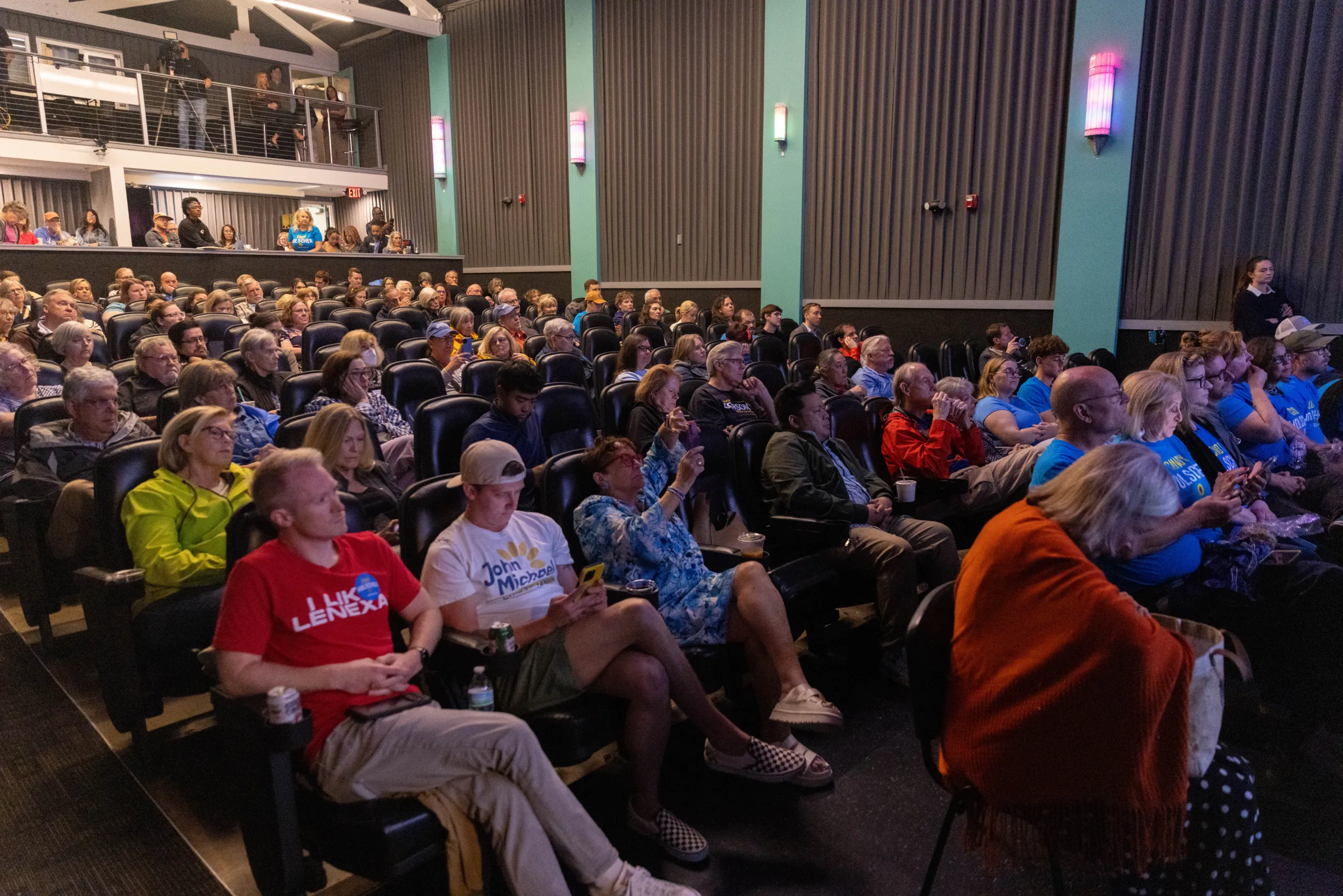
Afterward, Tricia McCormick and Lynn Hardy, both of Leawood, said they had come into the event without strong preferences over either candidate.
Hardy said she would be delighted to have a Democrat in the governor’s office again.
“Both of them did really well. They have different personality types, and that came through very loud and clear,” McCormick said. “She’s a lot more aggressive, and he’s a lot more deliberate, would be my wording.”
“I would be so happy with either one of them,” Hardy said.