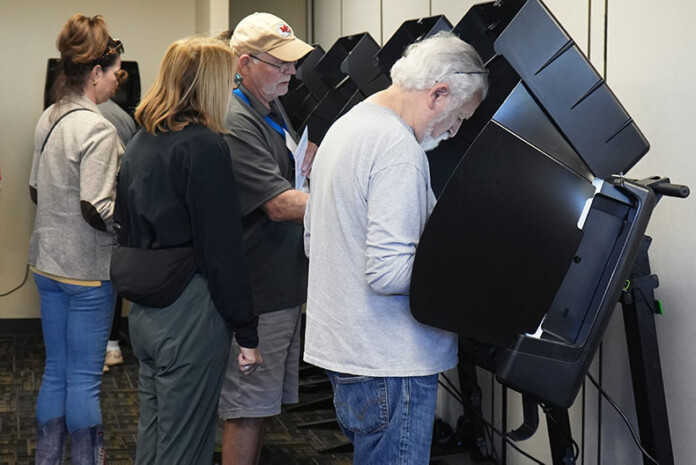
The Johnson County Election Office is eliminating eight early voting sites ahead of the August primary, a recently announced change that has some elected officials concerned about the impact on voters in some densely populated parts of the county and on public trust in the election system.
Interim County Election Commissioner Connie Schmidt notified county commissioners earlier this month of the locations, all of which were open for early voting in 2024, that will not be open for early voting this year.
Those closed sites include:
- Central Resource Library, 9875 W. 87th St., Overland Park
- Oak Park Library, 9500 Bluejacket St., Overland Park
- Leawood City Hall, 4800 Town Center Drive, Leawood
- Tomahawk Ridge Community Center, 11902 Lowell Ave., Overland Park
- Johnson County Community College’s Midwest Trust Center, 12345 College Blvd., Overland Park
- Westwood City Hall, 4700 Rainbow Blvd., Westwood
- Olathe Downtown Library, 260 E. Santa Fe St., Olathe
- Johnson County Sunset offices, 11811 Sunset Drive, Olathe
There will, however, be two new polling places added for early voting, in Spring Hill and De Soto, meaning that the county’s overall number of advance voting sites will drop from 18 to 12.
“I’m concerned about how these changes will impact public trust in our elections system, especially in a critical year where local, federal and state and constitutional amendments are on the ballot,” County Chair Mike Kelly wrote to Schmidt in a May 27 letter.
Kelly noted in his letter that the commission allocated its election funding last year based on the full roster of sites, meaning it can pay for all 18 sites previously used.
“A decision of this magnitude, potentially affecting how more than 460,000 registered voters access early voting, should occur only through a transparent, data-driven process with meaningful engagement of the elected body,” he said in his letter.
Kelly said that the general public should have had the chance to weigh in on the changes before they were made. Advance in-person voting begins on July 18 in Johnson County and ends at noon on Aug. 3.
Read Election Commissioner Connie Schmidt’s memo outlining changes to early voting locations.
 Loading...

 Reload document
  Open in new tab
 Kelly asks for 8 closed sites to be restored for August primary
Early voting is different from the voting that happens on Election Day because registered voters can vote at any of the advance sites, regardless of where they live, whereas on Election Day they must vote at their assigned precinct polling place.
The changes announced by the election office do not affect voting on Election Day itself.
Schmidt was away from the office this week, and an election office spokesperson said she was not available to comment.
Schmidt’s memo to commissioners said all 12 early in-person voting locations will have the same operating hours and will be open for two weeks during even-numbered election years and one week during odd-numbered years. That includes the Monday morning before Election Day.
“The goal is to establish equal access to early voting across the county and to standardize the days and hours of operation,” Schmidt wrote in her memo.
The memo does not explicitly say whether the same 12 early voting sites will also be in place ahead of the general election in November, though Kelly in his letter to Schmidt asked for clarification.
“I respectfully ask for clarity on whether the affected locations can be restored in time for the 2026 primary election, and for your assurance that the full suite of early voting sites will be in place for the 2026 general election,” he wrote.
Elected leaders worried about voter access
Kelly pointed out in his letter and in a later interview that advance voting is growing in popularity in the county.
In the 2024 general election, for instance, 60% of Johnson County voters used advance in-person voting, a number that was more than the combined total of those cast by mail and at precinct polling places on Election Day.
He also worried about closing familiar locations in community hubs whose residents depend on their consistency and nearness.
Downtown Olathe, for instance, will lose its only early voting location, as will northern Overland Park at Central Resource Library, he said. JCCC students and faculty also will lose an early on-campus voting site.
That concern was echoed by Overland Park Councilmember Drew Mitrisin, whose Ward 2 covers Central Resource Library and Oak Park Library, two of the sites eliminated. Some pockets of disadvantaged neighborhoods in the area have responded well to having access to early voting in person, he said.
“It’s all about access, and especially equity, because we just know that there are some neighborhoods near those polling locations that are disadvantaged in some ways, including in transportation access,” he said, referring to this map of neighborhoods.
“There’s a huge demand for advance voting in person, and instead of restricting that or limiting that, or modifying that in a negative way, let’s figure out how to tap into that demand and make it as easy as possible for everyone in Johnson County to vote,” Mitrisin continued.
2 early voting sites added in growing parts of the county
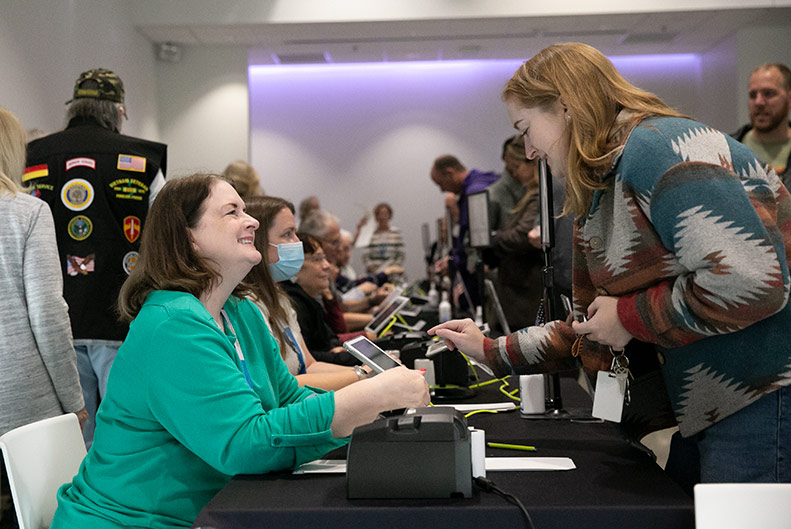
In his letter to Schmidt, Kelly also objected to what he said was a lack of data about the changes and their impact.
For instance, commissioners were not provided with metrics of how the success of the new voting network will be judged, nor was there an analysis presented of voting patterns related to education and employment hubs or whether wait times at the Arts and Heritage Center might increase, he said. Arts and Heritage, at 8788 Metcalf Avenue, is the highest volume early voting center.
Commissioner Michael Ashcraft said Schmidt presented the plan to commissioners during a work session two or three weeks ago. Commission work sessions are normally separate from regular business meetings and are not recorded.
Ashcraft said he’s always found Schmidt to be “extremely analytical and diligent in decisions related to elections.” He said her presentation mentioned a diminishing participation in some advance voting sites that made keeping them open not as cost effective.
Meanwhile, the areas near the new De Soto and Spring Hill sites have growing populations.
“It seemed perfectly reasonable and logical to me,” Ashcraft said.
Commissioner Shirley Allenbrand said the new De Soto polling place in her district will help in an area where population has been quickly growing. But she said she’s also concerned about the loss of continuity for voters — especially older voters — in other areas who have gotten used to going to the same voting sites for years.
Changing now, with just a couple of months before advance voting starts for the August primary will make it hard to get word out, Allenbrand said.
Although she said she respects Schmidt’s reasons and credits her for being a “data person,” Allenbrand said it would have been better to make the change after the primary, when there is more time before the Nov. 3 general election.
Kelly said he appreciates and shares Schmidt’s interest in being a good steward of county resources, but will ask her to reconsider and restore as many of the sites as possible and engage more with the county commission.
“Part of the reason I’m asking for reconsideration here is because I believe that we want to maintain that trust with voters and that such a process should accompany any major changes,” he said in an interview with the Post.
Previous JoCo election commissioner resigned abruptly last year
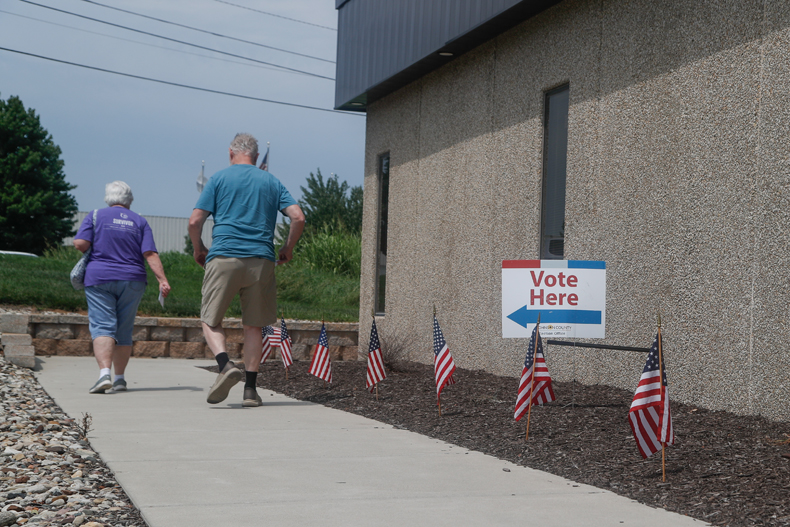
The county election office is independent of the county commission, although the commission does have authority over the election budget. The election commissioner for Johnson County is appointed by the Kansas Secretary of State.
Schmidt is acting as interim election commissioner following the resignation of Fred Sherman last December. Sherman, who had served as the county’s election commissioner since 2021, succeeding Schmidt at the time, said he was forced out by Secretary of State Scott Schwab over a policy disagreement that he did not disclose.
Further requests about that to Schwab’s office and through open records requests on the reason for that disagreement did not prove fruitful.
When asked, Kelly declined to say that he believed the polling place changes had a political motive.
“Let me say it this way. I believe that the Johnson County election office is an institution that is trusted. Our elections are safe, secure, and accurate. I think it’s important when we talk about voter access that we focus on individuals and not any particular party,” he said.
“So, my goal and hope is to enfranchise as many people as possible. I firmly believe when more people participate in elections, better decisions get made,” he added.
When reached by the Post, a spokesperson for Schwab’s office said, “The Secretary of State’s office does not approve the location of polling locations or advance voting locations. Those decisions are best made by local county election officers.”
Click here to find the advance voting sites that will be open for the August primary and other election information. Drop boxes and advance mail voting will also be available.
Kyle Palmer and Kaylie McLaughlin contributed to this story