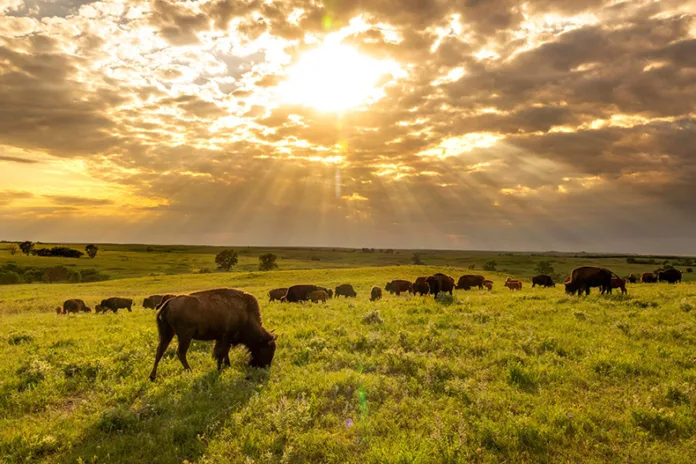
U.S. Rep. Sharice Davids held a roundtable in Shawnee with local officials and stakeholders about bison herd restoration as part of her America 250 week here in town.
She said the discussion helped her appreciate the importance of both preserving the American bison and increasing the large mammal’s population.
“It actually has these broad-sweeping impacts … around the ecosystem, around the wildlife and the way that focusing on preserving and increasing the bison population is actually helping our grasslands,” Davids said. “It’s helping our pollinators. It’s helping the entire ecology.”
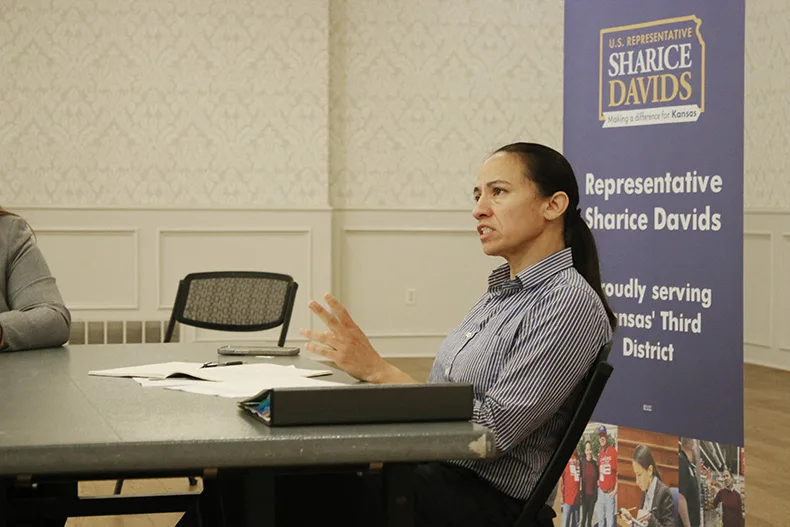
An issue that came up was how managing the health of grassland prairies directly affects bison herds.
“One of the things that’s really different about the prairie compared to other kinds of ecosystems is that for a tropical forest or old-growth forest, you might set aside a reserve— the idea is, ‘Let’s leave it alone and not disturb it.’ And prairies require disturbance. They require periodic fires; they require grazing. They really need management,” said Kansas State University professor emeritus John Blair, recent director of the Konza Prairie Biological Station.
Blair pointed out how indigenous people used to manage prairies with fires and knew that bison were attracted to recently-burned areas. More recently, he said, researchers tracked bison using collars and found that this still holds true.
“It creates this shifting mosaic of different habitats types that move across the landscape, and that contributes to the kind of biodiversity we’re trying to support,” Blair said.
Christopher Kennedy, secretary of the Kansas Department of Wildlife and Parks, said he appreciated a good conversation about managing bison herds, interacting with tribal nations and “how we can not just preserve bison but how do we preserve the overall ecosystem that provides for bison and a plethora of other species.”

The Nature Conservancy has two herds of bison in Kansas, said Tony Capizzo, the group’s Flint Hills Initiative director. One of them, with 85 animals, grazes on 1,500 acres of the Tallgrass Prairie National Preserve.
“Grasslands are one of the least-protected and most vulnerable ecosystems across the world, and in North America, we’ve lost 70% of our grasslands generally, and for tallgrass prairies like the Flint Hills, we’ve lost 96% of the original tallgrass prairie. … When we talk and think about bison management, it’s really in that context of how we support healthy grasses broadly,” Capizzo said.
He said that having the bison designated as the country’s national mammal in 2016 has helped the public make a connection to the grasslands.
It’s something that also helped Davids connect to the issue.
“When you think about the long history of the country, the American bison as our national mammal and something that really is a symbol particularly of the Great Plains, it prompted us to want to dig a little bit deeper on the work that Kansas specifically is doing,” she said.
Davids said that the information she learned during the conversation may help her in the future when working on bills concerning grasslands conservation, farms and USDA programs.