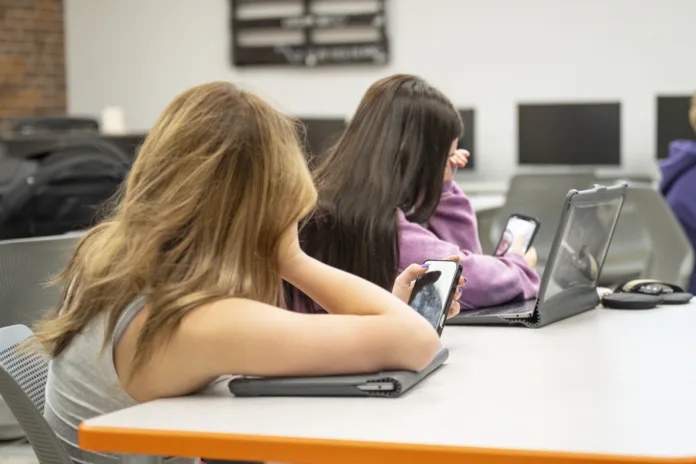
A new state law that bans cell phones from students’ possession during learning hours will be followed by the Shawnee Mission School District. But there’s no plan to collect the phones from students and redistribute them at the end of the day.
School board members on Monday began to consider a policy change that confirms the district will comply with the new state law but leaves many of the details of where to store phones up to students and parents.
The law says phones must be kept turned off in a location inaccessible to students during the school day, but it doesn’t restrict use in after-school activities. The law does, however, permit phones to be stored in vehicles, even on school property.
The policy under consideration repeats that language and encourages students to lock their cars, but says the district will not be held liable for theft or damage.
The new state law supersedes SMSD’s
School officials had worked on the district’s own version of a phone ban for months, finalizing it early in 2025, only to have it superseded by the Kansas Legislature last year. The district’s ban would have set different phone usage rules by grade level. At middle and high school levels, phones could have been stored in lockers but could be accessed during passing periods.
The Kansas law affected all grade levels evenly and did not allow accessibility during passing periods.
As school board members did a first reading of the policy Monday night, Superintendent Michael Schumacher said he and members of the policy review committee had labored to find the right way to implement the change for the coming school year. They settled on reiterating the language of the law to avoid any incorrect interpretation, he said. That approach was also advised by the Kansas Association of School Boards, he said.
If a student brings in a cell phone and doesn’t have an exception allowed by the law, the student would confiscate the phone and the student would face disciplinary action. Exceptions include use for medical reasons, an individualized education plan, or school-approved use to reach a parent.
The committee recommended keeping the discipline level for infractions at a less severe level to avoid risking suspensions for a policy the community is learning, but there would be a review of discipline in a few months.
“It’s very clear. Lawmakers, whether you agree with them or not, wrote the law and they wrote language we need to comply with,” Schumacher said.
SMSD worries about the law’s financial impact
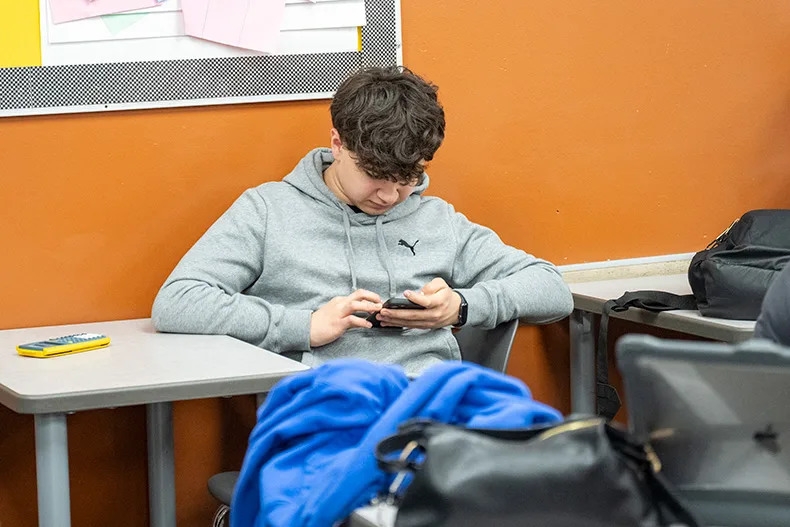
Shortly after the statewide cell phone bill passed, school boards began to consider what the everyday impact would be. Some districts in Johnson County feared significant financial costs and logistical problems that could go with collecting phones from students at the beginning of the day, storing them securely and redistributing them at the end of the day.
But there are no plans to do that in the policy Shawnee Mission board members are considering. Board member Heather Ousley clarified, “Cell phones are not allowed during the day but we’re not implementing a process to collect them at the beginning of the day and redistribute them at the end of the day,” because of the logistical and financial difficulty.
Board member Jessica Hembree, attending remotely, said she felt good about the policy but the scant language might need to be beefed up to help families know what is expected. She said the language, “is going to be lacking in some details parents and students are going to want to make sure they understand and are complying.”
“Reeks of classist socio-economic bias”
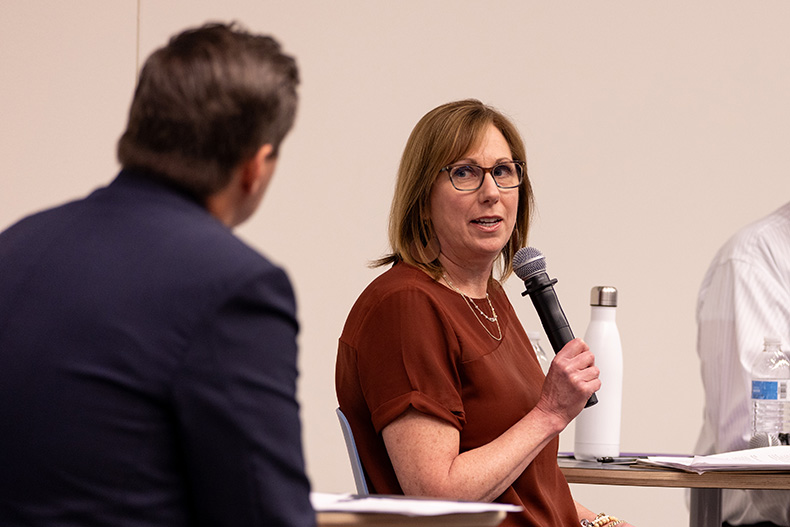
Kim Whitman, co-founder of Smartphone Free Childhood, advocated for a bell-to-bell ban on personal electronic devices in the classroom when Shawnee Mission was writing its policy last year. She said she still has concerns about the way the district intends to comply with the state law.
“Families will say students aren’t bringing their phones to school, but of course they will anyway and teachers will continue to have to police it,” she wrote in an email. “Continuing to put it on the teachers backs without potentially any administrative back up is missing the mark. Again, my fear is that nothing will change but the district has technically met the letter of the law.”
The schools that are most successful at such bans provide inaccessible storage for the devices during the school day, she wrote.
One person spoke during an earlier public comment session about the new proposed policy. Lisa Feingold, a school employee and Merriam resident, said she was “saddened” that the district’s cell phone policy was overwritten by the state legislature.
She added that relying on student vehicles to store phones during the day, “reeks of classist socio-economic bias as not all students have vehicles.”
What’s next
A first reading allows board members to review and discuss a proposal without voting. The item will come up at a later board meeting.