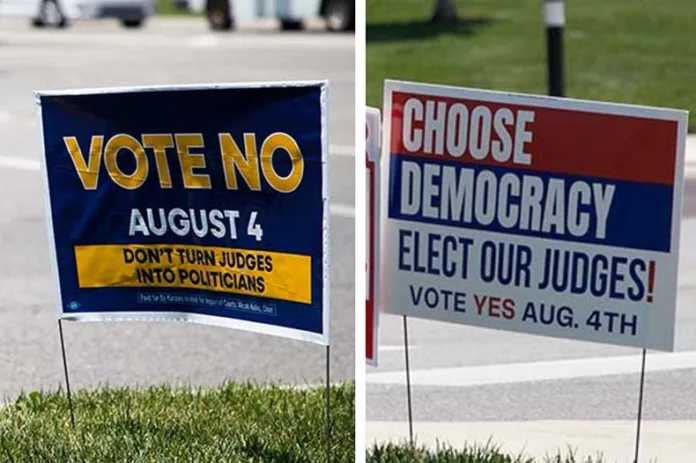
Early, in-person voting in Johnson County began Saturday, July 18, and voters will be able to cast advance ballots between then and Election Day on Tuesday, Aug. 4.
During the primary election season this summer, the Johnson County Post gave our readers in-depth and informative coverage of the races and issues affecting Johnson County.
That includes our seven primary election primers, rounding up all the candidates in contested primary races for federal, state and local offices that represent Johnson County.
One key item appearing on all registered voters’ ballots this summer — regardless of their political affiliation — is a question:
Should voters in the state elect the justices of the Kansas Supreme Court?
The explanatory statement on the ballot explains what a “yes” and “no” each mean when voters cast their ballot.
What a YES vote means:
“A vote for this proposition would give Kansas citizens the right to elect Kansas supreme court justices as provided by law. Justices will hold office for terms of six years. The Kansas supreme court nominating commission, whose membership consists of a majority of lawyers, would be abolished.”
What a NO vote means:
“A vote against this proposition would continue the current system in which the Kansas supreme court nominating commission, whose membership consists of a majority of lawyers, provides the governor a list of three individuals to choose from for vacancies on the Kansas supreme court. Justices hold office for a term of six years and retain their offices if they win a retention election in which they do not face an opponent.”
Below is a full copy of a sample ballot featuring the question.
 Loading...

 Reload document
  Open in new tab
 Get caught up
And here are links to all recent, local coverage of the constitutional amendment.
- Organizers make final pitches on Kansas Supreme Court ballot measure amid early voting
- Should Kansas elect Supreme Court justices? Here’s how you can vote
- Seeing ‘Vote yes’ and ‘Vote no’ signs for judges amendment? Here’s what they mean
- How could electing the Kansas Supreme Court affect issues like abortion and school funding?
 Thanks for reading! If you value having an independent news outlet keeping tabs on local government, schools and taxes, we're asking you to contribute to our Education Reporting Fund.