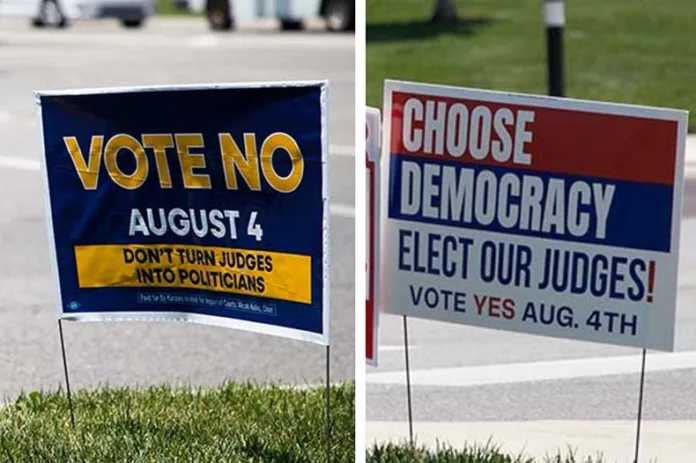
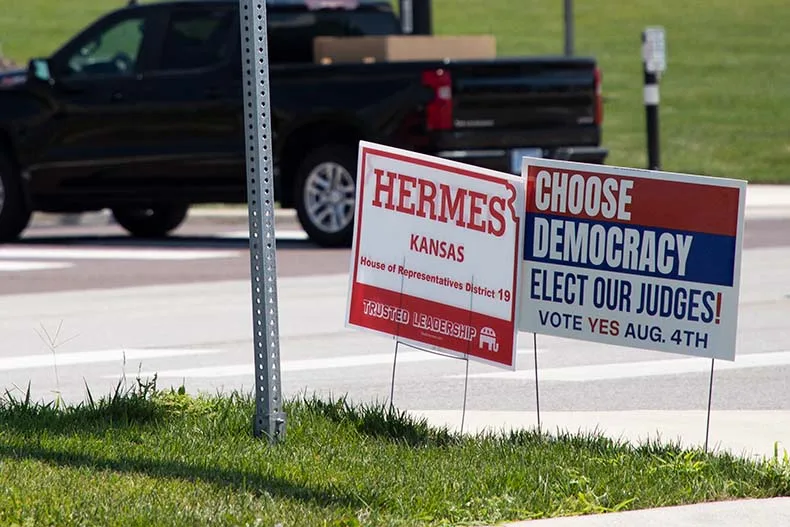
You may have seen yard signs popping up across Johnson County in recent weeks urging people to “Vote No” or “Vote Yes.”
Those refer to a constitutional amendment on the primary election ballot on Aug. 4 that seeks to change how Kansas Supreme Court justices are picked.
For generations now, justices to the state’s highest court have been recommended by a nominating commission made up of lawyers and nonlawyers from around Kansas.
This year, however, a Republican-backed constitutional amendment would reinstate an election process for the Kansas Supreme Court.
Backers of the amendment say changing the process will put power back in the hands of the people, end a selection process they say lacks transparency and improve accountability in the judicial system.
However, opponents worry that returning to an elective system for the state supreme court would undermine the judiciary’s independence and introduce political partisanship into the judicial system.
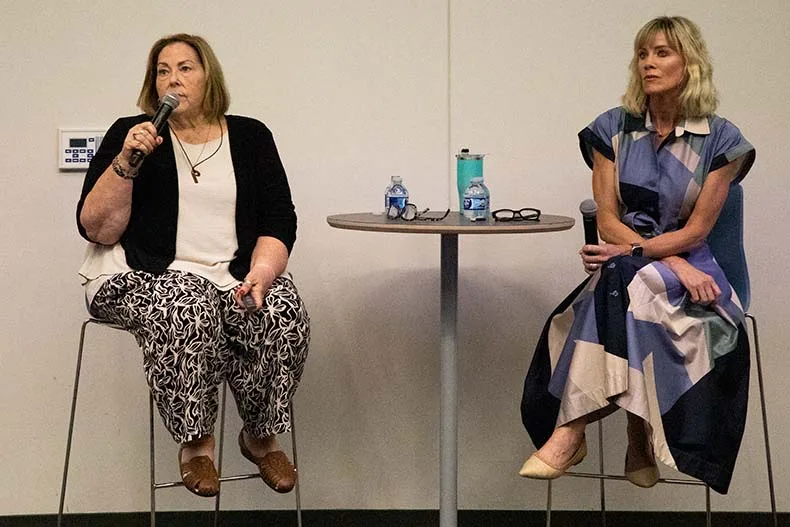
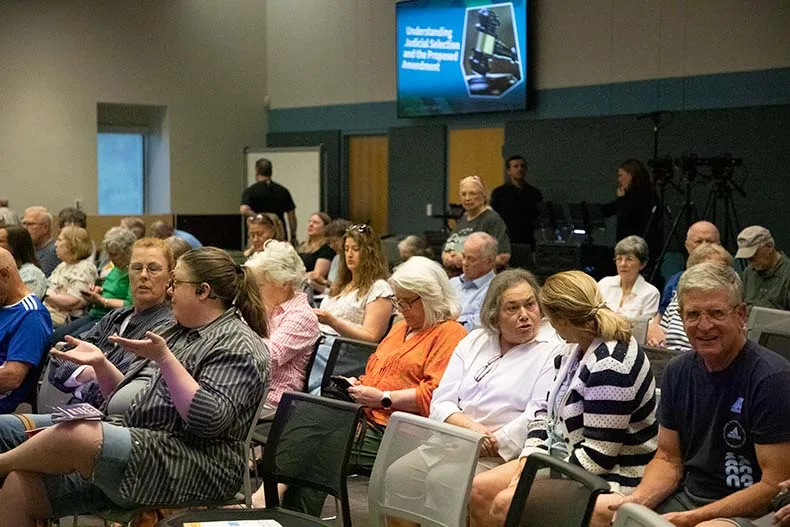
That disagreement and the history of Kansas’ Supreme Court selection were the focus of an informational meeting held by the Johnson County Bar Association’s Civics Education Committee at the Central Resource Library on Tuesday.
The event was hosted by Karen Arnold Burger, a judge on the Kansas Court of Appeals, and Katie McClaflin, an attorney who currently serves on the nonpartisan commission that helps governors pick Kansas Supreme Court judges.
How are Supreme Court judges in Kansas currently picked?
Currently, Kansas Supreme Court justices are picked through a process known as merit selection, which considers their legal background and other relevant experiences.
Applicants must be at least 30 years old and no older than 75.
It begins with an application process, then through interviews and other deliberations, the nonpartisan Kansas Supreme Court Nominating Commission picks three potential justices whose names are forwarded to the governor.
The nominating commission is comprised of four nonlawyers — one from each of Kansas’ U.S. Congressional Districts — who are picked by the governor.
Another four seats on the commission are taken up by lawyers, who are elected by other lawyers from each congressional district. Additionally, a commission chair is selected by lawyers from across the state.
The actual judicial selection process occurs in meetings that are available to the public, both online and in person. All records created during the process are public, as well.
McClaflin said it can be pretty arduous, and it typically takes much discussion and voting by the commission members to pick three nominees.
She said nominees’ political affiliation is not factored in at all.
“We have multiple rounds of voting until we get to the top three,” McClaflin said.
After that, the governor picks who among the three nominees will join the Kansas Supreme Court bench.
Just this week, Gov. Laura Kelly tapped Judge K. Christopher Jayaram, from Johnson County District Court, to fill a vacancy on the state Supreme Court created by a retirement. That’s likely Kelly’s last judicial appointment before the Aug. 4 vote.
Every six years, the public votes on whether to keep justices on the bench through a retention vote. This November, voters will be asked whether they would like to retain each sitting justice individually by filling in a “yes” or “no” bubble on their ballot.
Amendment would reinstate Kansas Supreme Court elections
The constitutional amendment would change the Kansas Constitution to institute elections for justices of the Kansas Supreme Court and abolish the nominating commission.
It would also open the door for justices to participate in political parties and campaigns and to contribute financially to them, though a lot of details about how that might work remain undecided.
If the amendment passes, then the Kansas Legislature will set rules around things like partisanship in elections and whether they would be statewide or regional.
Before 1958, Kansas elected its state Supreme Court justices, but that practice was ended through a constitutional amendment in response to a corruption scandal.
Judicial elections still occur in roughly 20 states in the U.S., while other states use a mix of appointments or merit systems.
Supporters of the amendment have said the existing system gives too much power to attorneys in Kansas to choose who makes up the Kansas Supreme Court.
Other arguments raised by proponents of the amendment have centered on transparency concerns with the current selection process, an alleged disconnect between the court and the will of everyday Kansans and worries over a lack of accountability.
On the other hand, opponents have cast the amendment as a backdoor way for conservatives to resume attacks on abortion rights and public school finance.
The Kansas Supreme Court has issued major decisions on those issues in recent years that Republicans in Topeka have decried.
A state constitutional amendment in the 1950s ended judicial elections
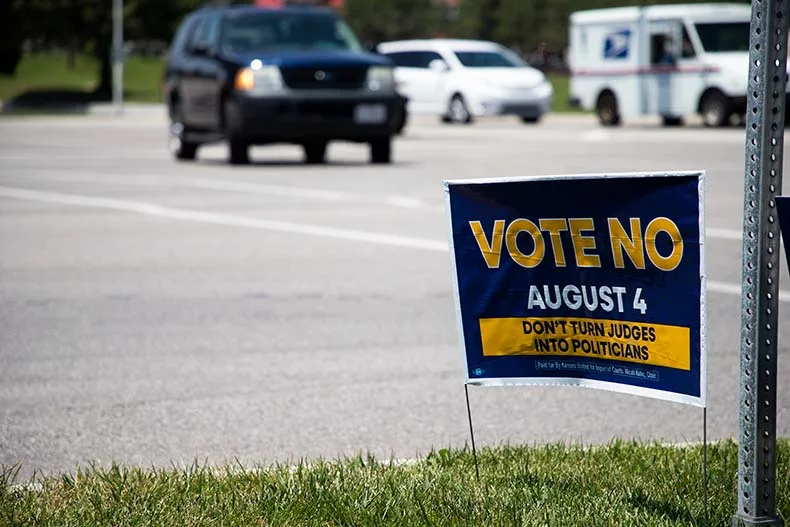
People who oppose the amendment say it could turn judges into politicians and invite outside, high-dollar donations into the process that come with an agenda to influence justice in Kansas.
They also point to the scandal that led Kansas to end judicial elections as a warning of what could happen.
When Kansas first became a state in 1861, its original constitution called for the election of judges, similar to other states that joined the Union around that time.
However, by the 1940s, that practice was falling out of favor due to concerns about corruption from wealthy individuals essentially buying seats on courts with large campaign contributions.
At Tuesday’s event, McClaflin pointed to the “Pendergast political machine” on the Missouri side as a prime example.
From that, a new philosophy known as the “Missouri Plan” began to spread, which encouraged states to end judicial elections in favor of a merit-based selection process.
The final straw for Kansas was the “Triple Play” scandal in the 1950s.
It all started when Gov. Fred Hall, who was deeply unpopular, lost a primary election in his reelection bid in 1956, becoming a “lame duck” governor, McClaflin said.
William Smith, who was the Chief Justice of the Kansas Supreme Court at the time, resigned his position.
Hall also resigned with just a few days left in his term, and then John McCuish, his lieutenant governor, became governor. One of the only things he did while governor was to appoint Hall to the Kansas Supreme Court to fill Smith’s vacancy.
(That process did require judicial elections, but allowed governors to fill vacancies that occurred between election years.)
“This did not go over well. It didn’t go over well with Kansans,” McClaflin said. She pointed to newspaper articles at the time, like one from the Emporia Gazette that called it “a brazen raw deal for Kansas justice.”
So, in 1958, Kansans voted to change the constitution to end judicial elections and institute the merit system still used today to select judges to the high court.
The amendment will appear on the primary election ballot
The judicial constitutional amendment will appear on ballots during the primary election this August. Any registered voter in Kansas can vote on this matter, regardless of party affiliation or lack thereof.
Election Day is Tuesday, Aug. 4, but early voting has already begun by mail. Advance voting in person starts on Saturday, July 18.
For information about your polling place, to check your voter registration or to view your sample ballot, visit the Kansas Secretary of State Voter View website.
Keep reading: How could electing the Kansas Supreme Court affect issues like abortion and school funding?