
Mission leaders are “begrudgingly” complying with a new state law that targets transgender Kansans bathroom usage.
Last week, the Mission City Council voted 7-1 to approve designating the city administrator as the government official who must deal with any potential complaints filed within the city under Senate Bill 244.
Councilmember Ben Chociej cast the lone dissenting vote, citing a “struggle” in his decision because he understands the city’s position.
Senate Bill 244, known as the “bathroom bill,” requires government buildings to “take every reasonable step” to segregate restrooms and locker rooms by sex.
The bill requires people to use the bathroom or other multi-occupancy spaces in government-owned buildings that matches their sex at birth. Persons who are found in violation of SB 244 could be fined or sued up to $1,000.
Meanwhile, entities (like a local government) found in violation of the new law would be subject to a penalty of $25,000 for the first violation, and $125,000 for each subsequent violation. Those fines can accumulate daily if the violation goes unresolved.
Several other councilmembers and the mayor on July 15 said that while they oppose SB 244, they believe it is unhelpful to spend taxpayer dollars on potential fines or lawsuits.
In recent years, the city has increased its property tax rate to fill budget holes. Still, budget constraints weren’t specifically the thrust behind Mission’s move to comply with the state law, City Administrator Laura Smith told the Post in a follow-up email.
“I think the level of fines included in the legislation and the ability for them to be cumulative makes non-compliance concerning for every City, not just Mission,” Smith wrote to the Post.
Republican lawmakers from Johnson County were largely quiet on social media or in their newsletters commenting on the bill, but state Sen. Mike Thompson commented on the bill in his Feb. 24 newsletter, praising it for “restoring reality in official documents and protecting the privacy of women.”
For Mission city officials, the ordinance passed on July 15 is to comply with state law — not a reflection of the city’s views.
Mayor Sollie Flora, like half of all councilmembers, expressed her opposition to SB 244.
Flora said she thinks it is unhelpful to community members if the city is “hit with continuing fines in case of noncompliance.” Still, Flora said the passage of the ordinance does not reflect support for the bill.
“(I) definitely recognize the harm this law causes and, frankly, and I’ve been up here for nine years now, I’ll call bullshit on this one,” Flora said.
“It’s bad, it’s hateful and it’s harmful. And you would think the legislature would have better things to do with their time and energy, but apparently they thought not, because they didn’t accomplish a lot else this session but they did pass this law.”
A look at the city’s ordinance
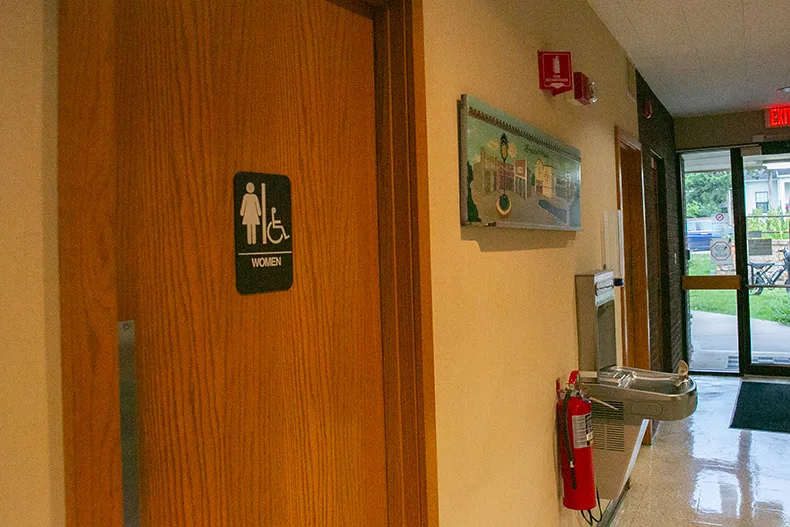
The city’s decision earlier this month simply designates the city administrator as the person responsible for handling any complaints on behalf of the city, as well as investigating any complaints and conducting reviews of multi-occupancy spaces to ensure compliance with SB 244.
Still, the city’s ordinance calls SB 244 “hurtful legislation” and that it goes against local control. The ordinance also states that the city
In the event that SB 244 is invalidated, the ordinance also allows for the city administrator to, at their discretion, remove all policies related to the bill.
City Administrator Laura Smith on July 15 told the city council that staff understands and supports the city council’s position on this issue.
“To the extent we are ever faced with having to deal with this issue, we will treat everyone with the dignity and respect they deserve, which is no different than what we are doing now,” Smith said.
Councilmembers “begrudgingly” approve ordinance
Several councilmembers expressed their opposition to SB 244 on July 15, though most approved the motion citing concerns of potential lawsuits or fines as their reasoning.
Councilmember Sam Komosa said he thinks “it’s a sad state of affairs that” the state of Kansas is “targeting the trans community, really, to score cheap political points.” Still, Komosa said he “begrudgingly” voted to approve the ordinance.
“I also recognize that we have to be pragmatic, and balance being a welcoming community with also being hit with, as the mayor said, lawsuits,” Komosa said.
Similarly, Councilmember Mary Ryherd said her vote approving the ordinance is a matter of fulfilling the city’s legal obligations and “not about passing judgment on any member of our community.”
“My vote tonight should not be interpreted as a reflection of my personal view towards minority members of our community who deserve dignity and respect, and to know that they are valued members of Mission,” Ryherd said.
Chociej cast the lone dissenting vote on July 15, saying he understands the city’s position as it relates to the statute itself, but it’s “very difficult to say we are going to comply with this as a matter of policy.”
“I don’t know, I really don’t think I can vote yes on this one,” Chociej said.
Other cities and SB 244
Most other northeast Johnson County cities say they are already in compliance with SB 244.
The only other city that appears to have adopted administrative policies related to SB 244 is the city of Merriam, which also provided staff training.
Others like Fairway, Prairie Village, Roeland Park and Westwood all say they are already in compliance with SB 244.
Keep reading local government news: Lenexa’s old city hall fountain — once dyed for local festivals — broke down and is being torn out