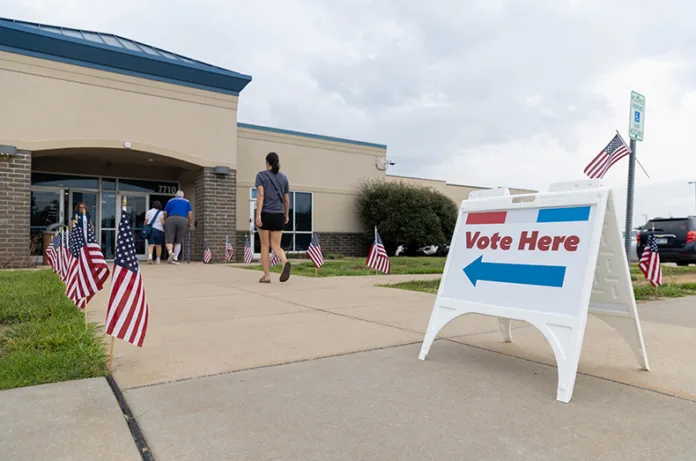
A legal interpretation of Kansas campaign spending law disrupted Democratic pre-primary activities this summer, causing the Johnson County party to cancel a candidate forum and spend thousands reprinting promotional cards and flyers.
Democratic leaders in Johnson County and elsewhere say guidelines from the state’s campaign finance overseer that were intended to clarify the rules limiting their support of federal candidates were a departure from past years and caused last-minute rethinking of events and literature featuring the state’s highest-profile races.
In the Flint Hills, for example, uncertainty over the interpretation prompted one party organization to bill federal candidates who attended an ice cream social to cover the cost of their ice cream and access to portable toilets.
The dust has settled somewhat since the Kansas Public Disclosure Commission advised local political parties in June that excluding candidates from forums or voter guides violates rules against financial support for candidates running for federal offices like U.S. Senate and U.S. House of Representatives.
Still, some party officials are shaking their heads and wondering about what they see as a change in the way the campaign finance law is being applied.
“The whole thing has been very bizarre,” said Deann Mitchell, chair of the Johnson County Democrats. “The rules have always been in place but they’ve never been enforced in the way that they’re being enforced now.”
“It’s just been changing as we go along and it’s been very disheartening and it’s been very costly to my party and it’s been a big distraction,” Mitchell said.
The commission’s chief lawyer, however, contends that the rules are unchanged from past years.
Candice Wilson, general counsel for the public disclosure commission, said it was unfortunate that Democrats had to spend extra money because of a misunderstanding of the rules.
She said the commission would continue to work with parties to avoid similar situations in the future but insists guidance given to parties this year was “the same as it’s always been.”
“Our office is nonpartisan,” Wilson said. “We seek to work with all parties to make sure they have the tools and guidance that they need to comply with our election and ethics laws.”
What does state law say?
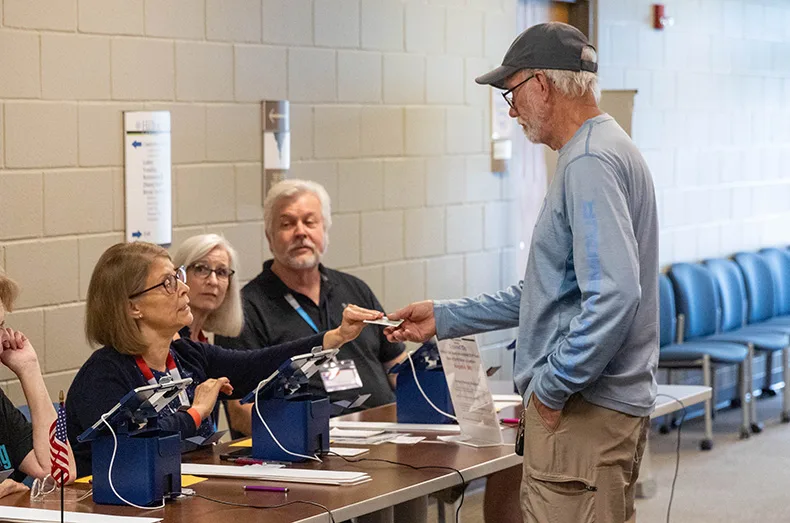
The commission’s advice focuses on a section of Kansas law pertaining to political contributions.
KSA 25-4153(k) is a one-sentence section of state campaign spending law that says, “Any political funds that have been collected and were subject to the reporting requirements of the campaign finance act shall not be used in or for the campaign of a candidate for a federal elective office.”
It does not apply to candidates seeking lower offices.
According to Wilson, that means that if an activity costs party funds and serves to benefit the candidacy of people running for federal office, it is in violation of the law. In her written guidance to party officials, she offered several examples of activities that could be on the wrong side of this law — voter guides, hosting a candidate at a speaking event, distributing signs and literature.
However, Wilson’s interpretation also said the party officials would be OK if their invitations to candidate forums and lists on voter guides included all candidates from their party running because the activity could be considered informational.
“For you not to be triggering this prohibition, you have to list all the candidates,” she told the Post. “If you’re listing all the candidates, it’s like you’re listing none of them. You’re not supporting a single candidate by listing them all.”
Democratic candidates excluded from JoCo party’s list
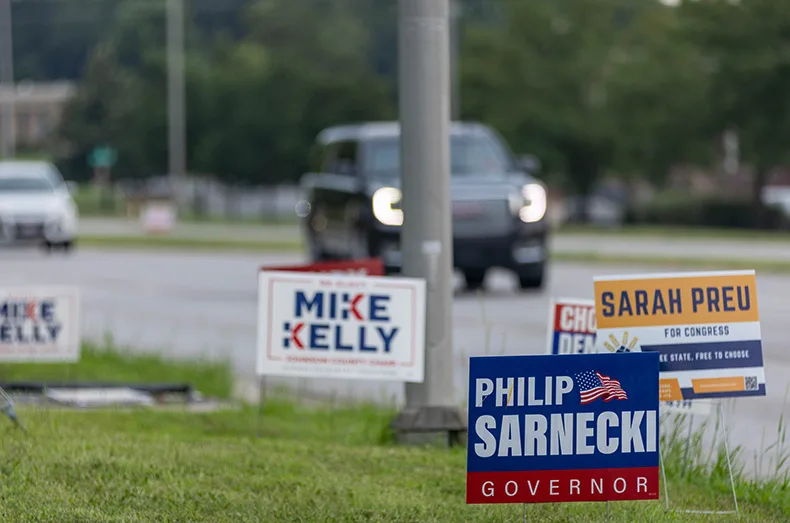
This became an issue for Johnson County Democrats earlier this summer after the party had already printed up some “walk cards” for volunteers to hand out as they knock on doors.
The cards showed the names of Democrats running in the Aug. 4 primary. Those lists included the names of some — but not all — of the 11 Democratic candidates on the ballot for U.S. Senate and the two for the U.S. House of Representatives, a decision that got blowback from the candidates excluded.
Johnson County Democrats have for the past few elections allowed Democratic candidates to opt into their voter guide. But the party also has the right to exclude candidates by vote of its committee, Mitchell said.
For the primary, U.S. Senate candidate Mike Soetaert declined to be included in the guide and Damon Anderson, also running for Senate, did not respond, Mitchell said. A committee of local party members also had decided not to include some other candidates, as well.
Those excluded candidates included U.S. Senate candidates Anne Parelkar, Jason Hart, Patrick Schmidt and Kevin Latz and U.S. House candidate Sarah Preu, who is challenging Rep. Sharice Davids.
After the Johnson County party sent those candidates notices that they would not be promoted, some of those candidates pushed back on social media, including Preu, who called the party’s decision “disheartening” and “indicative of both a lack of vision and of basic integrity.”
View this post on Instagram
Some of the other candidates said they had been told they were not included because they had not raised enough funding.
It was questions concerning those candidates excluded from the Johnson County party list that prompted Wilson to send out a clarification on the law in June, Wilson said.
“We spent several days pretty much nonstop fielding calls or emails from people calling to complain,” she said. “So we felt it was best to provide statewide clarification.”
Mitchell said the clarification caught her by surprise particularly when it came to voter guides, because there had been no mention of it when county party officials called a week earlier to check that they were following all the guidelines.
Has interpretation of the law changed?
What followed was a back-and-forth between Johnson County Democrats, the state Democratic party and the Kansas Public Disclosure Commission with strong differences of opinion on whether the interpretation of the law has changed.
The main part of the law itself is not new but was revised in 2025 to make changes unrelated to the rule on party support of federal candidates.
Wilson maintains that the part of the law pertaining to federal candidates exists to keep the state law consistent with other Federal Election Commission rules, and that the guidance was not a reinterpretation.
But Wilson, who has held the job since April, said neither she nor other longer-term staff members knew of a previous time that the campaign law caused as much of a stir.
Mitchell and some other local party officials say the ruling on excluding candidates is a departure from the way it’s been done during her six years as chair.
“We have been trying to follow the guidelines but it’s hard to follow guidelines when they change every day,” she said.
Elsewhere in Kansas
The disclosure commission’s clarification letter had repercussions in Johnson County and elsewhere.
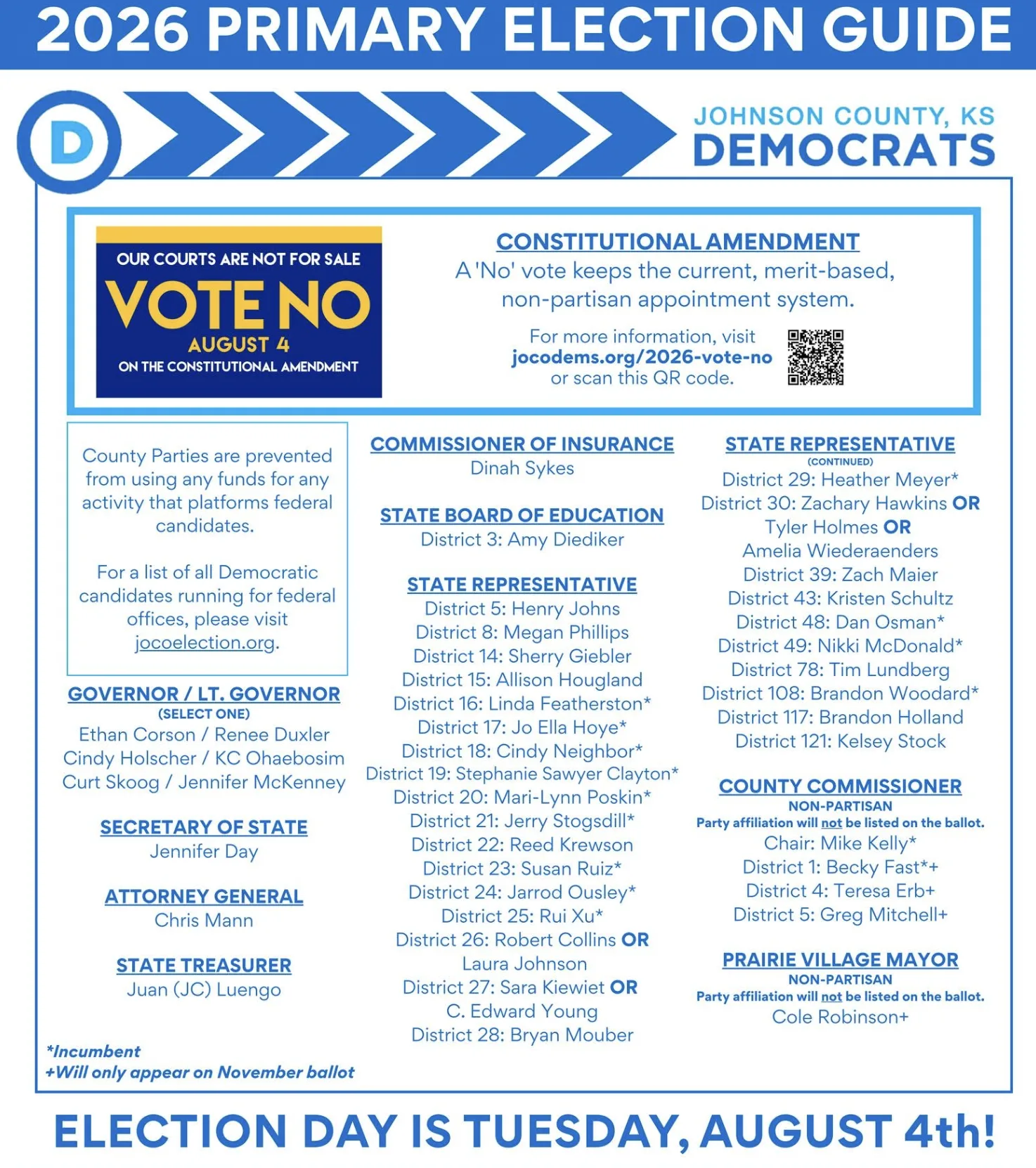
Mitchell said the county Democrats had already printed 70,000 lists that had to be put on hold and eventually reprinted at an additional cost of $15,000.
The party also canceled a June forum, she said, and the online voter guide now leaves off the names of federal candidates and uses this disclaimer:
“The Kansas Public Disclosure Commission (KPDC) has communicated that K.S.A. 25-4153(k) prevents County Parties from using any funds for any activity that platforms federal candidates.”
Instead, the voter guide point readers to the candidate list at the Johnson County Election office website.
Some Democrats elsewhere in the state were also scrambling. Pottawatomie chair Steven DeHart said he’d heard some were canceling events out of fear of breaking the campaign law.
DeHart was in the midst of planning an ice cream social for Democrats on his ranch near Olsburg and took particular care because of the ruling, he said. The candidates sat at tables to chat with the about 250 attendees and did not make a pitch for votes or contributions, he said.
Because the event was on his own land, about the only cost to the party was for the ice cream and portable toilets, he said. But even so, he checked with the party’s legal advisers in Topeka on whether the ice cream and toilets could be considered something the federal candidates would benefit from.
In the end, he charged the federal candidates $50 apiece that would cover their share of expenses.
“I wasn’t going to charge anybody. I would have paid it gladly,” he said, adding with a chuckle, “We didn’t limit the toilet paper or anything.”
Campaigning may look a little different in November’s general election as well, due to the way the state disclosure agency is interpreting the law.
To comply with the law, Wilson said literature in that election will need to be totally non-partisan, with all the candidates for every party listed on flyers and cards regardless of which party is printing them.
“You’re saying I literally would have to have (incumbent Republican U.S. Sen.) Roger Marshall on our voter guide,” Mitchell said. “That is not the norm. That has never happened before.”
Johnson County GOP was unaffected
Meanwhile Republicans appear not to have been as affected by the issue.
The Johnson County GOP webpage includes the names of the two candidates for U.S. Senate, incumbent Roger Marshall and challenger Pond Naramore, and the two candidates for the Third Congressional District, Eric Jenkins and Chase LaPorte.
Wilson said since the GOP list includes all the candidates, it is in compliance with the law.
County GOP chair Sue Huff said she was unaware of the turmoil among Democrats.
“We list anybody registered as a Republican. We don’t discriminate. We don’t pick and choose,” she said.
She also said she was unaware that there was any chance Democratic names of federal candidates might have to be included on future Republican voter guides during the November election.
“We support Republicans because we’re the Republican Party. If there is a ruling like that, I’m not aware of it,” she said.
 Thanks for reading! If you value having an independent news outlet keeping tabs on local government, schools and taxes, we're asking you to contribute to our Education Reporting Fund.