This campaign season, Post editor Kyle Palmer has extended offers for one-on-one Q-&-As to all candidates running for statewide offices, including U.S. Senate, Governor, Attorney General, Secretary of State and Kansas State Board of Education.
We will publish videos of Kyle’s full interviews and an edited transcript of his conversations as each candidate responds.
Look back at Kyle’s past interviews with U.S. Senate candidate Adam Hamilton, gubernatorial candidate Cindy Holscher, Secretary of State candidates Jennifer Day and Scott Morgan and Kansas State Board of Education candidate Jim McMullen.
If you value election coverage like this, consider signing up for a trial offer to get the Post for $1/week for six months.
Five seats on the Kansas State Board of Education are on the ballot this November, and partisan control of the board is up for grabs.
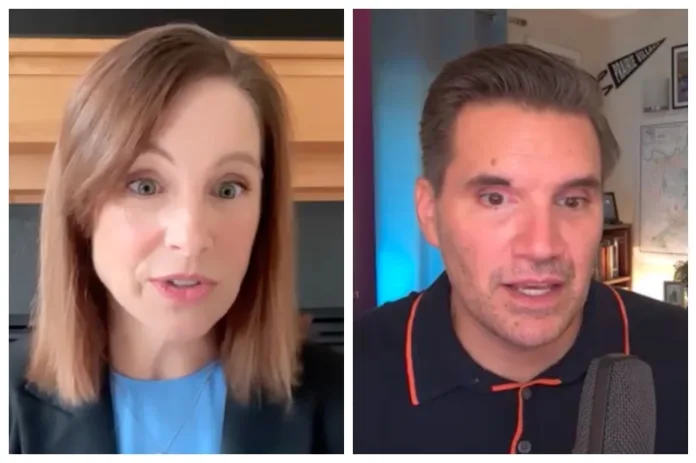
Amy Deedeker, a former music teacher and Olathe mother of three, is running as a Democrat attempting to flip one of those seats.
She’s running for the open District 3 seat covering southern Johnson County and northern Miami County. She’s facing Republican Jim McMullen, a former Blue Valley school board member, who spoke with the Post last month.
Watch the full interview
Read the highlights
The transcript below has been edited for clarity, length and grammar.
Post: You’ve been in the classroom as a teacher. You’ve been a parent, as well, sitting in on meetings and meeting with teachers. What did you see from each side that made you want a seat on the state board of education?
Diediker: I am a former elementary music teacher. I taught both in Junction City and DeSoto. From that perspective, I realized how important it is to have educator voice on the state board, and to have someone who’s really connected to educators, administrators and families in the community. I’m also a mom of three children, and my youngest child, when she was four years old, was diagnosed with a rare disease. So she has a 504 [education support] plan to help accommodate her complex medical needs. So I’m a mom that has navigated public schools with a child who has complex medical needs. I’ve sat in those 504 meetings with administrators and educators, and I know what that’s like. And so I think that part of my experience is unique and would bring a unique perspective to the board.
Post: What’s one thing the state board could do for families like yourself who have to deal with these complex problems — have to have meetings, have 504 plans written up? What is the state board’s role?
Diediker: So the state board actually has much more of an oversight that’s up and above, but I think the state board can use their voice to advocate for things like fully funded special education. I see the state board’s role as both the important role that they have in working on accreditation, teacher licensure, state standards, learning standards and high school graduation requirements. But they also are using their voice to advocate for situations like ours and for fully funding special education.
Post: There are four Johnson County school districts, including Olathe, where you’re at, potentially setting up a lawsuit against the state for years-long shortfalls in special education funding. What does fully funding special education mean to you? How would the state be able to pull that off if those funding levels eventually do get raised to that level?
Diediker: Fully funding education is mandated by the [Kansas] Constitution. Fully funding special education at 92% [of excess costs] is also mandated by the constitution, and it hasn’t happened in 15 years. So it’s really important for people to know that when we don’t fully fund special education, it takes money out of the general population, and it affects everyone. It affects everyone in the schools, the staff, the teachers, the students and our communities. Getting the state to do that is really important, and electing legislators who prioritize that is something that’s really important to our communities and our schools.
Post: What leverage does the state board have? It’s the legislature that does control the purse strings. It’s been 15 years since that level of 92% of excess costs has been funded. They [lawmakers] do keep kind of adding funds incrementally, but nowhere close to that level. What leverage does the state board have? What could you do as a single member on the state board?
Diediker: The state board, as you mentioned, does not have control over the purse strings that lie at the feet of the legislature. But as a state board member, I would be very vocal and loud about the importance of fully funding special education. I would testify in front of the legislature and speak with as many legislators as I possibly can to make sure they understand the importance. And sometimes I think some of the current state board members have not been loud enough, and so it’s about being a strong, loud advocate for fully funding special education.
Post: An area that maybe the state board does have a little bit more direct control is standards, not necessarily the curriculum that’s used in districts. That’s still up to local school boards, but whatever higher-level standards the state sets and expectations. I’ll point out your opponent, Republican Jim McMullen, has made a case for what he calls “knowledge first,” suggesting that Kansas schools have not been rigorous enough in recent years. He said in our interview that oftentimes schools “mistake activity for results.” He notes that reading scores have gone down, and test scores have gone down. Is he wrong? Where would you differ from him on that?
Diediker: I agree with him that we need to increase rigor, especially when it comes to math. I was speaking with a state board member recently who was talking about how in our high school math programs they’ve had to remove a lot of the higher-level math programs, and a lot of that is due to funding. We do need to have those options for students and make sure that we increase that rigor. Right now, we have a 90% graduation rate in the state of Kansas, and we have 72% of our kids reading at grade level or above. That to me is a sign that we are doing something right. But there’s still 28% that we need to catch up, and that requires us to focus on the science of reading. The state of Kansas has made huge strides in the science of reading and the Blueprint for Literacy. By 2028, all of our K-6 teachers will have the Blueprint for Literacy and the seal of literacy, and by 2028 we will also have reading specialists in every K-5 building. Where I think we need to focus at the state board level is what we’re doing for middle school and high school students when it comes to the science of reading. A lot of times, we have kiddos that need just a little extra support when they get to middle school and high school, and we don’t have as many educators there who are trained in the science of reading.
Post: Implicit in your opponent’s argument is this idea that what he calls “educational fads” have taken over and have distracted from the core mission of educating and maintaining these high academic standards. He points out things like DEI, trauma-informed care, whole child. Do you buy that? Do you think that schools are taking on too many things, too many roles and hats that again distract from this core mission of educating children?
Diediker: I feel really strongly that if we want our kids to be successful after high school, we have to teach the whole child, and that includes classics like reading, writing and math. And we are doing that, and we are continuing to improve our instruction in reading and writing and math. But I think it’s so important to have support staff like social workers and psychiatrists in the school buildings because our children can’t learn to read and write and do math if they aren’t mentally healthy. I feel very strongly that every single student that walks into a Kansas school needs to feel safe, supported and seen. Part of that is social-emotional learning and mental health support. Our children cannot learn if they don’t have that support. I was talking to someone from the Overland Park Chamber of Commerce, and he said to me that when he sees our current high school graduates joining the workforce, they are prepared academically. They are prepared in reading, writing and math. Where they lack is soft skills: being able to make eye contact, shake a hand. That is social-emotional learning, and we’ve got to focus on that in our schools if we want our kids to be successful after high school.
Post: This leads into my next question about cell phones, the use of technology in schools. There was the [cell phone ban] law passed last year, but now districts have had to decide how to implement it in their own particular localities. Do you think Johnson County districts are getting it right in terms of how to limit the devices’ usage?
Diedkier: Yes, I do. In fact, a lot of our Johnson County and Miami County schools had really good plans in place already before this legislation. I think when it comes to devices, the state board can create guidelines. But this comes down to local authority and local control. Every district needs to work with their local school boards, administrators and educators to come up with the best plan for their community. I can tell you too that as I am traveling around our district, I have been in over 20 schools, and what I see when I walk in those schools is focused, engaged, hands-on learning. So I think there’s a narrative out there that people are trying to spread that kids are on one-to-one devices all day long, and that is not happening. Our kids are actively engaged in learning in the school, and I think there is a place for technology. It should never take the place of in-person instruction, but it can be used to enhance instruction. I think at the local level, they can determine what is best for their community and what ways to enhance learning but make sure that it doesn’t take the place of in-person learning.
Post: There are vocal minorities of parents, particularly here in Shawnee Mission, which you do cover that small little swatch of Shawnee Mission, who call even for a banning of one-to-one technology beyond the personal cell phones. You sound like you think that goes too far?
Diediker: I think that’s too far. I think you know either extreme, all or nothing, is not good. The key word when it comes to one-to-one device use is balance. I’m telling you, I have been in probably over 50 to 75 classrooms at this point during the campaign, and I have only seen kids using one-to-one devices in two classrooms, and so I think our educators are very thoughtful and careful about the ways they use technology. I think that we need to trust them, and it should be a local control issue with guidance from the state board. But I would not be in favor of an all-out ban.
Post: This is a 10-member board. There are five open seats in this year’s election statewide, including this seat in District Three. I believe all five outgoing members who are not standing for re-election are Republicans. So there is a kind of partisan. There are partisan stakes to this election. I guess if Democrats were to flip control of the board, what actually changes for families in places like Olathe and Spring Hill? Is there a difference?
Diediker: I believe the biggest difference would be that there would be stronger voices to protect public education and to stay focused on fact-based, evidence-based learning standards and curriculum. The other thing that I think is really important to keep in mind is of the current 10 state board members, only two have a background in education, and one of them is leaving. So having that educator voice on the state board is really important, and I bring that experience.