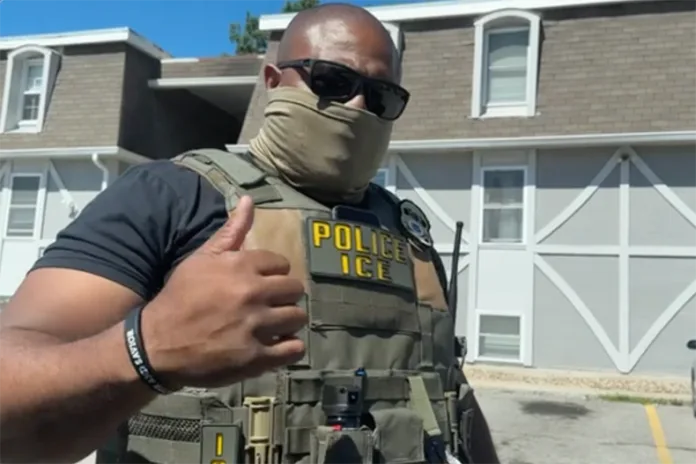
For weeks, reports of ICE activity in Olathe seemed to arrive almost daily, with residents documenting detentions at apartment complexes, businesses, gas stations and intersections and community volunteers tracking federal agents across the city.
But since the July 11 detention of a U.S. citizen in Olathe, few new public reports have surfaced in the city, according to local ICE watch groups.
Here’s what we know:
Has ICE activity increased in Olathe?
While the federal Department of Homeland Security doesn’t release city-by-city data about immigration enforcement operations, community reports, witness accounts and national trends all point to a more visible ICE presence in Olathe this summer.
Without official data from the DHS, it’s difficult to determine the exact number of ICE operations, but one website, crowdsourced by witnesses, gives some idea of what the activity has looked like recently.
ICEout.org is a crowdsourced website where users submit reports of suspected ICE activity all over the country.
Reports include information like location, time, number of ICE vehicles and how many people were detained. Most posts also include photos or videos. All reports are approved by a moderator but only marked “confirmed” if they have been reviewed by a trusted community organization or a news source.
While the reports are user-submitted and don’t necessarily give an accurate count of detentions or operations, they do show a broad pattern of ICE activity.
The website contains 17 reports of suspected ICE activity in Olathe during June and July. For comparison, the website had only one reported ICE sighting in April and none in May. It also shows about 20 reports during February, when the Post first documented an increase in ICE activity, including ICE agents showing up outside a Boys & Girls Club.
Last summer also saw a boost in activity in Olathe. There were 16 reports submitted in June and July 2025, according to ICEout.
The last week of this June appeared to be a particularly busy time for ICE operations. In a statement to the Post, Advocates for Immigrant Rights and Reconciliation, a Kansas City-based immigrant advocacy organization, also reported the increase and noticed other patterns in ICE activity, including detentions happening more frequently in the morning.
“What is new is that some of these arrests seemed to happen on weekends, noticeably more than we’ve seen before,” the statement reads.
Asked about the increase in activity in Olathe, a spokesperson for DHS told the Post via email, “ICE remains committed to removing criminal aliens from our communities by enforcing immigration laws and maintaining the integrity of our borders. ICE agents uphold our nation’s immigration laws in all 50 states, seven days a week, 24 hours a day.”
What incidents have been reported in Olathe?
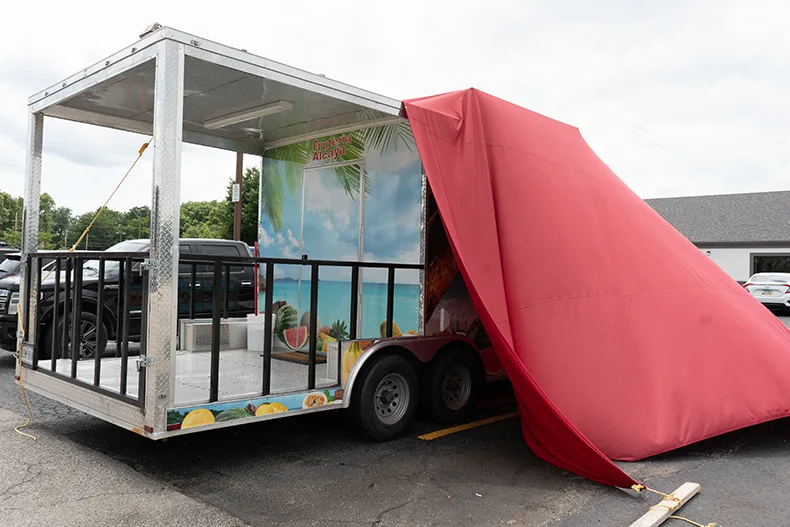
On June 28 at 11 a.m., a user uploaded four photos to ICEout.org with the description: “Took the fruit vendor.”
Word spread across the Olathe community that the person who ran a popular fruit stand off Santa Fe Street had been detained by ICE agents.
For weeks, the fruit stand was left unmanned in its usual spot. A Post reporter driving by this week noted that it’s now gone completely.
Two days later, Sophie Nedelco, an organizer with a community defense network, told the Post that she witnessed another incident near a QuikTrip at Dennis and Parker streets in Olathe.
Nedelco said she heard ICE agents were operating in the area and drove to the gas station.
“I saw five or so ICE vehicles blocking the street,” she said. “It was in the middle of the street and they were detaining a man.”
Nedelco recorded a video of the detention, which she shared with the Post. It also shows another agent walking toward her while holding up his phone, appearing to record or photograph her.
View this post on Instagram
She said she heard later the man was on his way to work when agents stopped him and allegedly broke his car window. Photos of a broken car window were posted to ICEout.
On July 11, 19-year-old Alan Marquez, a U.S. citizen, and his cousin were detained by DHS for hours at the New Century Adult Detention Center after an interaction with ICE agents at an apartment complex.
Marquez took a video showing an ICE agent backing into his car.
After releasing Marquez and his cousin, a DHS official gave him information for filing an insurance claim for the damage done to his vehicle, Marquez told the Post.
Why are ICE agents saying “25 feet”?
Videos taken by a witness at the scene of Marquez’s arrest show something else: an agent telling her “25 feet” — a reference to a newly enacted Kansas state law called the “Halo Act.”
The law makes it a misdemeanor to go within 25 feet of a first responder after being ordered to stay back. Violating the law can lead to a fine of up to $1,000 and up to six months in jail.
Passed by the Kansas Legislature this spring, the Halo Act went into effect on July 1.
Then, on July 11, a man posted a video on Facebook of another incident in which an ICE agent mentions the Halo Act.
The video shows an ICE agent pulling into a parking spot in front of a man who was filming another agent’s car. It doesn’t appear that they were in the middle of an active operation.
The agent, Jack Ravencamp, gets out of his car and walks towards the person filming.
“25 feet. Get back or I’m going to spray you,” Ravencamp says while shaking a bottle of pepper spray.
In an email to the Post, the ACLU of Kansas said the Halo Act erodes a boundary between local law enforcement and federal agents.
“It’s clear that this law has been weaponized to undermine constitutional rights to bear witness to federal agents’ running roughshod through our neighborhoods–but also the real physical safety of every Kansan that crosses paths with them,” the statement reads.
Supporters of the law, including Ty Masterson, president of the Kansas Senate and gubernatorial candidate, disagree.
“This simple public safety bill prevents radical protesters from interfering with law enforcement and will keep our officers and bystanders safe,” Masterson wrote after the legislature overruled Gov. Laura Kelly’s veto in April. “Minneapolis will not be coming to Kansas.”
The DHS spokesperson said, “Partnerships with law enforcement are critical to having the resources we need to arrest criminal illegal aliens across the country. We have had tremendous success when local law enforcement work with us.”
The Olathe Police Department said it was at the scene of Marquez’s arrest for crowd control, not immigration enforcement.
Every summer, the Olathe City Council reviews and updates the city’s public offense code to reflect changes in state law.
The city council was set to consider tweaking the city’s code to be in compliance with the Halo Act on July 21, but it was taken off the agenda.
The city hasn’t announced yet if or when the city council will vote on the code.
Is ICE still in the area?
ICE operations have also been reported across the Kansas City metro this summer — mostly concentrated in Kansas City, Kansas, and the northeastern neighborhoods of Kansas City, Missouri.
Unlike in Olathe, there have been more recent reports of ICE in KC.
On July 26, a man from Honduras was detained in Kansas City, Kansas, after ICE agents pursued him on foot. The man reportedly crashed through a window, slicing his leg to the bone.
Before that, eight workers at La Fontanella Foods in Kansas City, Missouri, were reportedly detained on July 9. A video of another Kansas City, Kansas detention circulated social media on July 11, showing 10 agents and multiple ICE vehicles blocking a major intersection.
Why has there been an increase?
The burst of federal Immigration and Customs Enforcement activity in Olathe this summer came as communities across the country reported similar increases elsewhere.
According to the New York Times, the Trump administration pushed for more immigration arrests nationwide and ICE almost doubled its daily arrest numbers this summer.
The newspaper obtained internal directions from ICE officials showing agents were told to target 2,000 arrests per day across the country — up from 1,000 earlier this year.
“Our message is clear: if you come to our country illegally, we will find you, we will arrest you, and we will deport you,” the DHS said in a statement.
Activists worried about an increase in ICE activity in the area ahead of the World Cup, but national reporting hasn’t necessarily linked the increase in immigration detentions to the tournament.
ICE’s role around World Cup venues across the country was mostly focused on security, human trafficking and counterfeiting, according to Politico.
The DHS told the Post that Kansas City Homeland Security Investigations confiscated almost $550,000 worth of counterfeit goods during the World Cup.
 Thanks for reading! If you value having an independent news outlet keeping tabs on local government, schools and taxes, we're asking you to contribute to our Education Reporting Fund.